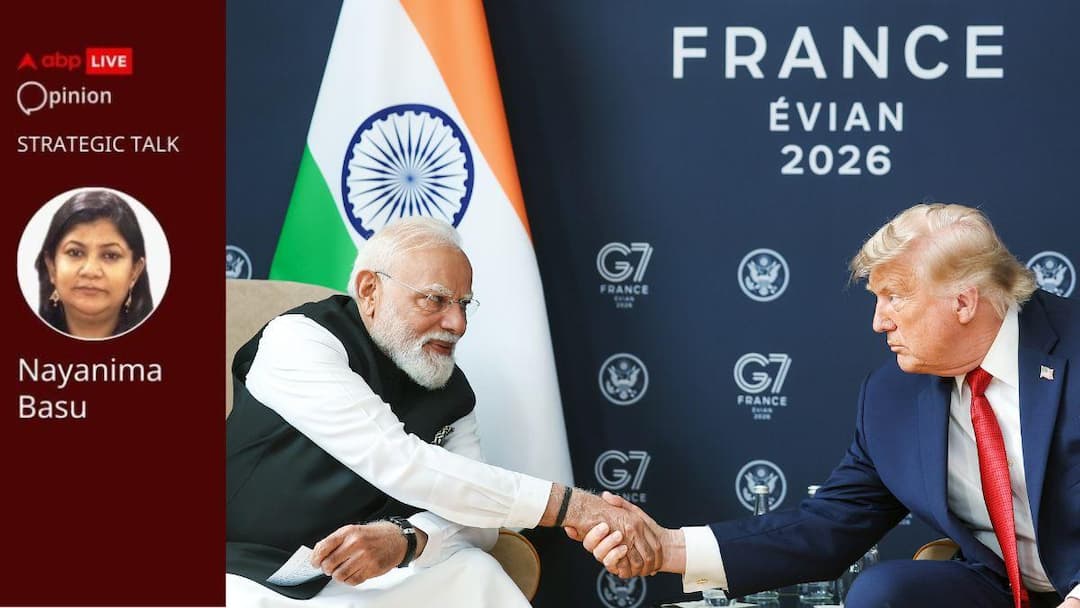
- Foundational agreements, joint exercises deepen military interoperability significantly.
The bilateral relationship between India and the United States, painstakingly built over more than a quarter of a century, is now rapidly plummeting. But all is not lost. The relationship has seen similar lows during the Cold War era from 1945 to 1991.While the pending bilateral trade deal, strategic ties with Russia, people-to-people connections, and renewed bonhomie with Pakistan have emerged as major irritants between Washington and New Delhi, some of the stronger aspects of the relationship, especially defence and security, continue to thrive at an unprecedented pace.
When Prime Minister Narendra Modi undertook his last visit to the United States in February 2025 to congratulate President Donald Trump on winning a second-term and also to pave the way for an ambitious two-way relationship, hopes on both sides reached zenith that got encapsulated in US-India COMPACT (Catalyzing Opportunities for Military Partnership, Accelerated Commerce & Technology).
But the past two years have been especially turbulent for the two countries that call each other “natural allies” even as the list of grievances swelling on both sides.
On trade, talks for a comprehensive agreement remain stuck in a loop of reciprocal tariffs, disputes over dairy and agricultural market access and digital services taxes, among others. On Russia, the optics could not be worse even as the US and Europe try to squeeze Moscow’s war economy, India remains one of the largest buyers of Russian crude, and continues to maintain its legacy defence relationship, including the S-400 system.
On immigration, the return of hardline rhetoric around the H-1B program has sent a chill through the 4.5 million-strong Indian-American community and the tech corridor that connects Bangalore and the Bay Area. Put together, it is easy to frame this as a relationship in decline.
But that framing would be a mistake. It mistakes turbulence for trajectory.
Also Read: All Oil, No Thaw: Rubio’s India Trip Fails To Ease Tensions
From estrangement to engagement, India-US relations have witnessed a shift that can now be described as entrenchment. And the reason this low will not become a lasting break is not sentiment or nostalgia about the world’s oldest and largest democracies.
It is hardware, agreements, and institutional trust painstakingly built over 25 years in the one domain that matters most for strategic trust: the defence partnership.
To appreciate the depth, we must remember the baseline. In 2005, defence trade between the two countries was effectively zero, and the very idea of American soldiers exercising in the Himalayas was unthinkable. The civil nuclear deal changed political psychology, but what followed it was a quiet, bipartisan revolution in defence cooperation.
Today, the United States is among India’s top three defence suppliers. The cumulative value of defence articles sold exceeds $25 billion. The Indian Navy’s ability to dominate the Indian Ocean Region is anchored in American-origin P-8I Poseidon aircraft. Its maritime helicopter fleet is being rebuilt around the MH-60R Seahawk.
The Army’s frontline artillery includes the M777 ultra-light howitzer, and its aviation corps flies Chinooks and Apaches. These are not off-the-shelf purchases, they come with a 30-year tail of maintenance, training, upgrades, and doctrinal exchange.
More consequential than the platforms are the four foundational agreements that the two sides signed after years of hesitation. LEMOA (Logistics Exchange Memorandum of Agreement) allows both militaries to access each other’s bases for refueling and replenishment. COMCASA (Communications Compatibility and Security Agreement) allows India access to encrypted US communication systems.
BECA (Basic Exchange and Cooperation Agreement) gives India access to topographical, nautical and aeronautical data for precise navigation and targeting. ISA (Industrial Security Agreement) enables private sector collaboration on sensitive defence technology.
Next, we need to consider the military exercise calendar. Exercise Yudh Abhyas is now the largest bilateral army exercise either country conducts. Exercise Vajra Prahar is a joint Special Forces war drill that brings together the Indian Army and the US Army. Then there is Exercise Cope India that pits fighter pilots against each other in complex air combat scenarios between the Air Forces of both countries. And Malabar — once a modest India-US naval exercise — now includes Japan and Australia, making it the military face of the Quad.
Add to this the growing intelligence fusion, especially on maritime domain awareness in the Indo-Pacific, and you have a level of military interoperability that India has with no other country, and that the US has with very few outside its formal treaty allies.
And this is where the future is being built. The paradigm has shifted from buyer-seller to co-development and co-production. INDUS-X, launched to connect defence startups in 2023, is already linking innovation ecosystems.
Then there is the landmark GE F-414 deal — a generational bet to co-produce fighter engines in India for the Light Combat Aircraft Mk-II program. If it succeeds, it will mean the engine powering India’s indigenous fighter fleet is made in India, by Indians, but with American core technology. It is, in effect, a strategic lock-in.
Now, set this against the three irritants.
The frustration around trade is legitimate. India wants greater market access for its labour-intensive goods, pharmaceuticals and services; the US wants greater access for its agricultural products, dairy, medical devices, and e-commerce firms, along with stronger intellectual property protection. Both sides have used tariffs as leverage. But trade friction is the friction of interdependence, not disengagement.
When bilateral trade was $20 billion, there were no disputes because there was nothing to dispute. Now that goods and services trade is approaching $200 billion and two-way investment is over $100 billion, disputes are inevitable. The US is India’s largest trading partner. The economic constituencies on both sides – from Tata and Infosys in the US to Boeing and Google in India are too large to be held hostage to any single tariff line.
Next irritant is Russia. This is the most emotive issue in Washington. Why does India, a Quad partner, continue to buy Russian oil and maintain Russian weapons systems? The answer from Delhi is not ideological but operational and historical. At the height of the Cold War, when the US was arming Pakistan, the Soviet Union armed India.
Even today, over 60% of India’s legacy inventory is of Russian origin. You cannot ground your air force, mothball your tanks and dry-dock your submarines overnight. India has been transparent that it will diversify, but diversification takes a decade, not a press release.
What Washington has wisely done, despite the public noise, is to incentivize that diversification rather than punish the legacy. By offering viable alternatives, from transport aircraft to jet engines to artillery, the US is ensuring that India’s next generation of weapons is American or American-Indian, not Russian.
The purchase of Russian oil is governed by similar pragmatism: it is about inflation management for 1.4 billion people. Understanding that pragmatism is part of strategic maturity. Incidentally, the US has now itself signed a deal under which it will procure 36 million barrels of diesel from Russia.
Then comes the H-1B question. No issue hits the people-to-people nerve harder. The US technology ecosystem faces a chronic shortage of STEM talent. India produces 1.5 million engineers a year and is the largest source of high-skilled talent for US firms. The biggest sponsors of H-1B visas are Amazon, Google, Microsoft and Meta.
Their lobbying power, combined with the political clout of the Indian diaspora, guarantees that while policies may fluctuate with electoral cycles, the core pathway will not close.
Finally, the US’ renewed equation with Pakistan has got India riled. Under President Trump’s second administration, Washington and Islamabad have seen a sharp upswing. It started with Trump’s claim of brokering a ceasefire after the four-day India-Pakistan armed conflict in May 2025 under ‘Operation Sindoor’ — a claim India has consistently denied — and continued with a rare White House lunch for Pakistan Army Chief Field Marshal Asim Munir in June 2026.
Since then, there has been a flurry of engagement: counter-terrorism dialogues, talk of a US drone MoU with the Pakistan Army, critical minerals and crypto initiatives, and Pakistan’s role as a backchannel mediator between the US and Iran, hosting talks that led to the 60-day Islamabad accord.
This is why history is instructive as this is not the first low. We have seen deeper ones.
In 1998, the US imposed sweeping sanctions after India’s nuclear tests. Defence cooperation was frozen. In 1971, the US sent the USS Enterprise into the Bay of Bengal. In 2013, the arrest of diplomat Devyani Khobragade brought relations to a public nadir. After each crisis, the relationship did not just recover, it deepened. Because the underlying strategic logic that a strong India is in America’s interest, and a partnered America is in India’s interest has remained constant.
We are now in another such trough. It will require political management. But let us not confuse management challenges with existential threats. While US Secretary of State Marco Rubio’s second visit to India in one year, was all about Venezuelan oil that gets processed in Reliance Industries’ Jamnagar refinery, the real issues were left out.
The Indo-Pacific is becoming more contested, not less. Supply chains are being rewired. Critical technologies from semiconductors to AI to undersea cables are becoming the new terrain of competition. In all of these, India and the US need each other. No other partnership offers Washington a democratic, demographic and geographic counterbalance of India’s scale.
And no other partnership offers New Delhi access to technology, capital and global networks at America’s scale.
Ties are down. They are not out. While the larger discourse is dominated by trade, oil and visas. The future is being built in hangars, shipyards and labs.
Also Read: OPINION | Granting Statehood To Ladakh Is The Best Rebuff To China
[Disclaimer: The opinions, beliefs, and views expressed by the various authors and forum participants on this website are personal and do not reflect the opinions, beliefs, and views of ABP News Network Pvt Ltd.]
Disclaimer : This story is auto aggregated by a computer programme and has not been created or edited by DOWNTHENEWS. Publisher: abplive.com