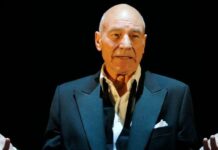
Patrick Stewart, the acclaimed British stage and screen actor renowned for both Shakespeare and sci-fi, has died. He was 86.
The Star Trek: the Next Generation and X-Men star died on Wednesday at his home in Los Angeles after “a brief and poignant journey with Alzheimer’s disease and Lewy body dementia”, said Kelly Bush Novak, his longtime spokesperson, to the Hollywood Reporter.
“He has been held in the warm embrace of family and friends, surrounded by live music, prayer, tears, laughter and the kind of profound emotion that only he could inspire after a lifetime of devotion to us all,” she wrote. “We will forever cherish the peaceful ease and reflection on his face, an enduring reminder of his invincible grace.”
With his authoritative baritone voice and commanding visage, Stewart was already a staple of the British stage by the late 1980s when, at 47, he was cast as a graying Capt Jean-Luc Picard in Star Trek: the Next Generation, the first live-action spin-off of the groundbreaking 1960s TV series. Over seven seasons aboard the Starship Enterprise, Stewart’s even-keeled performance and steely directives – “engage!” and “make it so” – turned him into a global star.
Stewart reprised his role in four feature film spin-offs – Star Trek Generations (1994), Star Trek: First Contact (1996), Star Trek: Insurrection (1998) and Star Trek: Nemesis (2002) – as well as the TV series Star Trek: Picard, which ran from 2020 until 2023.
His other most well-known role was playing Prof Charles Xavier in the X-Men series. The actor had found work hard to obtain after feeling typecast as a result of his Star Trek role but had been intrigued by working with director Bryan Singer for 2000’s X-Men.
He went on to play the role in seven films and will be seen reprising the role in this December’s Avengers: Doomsday.
His other film roles included gay comedy Jeffrey, romantic thriller Conspiracy Theory, violent horror Green Room and voice roles in Ted, Gnomeo & Juliet and, most recently, The Sheep Detectives.
Born on 13 July 1940 in the small industrial village of Mirfield, England, Stewart was the youngest of three sons born to Alfred Stewart, a British military veteran turned semiskilled laborer, and Gladys Stewart, a weaver at a textile factory. His childhood, in a small house with no running hot water, was marred by alcoholism and domestic violence, a situation he later described, in an article for the Guardian from 2009, as “barely tolerable”.
He found respite in acting, first in school – he was 12 when an English teacher assigned him the part of Shylock in Shakespeare’s the Merchant of Venice – and then local drama groups. “I managed to find my own refuge in acting,” he wrote. “The stage was a far safer place for me than anything I had to live through at home – it offered escape. I could be someone else, in another place, in another time.”
After graduating from secondary school at 15, he worked as a local reporter and furniture salesman before a local arts council provided the funding to attend the prestigious Bristol Old Vic Theater School, where he enrolled in 1957, at 17. Having shed his Yorkshire accent, he took his first professional theater role two years later, and in 1966 joined the Royal Shakespeare Company.
Throughout his career, he won a Grammy award and two Laurence Olivier awards for his stage work. He was also nominated for a Tony and four Emmys.
In 2023, he also released his memoir called Making It So.
“I think I’ve been in denial about my life for a very long time,” he said to the Guardian in a 2023 interview. “I never really took on board how successful I had become. Even today I sometimes think, ‘You’re a lucky son of a bitch, Patrick,’ when something unexpected or good happens to me.”
Disclaimer : This story is auto aggregated by a computer programme and has not been created or edited by DOWNTHENEWS. Publisher: theguardian.com