Staff writers
Updated ,first published
The Australian sharemarket has opened higher after a volatile night on overseas markets, as Google parent Alphabet’s historic plunge weighed down Wall Street, and Amazon also disappointed after the closing bell.
The S&P/ASX 200 was up 52.5 points, or 0.6 per cent, in early trade. The ASX added 0.5 per cent on Thursday.
Mining giant Rio Tinto slumped 2.6 per cent after an incident at its Oyu Tolgoi copper mine in Mongolia. A rockfall triggered by a seismic event on Thursday caused three workers to be injured, the company said in a statement on Friday. The company did not comment on the status of operations at the mine, but Bloomberg reported they had been suspended.
The mining sector was mixed in early trade. BHP edged up 0.1 per cent, while Fortescue slid 0.7 per cent. Gold stocks slipped as the price of the precious metal retreated. Northern Star was down 0.2 per cent and Evolution Mining retreated 0.6 per cent in early trade.
Financial stocks advanced as Commonwealth Bank and National Australia Bank each added 0.8 per cent while Westpac and ANZ Bank both climbed 0.8 per cent.
Shares in supermarket giant Coles plunged 11.7 per cent after the company’s first quarter sales result revealed that growth had slowed in October, and it highlighted customers were shopping around for value. It also said high fuel costs would add to its expenses, and it expected first-half supermarket profits to be flat compared with the prior period.
Energy stocks advanced after oil prices rose on signs the US might resume military strikes against Iran, risking fresh turbulence in the region that might affect energy flows.
West Texas Intermediate rose towards $US103 a barrel, after swinging more than $US3 in the previous session, while Brent settled near $US115. A top commander briefed US President Donald Trump on military options on Thursday, The Wall Street Journal reported. Trump has repeatedly given signals he might restart airstrikes against Tehran after midterm elections next week. Woodside Energy rose 2.2 per cent and Santos added 1.5 per cent while, among the refiners, Ampol advanced 0.9 per cent and Viva Energy was up 0.5 per cent.
Technology stocks were higher as WiseTech rose 1.3 per cent, Xero 1.7 per cent, Technology One 0.6 per cent and Codan 0.5 per cent. Data centre operator NEXTDC slipped 1.6 per cent.
The Australian dollar was 0.3 per cent lower at US70.34¢.
Overnight, the historic drop for Alphabet’s stock dragged the US market lower after the company behind Google and YouTube reported weaker growth for the summer than analysts expected. The report underscored worries about whether all its huge investments in artificial-intelligence technology would pay off.
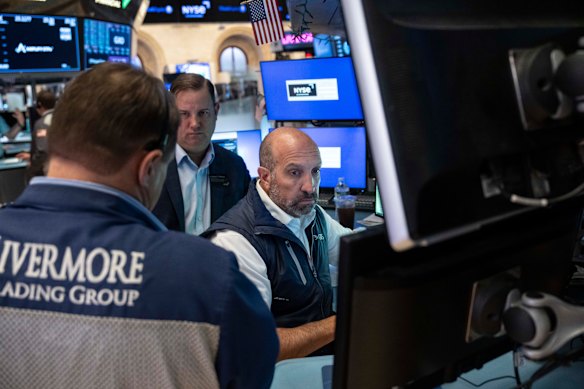
The S&P 500 fell 0.3 per cent for its first loss in four days, even though the wide majority of stocks rose within the index and across Wall Street. The Nasdaq composite tumbled 1.4 per cent, while the Dow Jones Industrial Average dropped 132 points, or 0.3 per cent.
Alphabet is one of the most influential stocks on Wall Street because it’s one of the largest, and the Class A shares of its stock fell 12.6 per cent for their worst day since they began trading more than 20 years ago. The tech giant had been under pressure to at least meet analysts’ expectations for growth amid concerns about how much it’s spending to invest in AI.
Alphabet said that it burnt through more cash during the latest quarter, according to a measure called free cash flow, after its purchases of property and equipment topped $US51 billion ($73 billion).
Worries are weighing on the entire AI industry following a frenzy to build data centres and fill them with AI chips. Not only are concerns high that the AI revolution might not produce as much profit and productivity as hoped, future spending on data centres is also under pressure because of how expensive it has become to borrow money to buy more chips.
Amazon offered a cautious sales outlook for the current fourth quarter that encompasses the critical holiday shopping period after delivering fiscal third-quarter results after the closing bell that came in below Wall Street analysts’ expectations.
However, the company posted strong sales growth in its prominent cloud computing unit. Sales in its so-called Amazon Web Services rose 39.3 per cent during the latest quarter ended September 30, higher than the 37 per cent clip in the previous quarter. It marked the fastest growth rate in nearly five years, the company said.
Still, shares were down more than 7 per cent in after-market trading when the results were released as investors focused on the core business.
Alphabet’s drop overshadowed what would have otherwise been a good day for the US sharemarket. Four out of every five stocks within the S&P 500 climbed, and the index would have been higher if not for Alphabet.
Many companies rallied after reporting stronger profits for the summer than analysts expected, including KLA Corp. The company, whose equipment helps make semiconductors, rose 5.5 per cent.
Eli Lilly climbed 6.6 per cent, Mastercard rose 4.2 per cent and Merck added 3.8 per cent.
Expectations are high for profit growth broadly across US companies. That’s what allowed the S&P 500 to set its record earlier this month despite high interest rates and other worries weighing on the sharemarket.
In the bond market, Treasury yields eased following several mixed reports on the US economy.
The overall economy’s growth may have accelerated more during the summer than economists expected, thanks to spending by US consumers and businesses investing in AI, according to a preliminary report. But Americans’ growth in incomes was weaker in September than economists expected, while a measure of inflation worsened.
Meanwhile, fewer US workers applied for unemployment benefits last week, which could indicate few layoffs across the country.
Following the jumble of reports, the yield on the 10-year Treasury fell to 4.94 per cent from 5.05 per cent late on Wednesday. It’s been generally pulling back since it topped 5.3 per cent earlier this month and touched its highest level since 2002.
In sharemarkets abroad, indexes rose in Europe after the European Central Bank held interest rates steady on the continent.
The bank’s president, Christine Lagarde, also said she will resign in February, nine months before the end of her term.
With AP, Bloomberg
The Market Recap newsletter is a wrap of the day’s trading. Get it each weekday afternoon.
From our partners
Disclaimer : This story is auto aggregated by a computer programme and has not been created or edited by DOWNTHENEWS. Publisher: www.smh.com.au