
This story is part of “India Invented This?” — The Better India’s weekly trivia series that uncovers the Indian minds, ideas and innovations behind inventions that have shaped the way we live. From ingenious solutions created by scientists and engineers to technologies developed in response to some of India’s biggest challenges, each story goes beyond the invention to explore the problem it solved, the impact it created and why it still matters today.
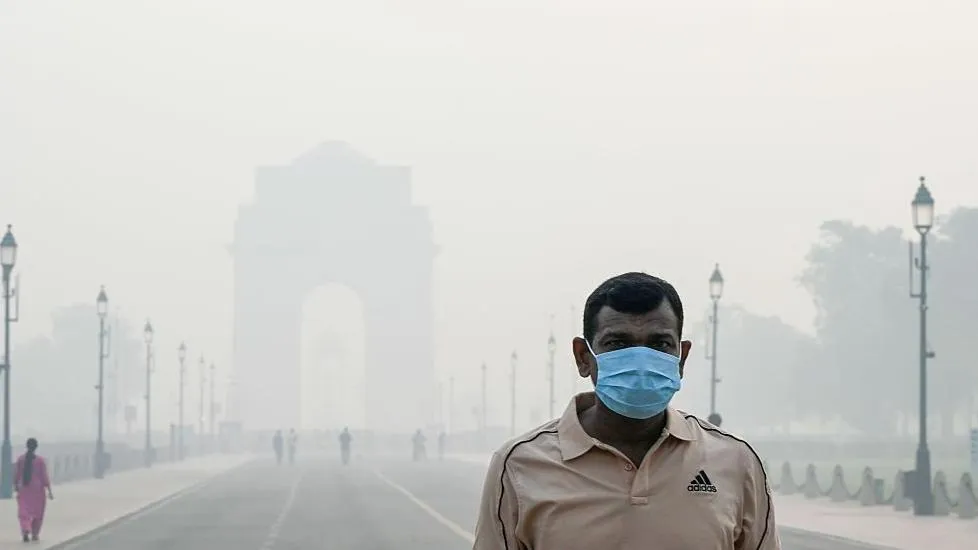
On a winter morning in Delhi, the skyline can almost disappear behind a grey haze. The air feels heavy, eyes begin to sting, and even a short walk outdoors can become uncomfortable. For millions of residents, this is a familiar part of life during the city’s pollution season.
But what if scientists could predict when the air is likely to get worse — before the haze settles in?
That is the question Dr Sachin Ghude, a scientist at the Indian Institute of Tropical Meteorology (IITM), Pune, has been working to answer.
Ghude has played a leading role in developing India’s Air Quality Early Warning System (AQEWS), which can forecast extreme pollution events in Delhi up to 72 hours in advance. Developed through a collaborative effort involving IITM, the India Meteorological Department and the National Centre for Medium Range Weather Forecasting, the system gives authorities valuable time to prepare for deteriorating air quality.
Predicting pollution before it arrives
Air pollution is not caused by a single source. Vehicle exhaust, industrial emissions, construction dust and crop-residue burning can all contribute to the problem. Weather conditions also play a crucial role: when winds are weak and the atmosphere prevents pollutants from dispersing, pollution can build up near the ground.
Understanding how these factors interact is central to Ghude’s work in atmospheric chemistry and air-quality modelling.
Think of AQEWS as a weather forecast for the air we breathe. While a conventional weather forecast predicts rain or temperature changes, this system also calculates how pollutants are likely to move, react and accumulate in the atmosphere.

To do this, it combines observations from ground-based monitoring stations with satellite information, weather forecasts and estimates of emissions from different sources. Advanced computer models then simulate how atmospheric conditions and pollutants may change over the next three days.
The result is a forecast of air quality, including pollutants such as fine particulate matter (PM2.5), which can penetrate deep into the lungs.
Why a 72-hour warning matters
The system’s biggest contribution is the time it gives authorities to respond.
When pollution levels rise sharply, officials may need to consider measures such as restricting construction activities or curbing certain industrial operations under the Graded Response Action Plan (GRAP). A forecast issued in advance can help them prepare for these interventions instead of reacting only after air quality has deteriorated.
The system was launched in October 2018 to predict extreme pollution episodes and provide early alerts.

Photograph: (The Indian Express)
The science has also moved towards more detailed forecasts. IITM has implemented an operational air-quality forecasting model for Delhi at a resolution of 400 metres, using satellite and surface observations alongside advanced modelling techniques. This allows forecasts to capture local variations in pollution more closely than a single city-wide average.
Such forecasts do not eliminate pollution on their own. Their effectiveness depends on how authorities use the information and how successfully they tackle the sources of emissions.
Where is all this pollution coming from?
Forecasting when pollution will worsen is only part of the challenge. Scientists must also understand where it comes from.
Different pollution sources leave different chemical signatures. By studying these alongside atmospheric conditions, researchers can better estimate which sources contribute to poor air quality and help policymakers identify more targeted interventions.
This is an important part of the broader scientific effort to make air-quality management more precise, moving beyond simply measuring pollution towards understanding what drives it.

For Ghude, whose research connects atmospheric chemistry with air quality, human health, vegetation and climate, this work brings complex science closer to everyday public needs.
A forecast cannot promise that tomorrow’s sky will be clear. But knowing that pollution may worsen three days from now gives authorities an opportunity to prepare — and gives the rest of us a clearer picture of the air we are about to breathe.
Sources:
‘Dr. Sachin D Ghude’ by ileaps
‘Impact of Biomass Burning on Fine Aerosol Chemistry and Aging Processes in the Indo‐Gangetic Plain’ by Sachin D Ghude for Journal of Geophysical Research: Atmospheres.
‘Delhi: Scientists look to trace exact source of pollution to help improve air quality’ by Kushagra Dixit for The Times of India, Published on 29 January 2022.
‘IITM releases documentary on air quality warning system for Delhi’ by Indian Express, Published on 19 February 2021.
Disclaimer : This story is auto aggregated by a computer programme and has not been created or edited by DOWNTHENEWS. Publisher: thebetterindia.com









