
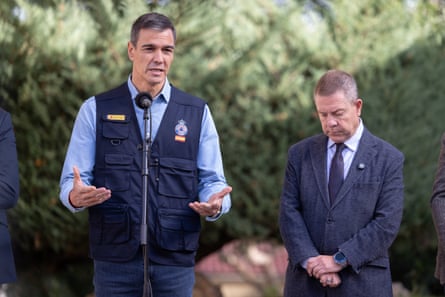
Spain’s prime minister, Pedro Sánchez, has admitted “trust in high-speed rail has been broken” after Wednesday’s deadly train collision that killed at least 69 people, injured more than 100 and prompted a national debate on the safety of the country’s rail network.
Sánchez said the Spanish state was “working tirelessly” to provide information as quickly as possible to the families of the victims – who include people from at least 23 different foreign countries – adding that his government was committed to finding what had caused Spain’s second deadly train collision this year.
Two trains, one from Spain’s state-owned Renfe and the other from the private rail company Iryo, were travelling from Madrid towards the southern region of Andalucía on Wednesday when they collided just before 9am. After the Iryo train came to a halt, the other slammed into its rear, knocking several carriages off the track near Urda in the central region of Castilla-La Mancha.
The crash came nine months after 46 people were killed and dozens injured when two trains – one from Renfe and one from Iryo – collided on the same line near the town of Adamuz in Andalucía.
“It’s unacceptable for a country like Spain – which has such a powerful high-speed rail system – to experience two accidents of this nature and magnitude within a single year,” the prime minister said on Friday.
“Therefore, our task isn’t merely to investigate the causes of what occurred, but also to provide solutions to further strengthen our nation’s high-speed rail system. Public trust in the high-speed system has been broken; the government’s responsibility goes beyond diagnosing the causes – it must also offer solutions to ensure that a tragedy of this scale doesn’t happen again.”
Shortly after Sánchez spoke, Spain’s transport minister, Óscar Puente – who is under growing pressure to resign – gave a press conference in which he dismissed calls to step down, promising instead to focus on “providing the Spanish people with solutions” to restore trust.
“My duty now isn’t to talk about whether or not I carry on with my job; it’s to solve the problems, clarify what happened and offer clear explanations,” he said. “The most important thing I can do is offer solutions as best I can. If the investigation shows there were failures of organisation or control, we will act accordingly. And if individuals are found to be responsible, action will be taken.”
Puente once again suggested that responsibility for Wednesday’s crash appeared to lie within the Madrid control centre of Spain’s state infrastructure operator, Adif. He said that in the run-up to the crash, the LZB signalling system – which automatically halts a train if the line ahead is occupied – had gone down, but stressed that such incidents were not at all uncommon. Once the system was down, he said, control and decision-making powers ultimately reverted to humans, as was the case in other transport sectors.
The minister added that the crash had occurred after an Adif operator ordered the Renfe train to move off at “normal” speed, rather than following the protocols, which stipulate a top speed of 40kph (25mph) so that drivers can see any dangers ahead in good time. According to a preliminary investigation report released on Thursday, the Renfe train was travelling at between 160kph and 200kph when it hit the Iryo train.
The report concluded: “The sequence of malfunctions, instructions, and actions eventually led to the collision, in the absence of the necessary mitigating barriers.”
Puente said the operator in question was a 48-year-old man, with all the relevant up-to-date training and two years of experience in control centres, who had been managing this specific area since February this year. “So, it was a sector he knew well,” the minister added.
Transport unions have pushed back at the government, arguing that current workloads are too demanding to handle safely and asking for more personnel to help with the pressures.
“We believe [the minister] is blaming a mere worker who was working under increasingly poor conditions,” Raquel Ayllón, a spokesperson for SCF, Spain’s railway traffic controllers union, told the Associated Press. “Human error isn’t incomprehensible. What is incomprehensible is that the safety system is regularly failing.”
Spain’s conservative People’s party (PP), which is forecast to topple Sánchez’ socialist-led minority coalition government in next month’s snap general election, has repeatedly called for Puente to step down.
The PP’s leader, Alberto Núñez Feijóo, said his party was holding Puente and Sánchez “politically responsible” for both rail crashes.
“Whoever has failed in their duty to run the transport ministry properly must bear the consequences,” he said. “And the person who appointed them – and kept them in their post – even more so. If they do not resign, we will remove them at the ballot box.”
Ada Colau, the former Barcelona mayor who now leads the leftwing Frente Amplio coalition that is running in the election, also said Puente needed to go.
“We’re not going to engage in the triviality of debating whether that resignation should take place today, tomorrow, or the day after,” she said. “It must happen as soon as possible.”
Asked about the possible effect of the latest crash on the election, Puente said he’d given the matter “zero thought”.
“I don’t believe anyone would expect me to be thinking about the election campaign at a moment like this,” he told reporters.
Disclaimer : This story is auto aggregated by a computer programme and has not been created or edited by DOWNTHENEWS. Publisher: theguardian.com




