Sports broadcaster and columnist Kelli Underwood and senior arts writer Karl Quinn presented the keynote speeches at The Age’s Melbourne Assembly forum, moderated by Waleed Aly, on the topic, “Sport v the Arts: What is the true heart of Melbourne?” Below is an edited excerpt of Underwood’s speech. Read Karl Quinn’s speech here.
I can win this debate with just three words: Sport is art. And Melbourne does it better than anywhere else in the world. Let me explain.
I’m not a suave, cultured arts writer (like my good friend, Karl); I’m a sports broadcaster. But even I know there are seven major art forms: music, painting, architecture, literature, theatre, film and sculpture.
Let’s start with music. Is there a better and more uniquely Melbourne sound than the roar from the MCG? When the players run out on the field and burst through the banner, in front of 100,000 fans, you can feel the ground shake and rumble. The Melbourne Symphony Orchestra’s percussion section is good – but not that good! Your heart beats a little faster.
And what about when a player is sprinting down the wing and a Rioli sets chase, lunging horizontally through the air like Superman, and lands a desperate tug on the opponent’s guernsey and pulls the player to ground? There’s a pause while our hearts are in our mouths. And then, that collective shout: BALL! It fills my heart.
What about painting? The best art award in Australia would have to be the Archibald, generally seen as the most prestigious portrait prize in the country. Of course, sport has won it.
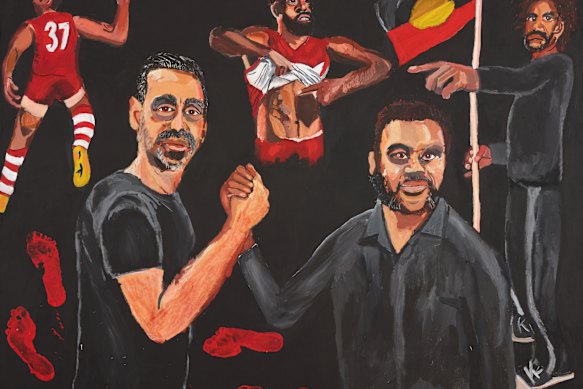
Remember Adam Goodes’ stunning portrait by artist Vincent Namatjira. It shows Vincent hand in hand with Goodes, before iconic images of Adam’s war dance and his re-enactment of Nicky Winmar lifting his jumper. What makes this even more special is that this portrait was the first by an Aboriginal artist to win the Archibald, in 2020, the prize’s 99th year.
To architecture. Good design makes you feel at home and provides a sense of belonging. Name me a building that does it better than the MCG. Good architecture is about innovation and problem-solving – like Rod Laver Arena with its groundbreaking retractable roof. And name me a better urban landscape than the Melbourne Formula One Grand Prix track at Albert Park, the best track in the world for the fastest cars to race.
How about literature? When it comes to storytelling and expressing ideas through the written language, it doesn’t get any better than Age columnist Caroline Wilson. I think we all agree, we look forward to buying The Saturday Age during the footy season just so we can sit down with an exquisite Melbourne coffee and read the latest Caro article. Spending my Saturdays with her insights in my head is what I’d describe as my own little piece of paradise amid work prep, weekend chores, kids’ demands and social engagements. Caro’s prose is food for my soul.
And there’s film. In my opinion, a Fox Footy game day broadcast is better than any Christopher Nolan or Martin Scorsese blockbuster, or a Meryl Streep or Robert De Niro drama. The camera work, the tight framing, the flicking between shots, the slow-motion replays, the wide-angle camera capturing the behind-the-ball biffo. Our Fox Footy crew doesn’t miss a beat. Every three-hour match broadcast is Oscar-worthy.
To theatre. Defined [by Encyclopedia Britannica] as “an art concerned almost exclusively with live performances in which the action is precisely planned to create a coherent and significant sense of drama”. That is precisely what happens at the ’G every weekend of the footy season. Or what about a one-goal thriller between Australia’s netball team, the Diamonds, and New Zealand’s Silver Ferns at John Cain Arena? Or Sam Kerr scoring a late winner for the Matildas at AAMI Park?
Live sport is the best theatre because we don’t know the ending. We attend the sporting theatre full of excitement and anticipation; we don’t know if we’ll feel joy, relief, anger, heartbreak; maybe if we’re lucky, all of the above in one evening. Sport is the ultimate theatre.
Theatre can also encompass comedy and tragedy. Fremantle playing “Wharfie Time” in the grand final when they were 17 points up, with four minutes to play, and thinking they had it in the bag. That was a comedy. Too soon? Maybe, it’s more of a tragedy.
And finally, sculpture. I was a bit stuck on this one, so I sent my good mate, Waleed Aly, a text. I typed, “Sculpture is a form of art. What’s the sporting equivalent?”
He shot back. “Dusty!” (aka former Richmond superstar Dustin Martin).
Then this text followed: “Those rippling muscles, powerful quads, and that chiselled jawline, not to mention those artistic tattoos. Dusty’s sculpture needs to become a bronzed statue out the front of the MCG.”
I believe my job is a form of art. The first time I walked into a commentary box, I likened it to an orchestra. It had this energy and excitement that I was instantly drawn to. When I was first invited into the 3AW AFL commentary box by Rex Hunt 20 years ago, I was struck by how each person had a role. Each knew their part. It was poetry in motion; an ensemble of colourful characters. There was the late Clinton Grybas as host and commentator with Rex as his co-commentator. Robert Walls and Tony Shaw did special comments and Dipper [Robert DiPierdomenico] was the boundary rider. I was the match day reporter.
Clinton – the conductor – was the host of the radio program. As the main commentator, Rex was hilarious and unpredictable.
As the match day reporter, I went into the rooms before the game and did interviews with coaches. After the game, Dipper did the winner’s rooms and I always got the loser’s rooms.
During the game, I would sit in the box and watch and learn, picking up the rhythms of sounds. There was this gradual steady increase in loudness and intensity and then the crescendo, a jaw-dropping mark, a breathtaking goal. I fell in love with those sounds.
Today – whether it’s as a TV or radio host or commentator – when I’m with my cast and crew, I feel like I’m part of an orchestra. Like an actor with thousands of lines in her head, my words are the names of 800 men’s players and 500 women footballers; their identifying tattoos, boot colours and hairstyles.
Returning to the theme of this debate, whether sport or the arts is the true heart of Melbourne, let’s break this down: sport, the arts and heart. Hearts are the beating force of our humanity. Hearts are the things that keep us alive. They are an emblem of love and vitality. They can hurt. They can skip a beat with joy.
There is nothing that makes my heart sing more than a record 86,000 fans filling the ’G in 2020 for the women’s cricket Twenty 20 World Cup final – and then watching Alyssa Healy and her teammates dance on stage with Katy Perry.
Nothing makes my heart ache more than Damien Oliver winning the Melbourne Cup days after his brother, Jason, died from injuries in a trackwork fall, and seeing Damien point to the sky in a nod to his brother as he passed the winning post.
Nothing makes my heart skip a beat more than Kysaiah “Kozzy” Pickett soaring through the night sky, using his opponent’s shoulders as leverage, to snare the Sherrin in his hands high above his body.
And nothing that make my heart swell with emotion more than watching Roger Federer execute an effortless backhand down the line at the Australian Open, the sound of his fast footwork squeaking on the rebound ace, watching him dance – ballet-like – around a tennis court with such balance and grace.
Ultimately, as humans and as communities, we’re tribal. We come together. We crave – and need – connection. And there’s nothing more important for many of us than the local club, whether it be the local footy club, soccer, netball or bowls club. This is the community infrastructure that binds Melburnians together, more than any other social activity.
In a world that is increasing fractured, divisive and confusing, what better way to restore and protect our humanity and our wellbeing than sport.
I’m going to leave you with the greatest day of my working life. It happened at the MCG just weeks ago.
It was the 2026 AFL grand final. It was split into two parts: first art, then sport.
First, the art: Kylie Minogue and her pre-game performance encompassed music, dance, choreography, staging, costumes and visual imagery.
It also represents my childhood; me singing into my hairbrush as a kid to Locomotion, attending her concerts with my sister in our 20s. It’s a dance floor in my 30s, and grand final day in my 40s.
Kylie definitely rocked the MCG. But what about the contest, the great battle?
I was on the boundary, sitting just behind the team benches as part of my role as the ABC Radio boundary rider. I decided to record on my phone the final moments of the game. I locked the camera on Brisbane Lions coach Chris Fagan in the dugout. He was about two metres away from me.
As the siren sounded, he stared straight at me and let out the biggest sigh. He’s not carrying on like a pork shop celebrating; he’s humble, respectful and classy, and displays humility, grace, authenticity, leadership and ultimate sportsmanship. Artistry, if you will.
At this point, we didn’t know it was his last game, but he knew it was the end of his fairytale story: from a coach who never played at the highest level, who took a team from last to top of the ladder and then led them to a historic three-peat.
The best art evokes an emotional response, and the biggest emotional response I’ve had in sport was in that game. From the final gut-wrenching four minutes, to the moments after the final siren, it was the very best of art.
You could make a movie out of this man’s story. Ah, but that, too, would be art.
Kelli Underwood is a commentator for ABC Radio, Fox Footy and a columnist with The Age. She was the first woman to call the AFL on TV and radio.
News, results and expert analysis from the weekend of sport sent every Friday. Sign up for our Sport newsletter.
From our partners
Disclaimer : This story is auto aggregated by a computer programme and has not been created or edited by DOWNTHENEWS. Publisher: www.smh.com.au