
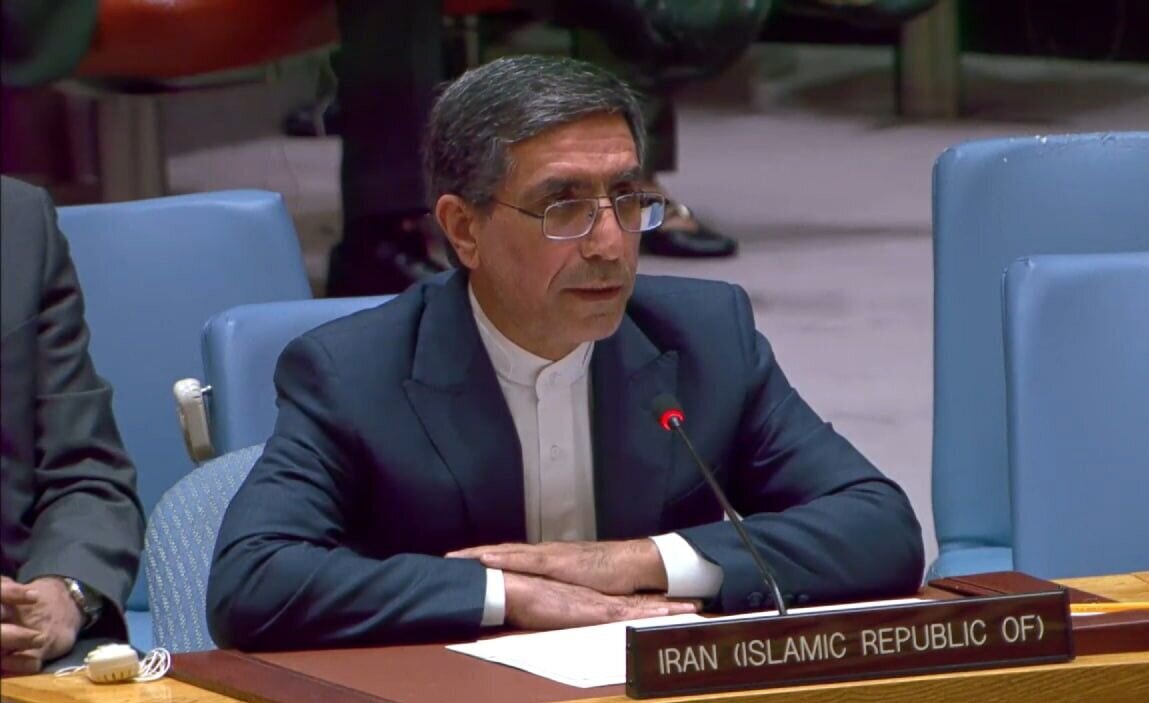
TEHRAN – Iran’s Ambassador and Chargé d’Affaires to the United Nations in New York, Gholamhossein Darzi, has said the United States and the Israeli regime bear direct responsibility for any disruption or obstruction of maritime navigation in the Persian Gulf and the Strait of Hormuz, warning that their continued acts of aggression and maritime restrictions threaten the security of the entire region.
Addressing a meeting of the UN Security Council on October 29, Darzi rejected attempts to hold Iran responsible for disruptions to maritime traffic, arguing that the current situation was the direct consequence of military aggression against Iran and measures targeting its civilian and maritime infrastructure.
He stressed that Iran had consistently upheld maritime security and freedom of navigation in the Persian Gulf and the Strait of Hormuz for decades, fulfilling its responsibilities as a coastal state.
However, he said, some participants in the Security Council meeting had once again overlooked the root causes of the current situation.
“The responsibility for any disruption, obstruction, or other interference with maritime navigation in the Persian Gulf and the Strait of Hormuz lies directly with the aggressors and those who facilitate or assist their acts of aggression against Iran,” Darzi said.
He added that such actions had endangered maritime safety and freedom of navigation throughout the region, describing attempts to shift responsibility onto Iran as unfounded and lacking credibility.
Iran cites attacks on vessels and maritime infrastructure
Darzi said the Strait of Hormuz and the maritime trade route passing through it had remained open until February 28, 2026, when the United States and Israel launched a ‘war of aggression against Iran.’
He accused the two sides of continuing their unlawful actions, including deliberate attacks on Iran’s civilian and maritime infrastructure, ports and vessels.
To illustrate the consequences of these actions, the Iranian diplomat cited several incidents involving Iranian naval and commercial vessels.
He said a US submarine sank the Iranian frigate Dena in international waters in the Indian Ocean on March 4, killing more than 100 Iranian sailors.
On April 19, US military forces attacked the Iranian commercial vessel Toska, he added.
Darzi also referred to a statement by the US Central Command (CENTCOM), saying that by May 23, US forces had redirected 100 commercial vessels and disabled four others in enforcing the maritime blockade.
He further said that on July 23, US forces attacked two Iranian search-and-rescue vessels, Naji-15 and Naji-16, in Iranian territorial waters while they were engaged in humanitarian operations.
Tehran denounces US maritime blockade as violation of international law
The Iranian envoy said Washington had imposed a blockade on maritime traffic entering and leaving Iranian ports since April 12, describing the measure and its military enforcement as a flagrant violation of Iran’s sovereignty and territorial integrity.
He argued that the blockade constituted a serious breach of Article 2(4) of the UN Charter, which prohibits the threat or use of force against the territorial integrity or political independence of any state.
Darzi also warned that restrictions on maritime traffic threatened civilians’ access to food, medicine, fuel and other essential supplies, potentially depriving the population of necessities indispensable to their survival.
He characterized the consequences of the blockade as a form of collective punishment and called for accountability for the resulting harm to civilians.
Iran invokes its right to self-defence
Rejecting accusations against Tehran, Darzi described Iran’s measures as defensive and lawful, emphasizing the country’s right, as a coastal state, to protect its sovereignty, territorial integrity, population and vital national interests.
“As a coastal State, Iran has the legitimate right, under international law, to take all necessary and appropriate measures to protect its sovereign rights, its territorial integrity, its people, and its vital national interests against the US ongoing threat or aggression,” he said.
The diplomat called for full accountability for ‘serious violations of international law’ and the damage and suffering inflicted on civilians.
He urged the UN Security Council not to remain silent in the face of these developments and called on the body to explicitly demand that Washington immediately end its unlawful actions.
Darzi concluded by reaffirming that Iran would pursue all available legal avenues to ensure that those responsible were held accountable.
A call for the Security Council to address the root causes
At the beginning of his remarks, Darzi also addressed the role of emerging technologies, including artificial intelligence, in maritime security.
He acknowledged that such technologies could create opportunities to improve maritime safety while simultaneously introducing new vulnerabilities. However, he stressed that the Security
Council should focus on genuine threats within the framework of its mandate under the UN Charter and respect the responsibilities of competent international bodies.
His remarks underscored Tehran’s position that maritime security in the Persian Gulf and the Strait of Hormuz cannot be separated from the broader security environment and the consequences of military action against Iran.
Iran maintains that ensuring safe and uninterrupted navigation in the strategic waterway requires an end to military aggression, respect for the sovereignty of coastal states and compliance with international law.
Disclaimer : This story is auto aggregated by a computer programme and has not been created or edited by DOWNTHENEWS. Publisher: tehrantimes.com




