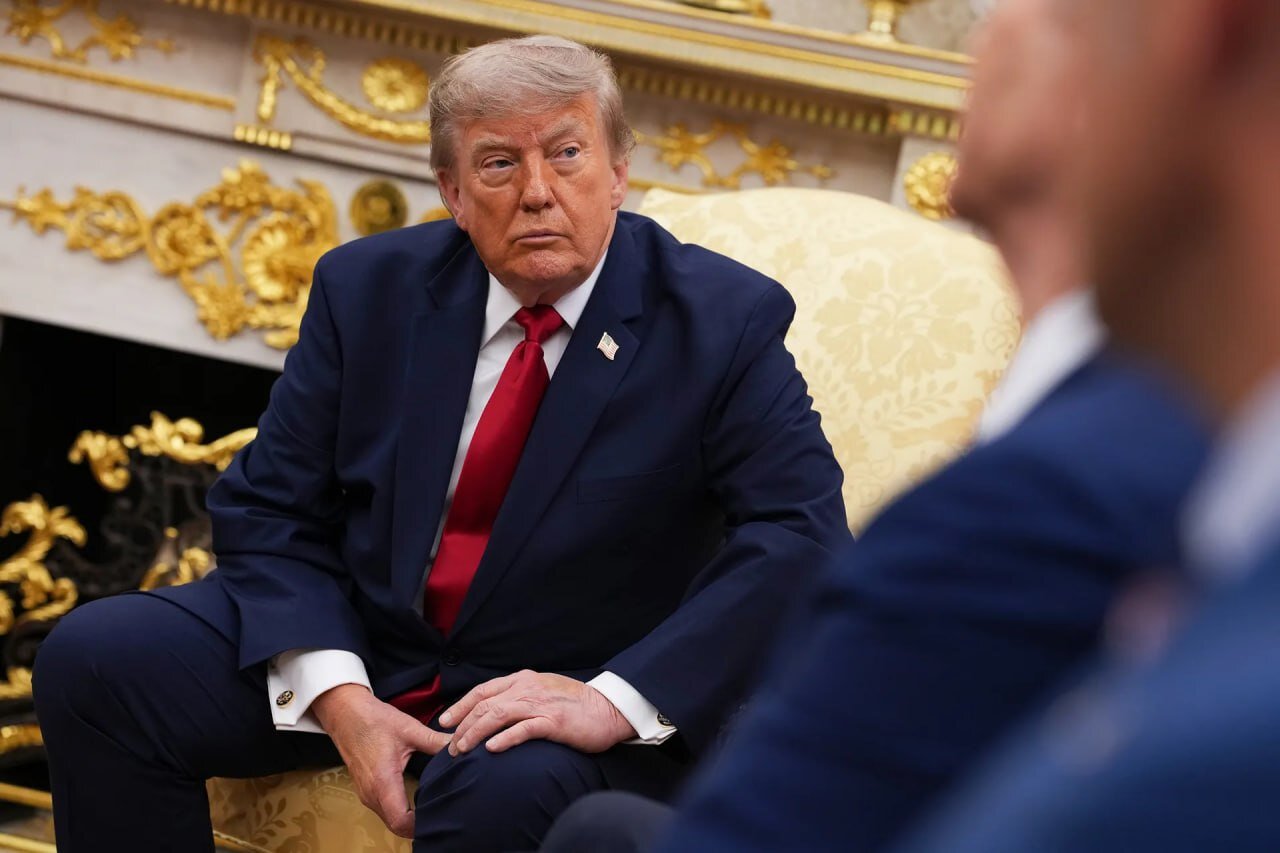
Goa, India – Donald Trump has been bluffing for far too long. He threatens, he warns, he issues ultimatums, and then he expects the world to believe that he has everything under control. But there comes a point when even the loudest threats begin to lose their effect. Iran may well be that point for Trump. He seems to have underestimated a country whose political instincts, historical memory and civilisational confidence cannot be understood through the narrow lens of American power.
Trump appears to believe that if he raises his voice, threatens military action and keeps the world guessing, Iran will eventually surrender. That might work with some governments. It is unlikely to work with Iran. The Iranian leadership has survived decades of sanctions, isolation, political pressure and military threats. It has learned to live with adversity, and it has developed its own ways of responding to pressure. One may disagree with Iran’s government, its policies or its political system, but to dismiss its capacity to think, plan and respond would be a serious mistake.
This is where Trump seems to have got it wrong. He is accustomed to dealing with politics as though it were a business negotiation in which the other party must eventually accept his terms.
But international politics does not work like a real estate deal. Countries have their own histories, their own interests and their own understanding of what they can and cannot concede. Iran is not going to abandon its strategic interests simply because the American President demands it.
The gap between Trump’s threats and reality
For months, the world has watched the familiar performance. Trump makes a dramatic announcement, the threat of military action hangs over the region, and then everyone waits to see what happens next. His supporters may interpret this as strength. But there is a difference between strength and the ability to keep making threats without securing a political outcome. At some stage, the threats themselves become a problem. If you repeatedly promise decisive action and the other side refuses to bend, you must either escalate or find a way out. Neither option necessarily makes you look strong.
Iran understands this dilemma. It does not have to respond to every American statement with an equally dramatic announcement. It can wait, calculate and choose its moment. It can also make the costs of escalation sufficiently high to force Washington to think twice. The point is not that Iran is invulnerable or that it can dictate every outcome. It is that the United States cannot assume that its military superiority automatically translates into political victory.
History has repeatedly demonstrated this distinction. A powerful military can destroy targets, damage infrastructure and inflict enormous suffering. But can it compel a country to accept the political future designed for it by a foreign power? That is a different question altogether. The United States has learned this lesson in Vietnam, Iraq and Afghanistan, often at an enormous cost. Yet American presidents continue to behave as though the application of sufficient force will eventually produce the desired political result.
Trump appears determined not to learn from these experiences.
Iran is more than a military challenge: it has a long historical memory
One does not have to romanticise Iran to recognise the depth of its historical consciousness. Persian civilisation stretches back thousands of years. Its political culture has developed through periods of empire, foreign intervention, revolution and war. Modern Iran has also experienced the overthrow of its elected prime minister in the 1953 coup, the restoration and support of the
Shah by the United States, and the revolution of 1979 that transformed the country’s political order. The Iran-Iraq War of the 1980s left a deep mark on the national psyche.
These experiences matter. They have helped shape the Iranian leadership’s suspicion of American intentions and its determination to resist what it sees as attempts to dictate the country’s future. Washington may regard its demands as reasonable or necessary. Tehran may see the same demands as another attempt to impose American will on Iran.
That difference in perception cannot be wished away.
Trump may believe that Iran will eventually calculate that resistance is too costly. But Iranian leaders must also calculate the political cost of surrendering under American pressure. They have to consider not only the immediate military situation but also their standing at home, their credibility with regional partners and the message that capitulation would send to other countries. A government that believes it is fighting for its sovereignty will not necessarily make the choices Washington expects.
This is why the language of ultimatums is so dangerous. It leaves little room for compromise without humiliation. And when leaders begin to see compromise as humiliation, even a sensible settlement can become difficult to achieve.
There is another issue that deserves attention: the reports and speculation surrounding Ayatollah Mojtaba Khamenei.
Uncertainty surrounding the Iranian leadership has prompted reports about Khamenei’s condition, attracting considerable attention because of his central position in Iran’s political system.
However, Iran’s leadership and institutions cannot be understood simply through speculation about one individual.
Khamenei occupies the country’s highest political and religious office, and his influence over its strategic direction has been considerable. But Iran also has a wider political and security establishment, including the presidency, the cabinet, the parliament and powerful security institutions. Their roles and relationships matter when assessing how the country might respond to a crisis.
The assumption that removing one individual would bring Iran to its knees is questionable. Washington would be making a serious miscalculation if it assumed that eliminating Iran’s supreme leader would force the country into submission.
Such an act could escalate the conflict, provoke retaliation and undermine prospects for a negotiated settlement. The consequences would extend beyond Iran, potentially drawing the wider region into a much broader confrontation.
The unanswered question of Trump’s endgame
This is the question that needs to be asked more often. Military threats are one thing. Having a clear idea of what comes afterwards is quite another. If the objective is to weaken Iran’s military capabilities, what happens next? If the objective is to force political concessions, what concessions are actually achievable? If the aim is regime change, what makes Washington believe that the result would be a stable, friendly government rather than prolonged instability and a more dangerous regional conflict?
These are not academic questions. They concern the lives of millions of people.
Iran is situated in one of the world’s most sensitive regions. Any major conflict could affect neighbouring countries, international energy markets, shipping routes and the wider global economy. The consequences would not be limited to Washington and Tehran. Countries that have little influence over the confrontation could find themselves paying a heavy price through rising fuel costs, disrupted trade and regional insecurity.
The Strait of Hormuz is particularly important in this regard. A serious disruption to shipping through this narrow waterway could have consequences for global oil supplies and the economies that depend on them. Iran knows the strategic significance of its geography. Washington knows it too. That is precisely why military escalation cannot be treated as a cost-free exercise in presidential toughness.
Trump may be confident that American military power gives him the upper hand. In conventional terms, the United States possesses formidable advantages. But Iran does not need to match America weapon for weapon to make a conflict costly. It can use its regional relationships, asymmetric capabilities and geographical position to complicate American calculations. Even a militarily superior power must consider what it will have to endure in order to achieve its objectives.
That is the reality behind the bravado.
Ultimately, the question is not whether Trump can sound more threatening than Iran. It is whether he can achieve what he claims to want without plunging the region into a wider war. If his strategy is built on the assumption that Iran will eventually submit, he may discover that the bluff has become a trap of his own making.
The world does not need another war born of presidential arrogance and strategic miscalculation. It needs diplomacy grounded in realism, respect for sovereignty and an honest recognition that American power, however formidable, has limits. Trump may believe that Iran will eventually blink. But if he mistakes Iran’s refusal to surrender for an invitation to escalate, the consequences could extend far beyond Tehran and Washington. The ultimate test of American power will not be how much destruction it can inflict, but whether it possesses the wisdom to know when to stop.
Disclaimer : This story is auto aggregated by a computer programme and has not been created or edited by DOWNTHENEWS. Publisher: tehrantimes.com