“We didn’t know if we had enough money to complete the journey. We did not even know what we would do when we came back. But we knew that if we kept waiting for the right time, we might never go.”
For Samrat Ulhas Dambe (30) and his wife Varshali Samrat Dambe (35) losing their jobs in 2024 brought an uncertain future into focus. Both had worked in the corporate world, building careers and following familiar routines.
Then, around June that year, they were laid off. With a few months ahead of them and no solid idea of what came next, they began thinking about a dream they had carried for years.
Could they ride along India’s borders on their motorcycle?
The idea had been with Samrat since he was 12, when he would draw the outline of India and imagine tracing its borders on a bike. Over the years, it became a dream the couple shared. They had been riding together since 2018 and bought a Benelli TRK in 2022, hoping to take on longer adventures.
Now, with time on their hands but limited savings, they decided to attempt the journey, which they called the ‘Art India Ride’.
On 19 September 2024, they left their home in Mhapral, a village in Maharashtra’s Ratnagiri district, about 150 kilometres from Mumbai. They would spend the next 80 days travelling 16,428 km, covering 22 states and four Union Territories, through deserts, mountain passes, remote border settlements, and unfamiliar roads.
They returned home on 8 December 2024, having completed a journey they had once thought they might only manage halfway. In January 2025, their achievement was recognised by the India Book of Records as IBR Achiever 2025.
But the record was only one part of the story. Along the way, the couple faced freezing temperatures, tight budgets, and moments when they wondered whether they should turn back. They also found strangers who welcomed them into their homes, fed them, and treated them like family.
When the time finally felt right
Before the journey, Samrat worked as a digital marketing expert at a multinational company, while Varshali was a digital marketing manager at a digital agency. Their lives revolved around work and the usual plans people make for the future.
The layoffs in June 2024 left them with uncertainty, but also something they rarely had before. Time.
“We suddenly had three to four months available, and we didn’t know exactly what we were going to do next,” the husband tells The Better India. “It was an uncertain phase, but we began to see it as an opportunity to do something we had always wanted to do.”
Samrat’s dream of riding around India’s borders had never really gone away. The couple had already spent years riding together, and the idea of taking on the country’s outer reaches felt like a natural next step.
By August, they had decided to go ahead. They did not have enough savings to be certain they could complete the whole route. At first, they thought they might travel through only half of India. Still, they did not want to keep postponing the dream until their finances were more comfortable.
“If we waited for the perfect financial moment, we knew life would get in the way, and the dream might fade. We decided to start and see how far our resources would take us,” Varshali adds.
There was one last change before departure. They had initially planned to travel south first, but heavy rainfall across South India prompted them to rethink the route. With just eight days to go, they decided to begin in Gujarat and travel clockwise around the country instead.
On 19 September, they set off from Mhapral, carrying excitement, nervousness, and no guarantee of how far they would get.
Five bags and a budget to stretch
The couple knew that completing the journey would require careful spending. Their Benelli TRK averaged around 20 km per litre, so fuel was a major expense. They set a daily limit of Rs 3,500 for fuel, food and accommodation, and generally looked for rooms costing no more than Rs 1,000 to Rs 1,500 a night.
They ate at small local eateries and kept their stays simple. The couple had no elaborate itinerary mapping out every day. Instead, they usually decided their next halt and route only a day or two in advance.
“We wanted to remain flexible. Weather, road conditions and accommodation could change our plans at any time,” she explains.
That flexibility had already proved useful when they changed their route before setting off. It also gave them the freedom to travel places they had not known much about before reaching them.
Packing was another exercise in deciding what they could do without. For 80 days, their belongings fitted into five bags. Each had a saddlebag for clothes and personal items. A top box carried their laptop, cameras, electronic equipment, and a basic toolkit. Their tank bag held phones, documents and essentials, while an additional bag carried winter layers and raincoats.
They travelled with just three T-shirts, two pairs of jeans and their riding gear, along with the equipment they needed for the road. “Travelling with so little taught us that we didn’t need as many things as we thought we did,” Samrat says.
Their money was always part of the calculation. Fuel, food, accommodation, and motorcycle maintenance all had to fit within their means. They had also agreed that if their savings fell to Rs 40,000, they would return home and look for jobs.
That possibility meant every stretch of road carried a question. Could they afford to keep going? Would the weather cooperate? Where would they sleep that night?

They decided to continue riding, figuring out the road ahead as they went.
The road tested them before it rewarded them
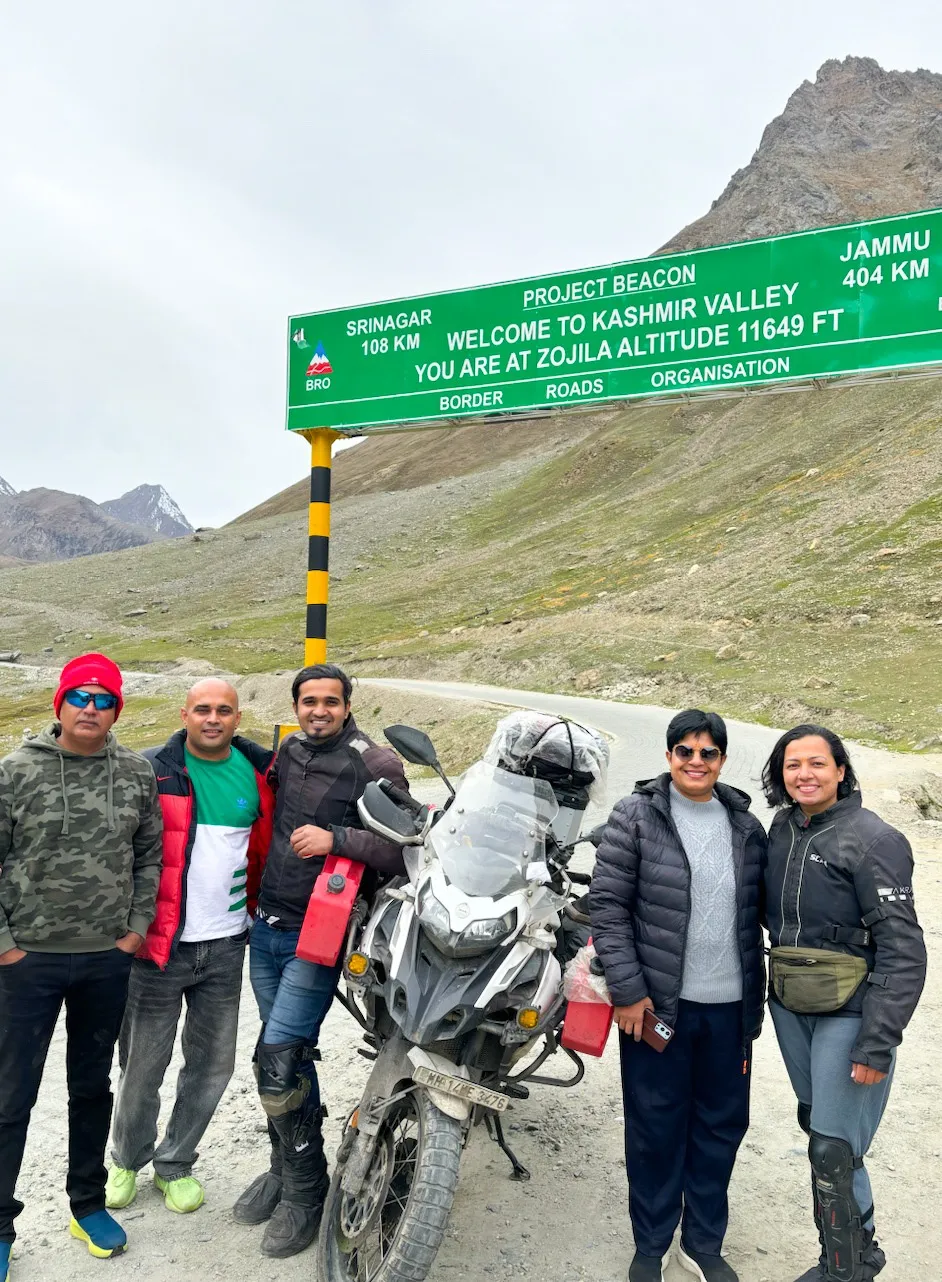
Their route took them from Maharashtra through Gujarat and Rajasthan, then Haryana and Punjab, Jammu and Kashmir, Ladakh and Himachal Pradesh. They continued through Chandigarh, Uttarakhand, Uttar Pradesh and Bihar, before reaching West Bengal and Sikkim. From there, they rode through Assam, Arunachal Pradesh and Meghalaya, then followed the eastern coast through Odisha, Andhra Pradesh, Tamil Nadu and Puducherry.
After reaching Kanyakumari, they turned back north through Kerala, Karnataka and Goa, completing their journey in Maharashtra.
The first few days were harder than they had imagined. Near Santalpur, around the Gujarat-Rajasthan border, they crossed a long, isolated stretch without seeing another person. A storm rolled in, the power went out, and the area began to feel unfamiliar. The only hotel they could find was surrounded by parked trucks, with only truck drivers stopping there for the night.
Samrat grew anxious and began wondering whether they should turn back. Varshali encouraged him to continue. It was a difficult moment, not because the couple had suddenly stopped believing in their dream, but because they were realising what it meant to pursue it without knowing what lay ahead.
Ladakh brought another set of challenges. They reached the high-altitude region in October, when the tourist season was winding down, and many hotels had closed. Around Pangong Lake, temperatures dropped to minus 12 degrees Celsius. They had not ridden in Ladakh before and had not fully anticipated how harsh the conditions could be.
Poor network connectivity, difficult roads and the remoteness of some stretches added to their worries. They were also concerned about getting a puncture on their motorcycle’s tube tyres in places where help could be difficult to find.
At Upshi, the cold became particularly difficult for Varshali, who was shivering. They eventually found a local Maharashtrian who helped them arrange a room with a heater. The experience taught them to adjust quickly, look out for each other and accept help when they needed it. There were no guarantees that the next day would be easier, but they learnt to deal with one challenge at a time.
The strangers who made them feel at home
For the couple, the most memorable parts of the journey were the people they met rather than the places they saw.
In Punjab, a family welcomed them into their home and insisted they stay as guests. In Tawang, Arunachal Pradesh, a woman from Maharashtra who lived there offered them prayers and blessings for the road ahead, greeting them with a traditional Tibetan white shawl.
In Bhalukpong, they met an elderly couple who ran a cafe. The two travellers formed a warm connection with the uncle, who treated Samrat with the affection he might show his own son. When the couple returned to see him on their way back, he became emotional as they prepared to leave.
Thousands of kilometres from home, they found people willing to make space for them, share what they had and offer encouragement without expecting anything in return. Their journey also gave them a closer view of life in remote border regions and the work of the Indian Army and the Border Security Force. They came away with a stronger appreciation of the people who live in difficult conditions and those who serve in them.
“Before the journey, India was a map of different states, languages, food, and cultures,” the husband explains. “After travelling 16,428 kilometres, it felt like one giant, compassionate family. The warmth we received from people remained largely similar, wherever we went.”
One encounter in North Bengal brought home just how far a journey can reach beyond the people making it.
Travelling from Sikkim towards Jaigaon in West Bengal, the couple stopped at a small stall for breakfast. A group of people arrived by car and noticed the Maharashtra registration on their motorcycle. Curious about how far they had travelled, they invited the couple to sit with them and talk.
The conversation lasted nearly two hours. One of the men, Arun Sircar, a corporate professional from Kolkata, explained why he had been asking so many questions.
“Once upon a time, this was my dream too. I moved to the USA, worked hard, and bought a luxury BMW because I wanted to travel. My wife and I wanted to live life on the road, just like you. But somehow, life caught up with us, and we got stuck,” he says.
He had driven across the United States but had never experienced his own country in the way the couple was doing. “You are living my dream, bro. Through your journey, I feel like I am travelling too,” he told them.

The words moved Samrat and Varshali. Their ride had begun as a personal ambition, but here was someone who felt connected to it because it represented a life he had once imagined for himself.
Sircar and his wife invited the couple to their home. She prepared a vegetarian feast despite not having cooked vegetarian food before, and they invited friends over to hear about the journey. The couple were also given a room for the night.
For the travelling duo, the connection became a reminder that a journey could mean something to people who had never taken the same road themselves.
What the road taught them
Kaushal Sethia, a 26-year-old software engineer from Surat, had met the couple in Naggar, Himachal Pradesh, where they were neighbours at a homestay. They spent almost a month together and became close friends. When the duo began their border expedition, Sethia and his family followed their progress and regularly asked for updates.
What stayed with him was not just the distance they covered.
“The way they support each other is what makes the journey special. It tests you physically, mentally, and emotionally. The most difficult part of a journey is starting, and they didn’t just start it. They completed it against all the problems,” he says.
The 80 days had tested the couple’s relationship, too. Sharing a motorcycle, limited belongings and constant uncertainty meant making decisions together, managing tiredness and adapting to changing conditions. They learnt to recognise when one of them needed encouragement, rest or a little space.
For Samrat, riding also became a way of silencing the noise in his head.
“When you are on a motorcycle for days at a time, the beat of the engine and the focus the road demands bring you into the present moment,” he says. “For me, it feels like meditation.”
The couple returned to Mhapral on 8 December 2024, after spending 80 days on the road. Their total expenditure came to around Rs 3.75 lakh, covering fuel, food, accommodation, repairs, and maintenance.
They had completed the journey without knowing at the outset whether their savings would last. They had also returned with memories of people who had made the road feel less lonely.
They were not thinking about a record while travelling. After reaching Goa, a friend suggested that they apply to the India Book of Records. They submitted photographs, fuel receipts, and other documents for verification, and in January 2025, they were recognised as IBR Achiever 2025.
The recognition was welcome, but the couple say the people they met and what they learnt mattered more than the certificate.

Carrying the journey forward
On 6 April 2025, Samrat and Varshali started ‘Souls of Motorcycle’, a riding community inspired by what the Art India Ride had taught them. They wanted to create a space for motorcycle enthusiasts to learn, travel responsibly and experience the road as more than a test of speed, distance or engine capacity.
The community has grown to more than 700 members, with over 8,000 Instagram followers. The couple organise rides to destinations such as Ladakh and Sikkim and are working to expand into cities including Surat, Chandigarh, Kolkata, and Bengaluru.
Their aim is to help more people become confident riders, discover places they might not otherwise visit and find some mental space away from their everyday routines.
For the couple, riding is not only about reaching a destination. It is also about being present, meeting people and returning with a different perspective on life. The Art India Ride gave them a way to experience that for themselves, and Souls of Motorcycle is how they now hope to share it with others.
Their journey began at a moment when the future felt uncertain. They had lost their jobs, their savings were limited and they could not be sure they would complete the route. But rather than waiting for life to become predictable, they chose to begin.
They rode through freezing nights and lonely stretches, accepted help from strangers and experienced how much could happen when two people kept moving towards the same goal.
The record gave their journey a number. The people they met gave it meaning.
And the dream that began with a boy drawing the outline of India became 16,428 kilometres of road, shared courage, and a reminder that sometimes the right time is the time you decide to start.
All pictures courtesy Varshali Dambe.
Disclaimer : This story is auto aggregated by a computer programme and has not been created or edited by DOWNTHENEWS. Publisher: thebetterindia.com