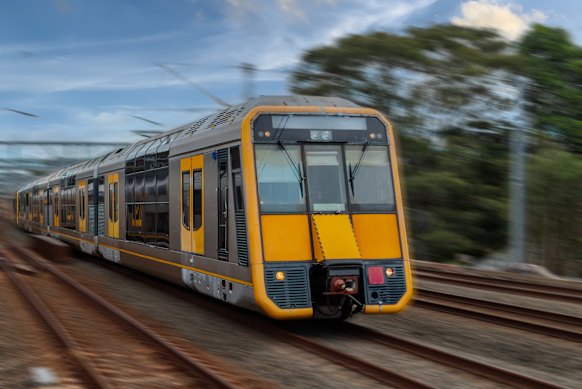
The problem with common sense is that it’s not all that common. That’s why I was so pleased to see it prevail over winning (or is that losing?) political votes (“None on board: Backdown over train timetable”, October 25). The T4 line between Waterfall and the central city was proposed to take 14 minutes longer due to extra stops, affecting thousands of travellers including myself, who has caught the train from my home station, Engadine, since 1972. Premier Chris Minns had the common sense to reverse his government’s initial decision after the unpopular backlash that followed it. He took the public reaction on the chin and couldn’t be accused of assigning the blame for a decision to others. The premier might have also thought that the light at the end of the tunnel was not a solution to his problem but a train building up a head of steam in his direction, with the front light on high beam. Paul Hunt, Engadine
As with most things related to public transport, I believe these changes were designed by people who do not regularly travel by train. When they do the redesign again, I suggest the planners be required to travel at peak and off-peak times, carrying luggage, and with a less-fit companion and/or children and a stroller, and change from bus or light rail to train. And just because I do not live near a station, that does not mean I do not use trains regularly. Helen Howes, Collaroy
Blunderers in Chief
Regarding the article “Reality of life in Chiefs’ bubble” (October 25). Apart from saying very little, what it does say is misleading. There are thousands of Australians with families residing in PNG. I do, as do my son and his family. We live very busy social and sporting lives. You can drink the tap-water, Wi-Fi is as good as it is in Sydney, and my son, his family and mine move through the community daily without security. It seems to me the only group who fixate on security in PNG is the diplomats whose pay is determined, to a large degree, by the security situation of the country they are assigned. Groups of diplomats and their spouses on early morning walks being followed and led by security vehicles (as we pass on our solitary walk) is a strange and perplexing sight. What the majority of Australians living in PNG dislike with a passion, as I do, is the waste of Australian taxpayers’ dollars on a football team. If the Australian government was serious about assisting PNG, these moneys would be spent on education and health, not on making mostly Australian footballers millionaires. Winning the hearts of PNG citizens using the geopolitical assault of the Chiefs is a serious and stupid blunder. It will not work. Peter Lowing, Port Moresby, Papua New Guinea
Small world
As a regular viewer of rugby league and a loyal Rabbitohs supporter, it pains me to point out the deficiencies of the current World Cup competition (“Walters mulls spinal tap as pressure on players grows”, October 25). The name “World Cup” is definitely a misnomer. The representation of players is really confined to three English counties plus Australia, New Zealand and a clutch of Pacific Islands. I suspect players representing France and Lebanon may have little connection to those countries, except perhaps as tourists. The majority of players involved are, I suspect, Australian-born, and they play for Australian and New Zealand clubs. And the imbalance in the competition that means that some participants win by a cricket score really does little for the image of the game. The efforts to market the code as an international sport only exposes it to damaging criticism. Derrick Mason, Boorowa
Bill of right ideas
Another excellent lesson for us all from Bill Clinton, in Peter FitzSimons’ interview with Laura Schwartz (“If the Democrats win the midterms, a lot of people are going to prison”, October 25). Politicians from opposing parties are “opponents, not enemies” and they can have “different ideas and different solutions to solve the problems of the people”. But all can “agree on what those problems are”, despite feeling “like my ideas will be more effective and better than his”. If our own politicians could embrace this concept, treat each other with respect and dignity, and not demonise each other as “enemies”, it would “lower the temperature” more effectively than any piece of legislation ever could. Some bilateral agreement occasionally wouldn’t hurt either. Alan Marel, North Curl Curl
Language barriers
While it is encouraging to read of the promotion of languages in our public high schools (“The public school students pushing back against the decline in study of Latin”, October 25), it is disappointing that the study of a foreign language in primary schools, although promoted in 2020, has not yet been implemented. Our schools need to return to the days many years ago when languages such as French, German and Latin, as well as some Indonesian and Japanese, were available in almost all public high schools. One of the main problems was that language studies were considered elite; there were schools that would only allow the top classes to study them. This attitude is fatal. To broaden the education of future students, we need to encourage all students in all schools, both public and private, to reintroduce languages as core subjects. Nola Tucker, Kiama
Latin, I told a kid soon to be entering year 7, seemed so useless when I was 12, but eventually I came to regard it as the most useful subject I took at school – for me just pipping English and modern history. Carpe diem, iuvenes. Andrew Cohen, Glebe
- To submit a letter to the Sun-Herald, email letters@smh.com.au. Click here for tips on how to submit letters.
- The Opinion newsletter is a weekly wrap of views that will challenge, champion and inform. Sign up here.
From our partners
Disclaimer : This story is auto aggregated by a computer programme and has not been created or edited by DOWNTHENEWS. Publisher: www.smh.com.au