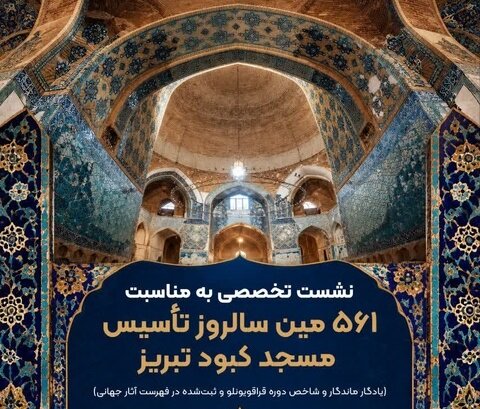
TEHRAN – A specialist meeting marking the 561st anniversary of the establishment of Tabriz’s Blue Mosque will explore the history of the Qara Qoyunlu dynasty and the distinctive tilework associated with its period of rule.
The meeting is scheduled to take place on Tuesday, November 3, 2026, at the meeting hall of the Azarbaijan Museum in Tabriz, Miras Aria news agency reported.
The event will feature presentations by Masoumeh Qarehdaghi, associate professor and head of the History Department, and Ali Nemati, associate professor of conservation and restoration of cultural and historical objects.
Two main subjects will be addressed: the political and administrative structure of the Qara Qoyunlu dynasty and the development of tilework during its rule.
Qarehdaghi will discuss the dynasty’s system of governance and the historical circumstances surrounding the creation of monuments from that period. Nemati will examine the artistic characteristics and decorative techniques of Qara Qoyunlu tilework, with particular attention to the craftsmanship and ornamental features of surviving works.
The Blue Mosque, also known as the Jahan Shah Mosque and the Mozaffariyeh Edifice, is among Iran’s notable architectural monuments dating from the 15th century. Its construction is closely associated with the reign of Jahan Shah, the Qara Qoyunlu ruler who governed much of Iran and neighboring territories during the 15th century.
The Qara Qoyunlu, also known as the Black Sheep Turkomans, were a Turkoman Muslim dynasty that ruled parts of present-day Azerbaijan, Armenia, northwestern Iran, eastern Turkey and northeastern Iraq from approximately 1374 to 1468. Their period of rule was marked by significant architectural and artistic patronage, particularly in northwestern Iran.
An inscription above the Blue Mosque’s entrance bears the date 870 AH (1465–66), providing an important historical reference for the monument. The mosque is particularly renowned for its intricate mosaic tilework, dominated by shades of blue and turquoise, which has earned it the celebrated name Turquoise of Islam.
Its architectural significance, however, extends beyond its elaborate decorative surfaces. The building’s spatial arrangement and the integration of a mosque with a mausoleum make it an important example of Qara Qoyunlu architecture and provide valuable material for studying the period’s religious and funerary traditions.
The monument suffered extensive damage in an earthquake in 1193 AH (1779–80), and parts of the structure were subsequently rebuilt during restoration campaigns. Consequently, an understanding of its architectural history requires consideration of its original design, surviving decorative elements and subsequent conservation interventions.
The Blue Mosque has also been highlighted in Iran’s submission to UNESCO, reflecting its architectural and artistic significance. Its distinctive tilework remains one of the most remarkable expressions of decorative craftsmanship in the architectural heritage of northwestern Iran.
AM
Disclaimer : This story is auto aggregated by a computer programme and has not been created or edited by DOWNTHENEWS. Publisher: tehrantimes.com