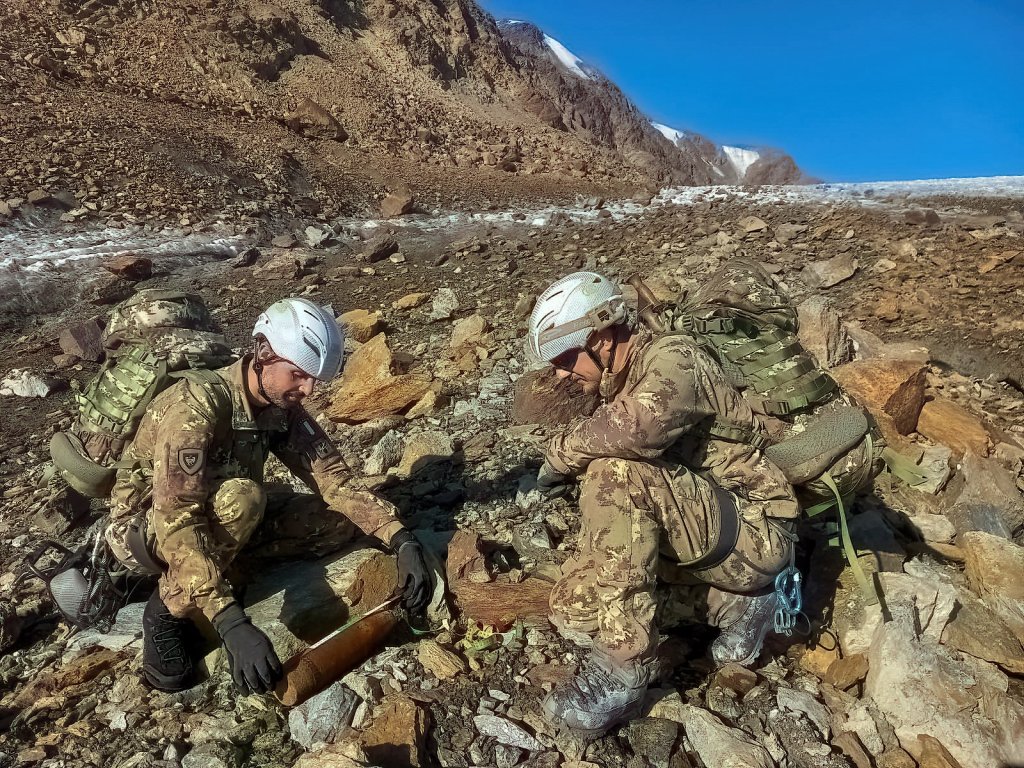
Hundreds of World War I-era munitions that spent more than a century buried under snow and ice have been discovered in the Italian Dolomites.
Roughly 250 artillery shells, mortar bombs and other ammunition were exposed by melting glaciers in the Trentino-Alto Adige region in northern Italy, the Italian army’s Julia Alpine Brigade, an elite unit specializing in mountain warfare and cold-weather operations, told CNN.
The over-century-old devices, left behind from the White War, or “Guerra Bianca,” fought between Italian and Austro-Hungarian armies from 1915 to 1918, were discovered by hikers and mountain workers in the area of Canal San Bovo in the Primiero Valley in eastern Trentino, according to The Guardian.
In June, the first unexploded ordnance — a 90-millimeter mortar — was unearthed after a car rolled down a ravine near Caldonazzo, in the Valsugana region.
Firefighters removing the vehicle spotted the shell at the foot of a tree, prompting a bomb squad to remove it.
The Julia Alpine brigade launched a campaign to clear the munitions from the area from August to Oct. 16, before winter snow returned to the region.
The mission they said took “solid mountaineering skills” to navigate “inaccessible areas, at high altitudes, and on particularly challenging terrain,” they told CNN.

This is not a rare occurrence, since munitions from both World Wars are revealed each year in the Alps. But unusually low snowfall in 2025 and this summer’s heat wave have accelerated the retreat of glaciers, exposing more of the dangerous remnants.
“It is very much a consequence of global heating,” Stefano Morosini, a professor at the University of Bergamo and the coordinator of heritage projects at Stelvio national park, where some of the shells were found, told The Guardian.
“In recent years, at the end of each summer, these dangerous artifacts emerge and each year there is a higher number … Some had already exploded but many hadn’t, so now when they re-emerge, they are very, very dangerous.”
Officials are now warning hikers and other visitors not to handle any munitions they encounter and to alert authorities instead.
Disclaimer : This story is auto aggregated by a computer programme and has not been created or edited by DOWNTHENEWS. Publisher: nypost.com