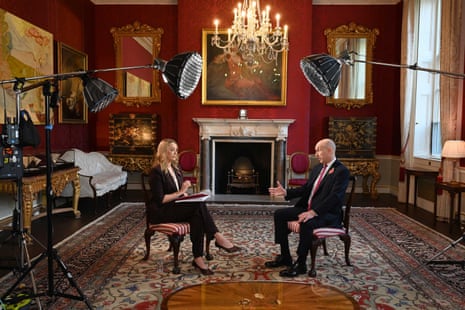
At the end of his interview with Kuennsberg, Healey was also asked to comment on a potential apology for Britain’s near-250 years of perpetrating the slave trade and why the government should or shouldn’t pay reparations to enslaved people and their countries.
Sitting in the grand settings of Number 11 Downing St, Kuenssberg pointed out the lavish interiors:
“So many Commonwealth countries think that this country’s wealth, maybe the wealth in this building, this gilt chandelier, came off the back of slavery. So why is a government not willing to contemplate reparations?”
Healey replied saying the PM was open to “a discussion about an apology”, but “he doesn’t believe that reparations are the right approach”. He makes the same argument as Burnham that the current British people shouldn’t have to pay for past wrongdoings.
Considering a formal apology doesn’t mean accepting that British people now should accept the financial liability for any party and things that happened hundreds of years ago, in which they had no role.
A reminder again of some of the history, which is so key to this reparations discussion.
-
For almost 250 years (1560s-1807), British ships trafficked more than three million enslaved African men, women and children in a state policy backed by the monarchy and parliament.
-
Many were taken to British-owned plantations in the Caribbean, which enslaved generations. Children were born into slavery, uprisings were put down with extreme brutality
-
There were still 800,000 enslaved people on British plantations when enslavement was finally abolished by parliament in 1833
-
Abolishment was only achieved because the government agreed to “compensate” the enslavers. The government paid an enormous sum, the equivalent of billions of dollars these days, to the “owners” of enslaved people; this came from a huge loan that was only paid off in 2015.
-
Britain has never paid any compensation or reparations to the people who were enslaved, or their countries.
-
U.K. politicians have traditionally focused on the country’s role in banning the slave trade in 1807 and outlawing slavery throughout the British Empire in 1833.
I’m going to wrap up the blog there, thanks for reading.
-
The chancellor, John Healey repeats the PM’s argument that the UK will not pay reparations for its role in perpetuating transatlantic enslavement for nearly 250 years because British people today shouldn’t have to pay for historical wrongdoings
-
Andy Burnham has said however that the UK could be open to issuing a formal apology, a move that goes further than previous British governments
-
He and King Charles – currently on a Caribbean tour -are due to meet heads of state at a Commonwealth leaders meeting later this week in Antigua and Barbuda where accountability is a top issue
-
The Caribbean countries have been pushing for Britain to apologise for the slave trade and engage in ‘repatory justice’ discussions; King Charles faced demonstrations last week in Guyana
-
Their leaders have largely welcomed Burnham’s apology announcement as an important first step; but disagree on the lack of reparations
-
Meanwhile Tory leader Kemi Badenoch says neither the apology or reparations should happen, and “I don’t think that Andy Burnham needs to be apologising because it is a lever to wedge open the door to ask for cash.”
-
Lib Dems’ Ed Davey says it’s about the time that Britain has a discussion on its slave-trading past, but also says reparations isn’t the right approach
-
Burnham has suggested that instead of reparations, the UK should lead the way in helping restructure debt for poorer countries which suffered the impact of the British slave trade.
It’s Independence Day in Antigua & Barbuda and special guests like King Charles III are participating in local activities.
His visit has mainly sparked discussions on reparations with at least two civil society groups planning protests during the international summit.
But for residents, discussions on reparations are not on their priority list especially as something as simple as an apology from the King and his UK government seems to be so controversial.
Many brush it off as us “never getting money” while academics are calling for reparations in the form of investment in health, education and industries that will improve the standard of living of people living in Antigua and Barbuda.
For many locals, their top concerns continue to be the growing cost of living and increased gas prices. Others have taken to social media to make jokes about what infrastructural changes the King’s arrival has caused. Potholes, roads and buildings that have been neglected for years have overnight garnered the attention of the government’s Public Works Department.
The Met Police has disclosed the total number of arrests they made on Saturday at the anti-genocide demonstration outside the US embassy in London.
In total, 325 people were arrested. Police said the vast majority – 320- were arrested for expressing support for Palestine Action, which has been listed as a banned organisation under the UK’s terrorism laws for the past 15 months.
Below are pictures from the rally. People were arrested for holding placards reading: “I oppose genocide, I support Palestine Action”. Many were forcibly removed from the protest site by police.
In case you missed it earlier, just wanted to highlight again the database put together by specialist historians which identifies the investors in Britain’s slave trade.
Kings and queens were investors, as were more than 100MPs, clergymen and original financiers of the Bank of England. Many slave traders still have memorials and statues venerating them, (although Edward Colston’s was toppled during Black Lives Matter protests in 2020.)
This was a project three years in the making. It provides biographical detail for as many of 10,500 investors from historical records, building the most comprehensive single picture so far of those who perpetrated the enslavement of African people.
They include the composer George Frideric Handel, and the philospher John Locke, who both were shareholders in the Royal African Company.
It is a legacy of the dehumanisation inflicted on so many African men, women and children that much less was documented about them than about their enslavers.
The Guardian’s David Conn is reporting on significant findings of the project, led by Prof William Pettigrew of King’s College London.
The weight of historical evidence is adding to the growing global movement calling on European governments to be accountable; to issue a full, formal apology and engage in reparatory justice discussions.
Successive British governments have refused to do so, arguing there is no duty to make reparations because enslavement and the slave trade were not against the law at the time. The Burnham government is arguing that British people today shouldn’t be saddled with the wrongdoings of the past.
Jamaica has sought a legal challenge on this government petition; it has petitioned King Charles for a ruling from the Privy Council, the final court of apppeal for UK overseas territories and some Commonwealth countries.
The former chancellor Rachel Reeves has argued Britain’s future should be back in the European Union, saying Brexit has made the UK “poorer, weaker and less secure”.
In her first major intervention since leaving the Treasury when Andy Burnham took office, she said those forging a path back towards EU membership had to make compelling arguments to the public.
Reeves, who was sacked as chancellor by Burnham, said in an article for the Sunday Times that no one who worked with her in the Treasury could be in doubt about her pro-European instincts. “I am proud of the progress we have already made in strengthening our relationship with the European Union. Brexit has made us poorer, weaker and less secure,” she said.
“There is a debate to be had about our future relationship with Europe, and I welcome Andy Burnham’s leadership in facing up to this. No one in the Treasury ever doubted where my instincts were.”
The current focus for British negotiations is the EU summit later this month to seal an agreement to ease some trading restrictions and a youth mobility deal. But the prime minister has made it clear he wants to see a long-term and stable relationship with the bloc.
Burnham has said he believes there should be “honest discussion” about freedom of movement and that rejoining the single market could be done without the need for another referendum, if Labour put it in its manifesto. In contrast, he said fully rejoining would need another in-out poll.
King Charles faced reparations protests in Guyana
“The royal family enslaved us! Apologise now! Reparatory justice now!”
King Charles has faced some protests for reparations in Georgetown, Guyana in recent days.
He and PM Andy Burnham, will be greeted with such messages again as they travel through Antigua’s capital, St John’s to the Commonwealth leaders’ summit next week.
On billboards, placards and T-shirts, in letters and at a candlelight vigil for the thousands of Africans trafficked to Antigua and Barbuda during the transatlantic slave trade, the message from the Caribbean will be pervasive: slavery reparations is not an issue they “are going to be able to dodge”.
James Knight of Citizens for Reparatory Justice, which is organising some of the demonstrations, said the king and UK government had made protest necessary.
“It is definitely necessary that we make known our deep sense of indignation in response to what has been announced ahead of the meeting by the British government and King Charles that there will be no apology, no reparations,” he said.
“And to make that announcement when you’re coming to a meeting where people have been asking to have the matter discussed, to us, is extremely insulting [and] insensitive”.
The Commonwealth meeting is the culmination of more than a decade of calls from Caribbean leaders for Britain to acknowledge its role in the enslavement of millions of Africans and the colonisation of African and Caribbean countries, and to address the enduring consequences.
Professor Verene Shepherd, vice-chair of the Caribbean Reparations Commission, described Burnham’s announcement as “good news”, but rejected the suggestion that Britain today cannot be held liable for reparations.
“Only a full and formal apology can allow for the healing of wounds and the destruction of cultures caused by colonialism,” she said, adding that “a full apology accepts responsibility, commits to non-repetition, and pledges to repair the harm caused”.
The Caricom body was established in 2013 by Caribbean community heads of government to build the argument for reparations from former colonial powers.
Shephered said descendants of enslaved people wanted “a conversation on actual reparations, not debt restructuring but debt cancellation rooted in the reality of the lingering legacies of colonialism”.
Confronting that ‘complicated history’ of which the PM speaks includes paying for the wrongs of chattel slavery. In fact, it is not complicated at all. It is very straightforward.
Shepherd, a professor emerita of social history at the University of the West Indies in Mona, Jamaica, also challenged Britain’s traditional narrative around abolition, saying:
Enslaved people, including in Ayiti, not Britain, led the fight for abolition. British development benefited from the blood, sweat and tears of millions of enslaved Africans.
We reject the notion that a nation that profited from chattel slavery should not now be held responsible for its actions. Britain is liable! As that late reparations warrior, Jamaican Dudley Thompson, said: ‘The Debt Has Not Been Paid, the Accounts Have Not Been Settled.’ Settle it now! We want equal rights and justice in Peter Tosh’s formulation.
In Guyana, President Irfaan Ali welcomed Burnham’s statement and called for a Commonwealth subcommittee to work out the details of the dialogue.
I want to acknowledge the statement by the British government, and I’m happy that finally the discourse has moved to a position where it should have been, where the British government is involved, because that’s the state we are dealing with.
But Ali questioned what such dialogue should ultimately achieve.
“I’ve always made the case that we need to sit down in a mature conversation. The indignity cannot be paid for.
“But how do we identify a formula? How do we identify a system of support where the UK government, with its financial institutions, can sit with countries, can sit in a deliberate way and work on a development pathway, identify development gaps, whether in health, education, social services, infrastructure; development gaps that affect countries’ ability to invest in adaptation and mitigation for climate disasters, especially in this region.”
Ali said he wanted Commonwealth leaders to establish a subcommittee within the next six to 12 months to work with the British government on identifying and costing development gaps resulting from slavery.
For some, the next meeting of Commonwealth heads of government meeting (Chogm)is crucial for King Charles. Already campaigners have warned that his position as head of state is at risk in several countries unless he does more to confront the monarchy’s historic links to slavery.
As my colleagues write:
Patrick Vernon, a cultural historian and UK representative of the Global Jamaica Diaspora Council, said the stakes for this trip could not be higher for the future of the royal family’s standing in the region, warning: “I think it’s the biggest crossroads for the Commonwealth since its creation.”
Charles is expected to deliver three significant speeches during the trip, but will follow government advice not to issue a formal apology for Britain’s role in the transatlantic slave trade. The British government has also ruled out paying reparations.
The visit is expected to be met with protests over the monarchy’s colonial legacy and demands for a formal apology and reparations. It comes four years after the Prince and Princess of Wales’s controversial 2022 Caribbean tour, where images of the couple greeting Jamaican children through a wire fence sparked widespread criticism across the region.
Truth telling and transparency is key to acknowledging Britain’s history of enslavement and the transatlantic slavery.
Some descendants of British people who profited from the slave trade have already apologised and offered compensation.
That includes The Guardian newspaper. In 2023, we apologised for the role our newspaper’s founders had in transatlantic enslavement, and launched a 10-year programme of restorative justice involving community engagement with descendant communities linked to the Guardian’s founders in Jamaica and the US.
We also launched the Cotton Capital series, an ongoing run of reports on the legacies of this slave trade and how it’s still felt and grappled with today.
For example, this is the case that has been made about the logic of slavery reparations – and how it’s not just about payment but addressing inequalities and engaging in good faith with descendants of enslaved people.
Disclaimer : This story is auto aggregated by a computer programme and has not been created or edited by DOWNTHENEWS. Publisher: theguardian.com