
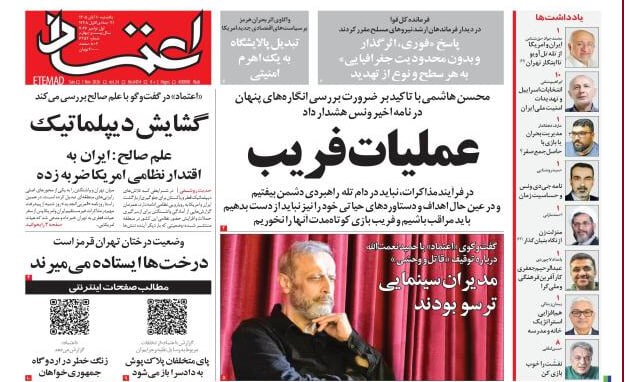
Strategic affairs analyst Saeed Leilaz examined the letter sent by J.D. Vance to Mohsen Rezaei in an interview with the Etemad newspaper. The timing of the letter is significant because it comes amid heightened political and economic uncertainty. Leilaz argues that although the letter has been presented as an attempt to revive negotiations, it is accompanied by warnings and threats against Iranian infrastructure.
After failing to achieve certain military objectives, Washington has shifted toward a strategy designed to gain time, reduce attention on Iran’s leverage in the Strait of Hormuz, and prepare the ground for stronger future pressure if necessary. Iran should respond through a balanced strategy that combines deterrence and diplomacy. He emphasizes the importance of maintaining military readiness, strengthening economic resilience, removing domestic obstacles to economic growth, and supporting productive sectors of the economy. Diplomatic channels should remain open, and negotiations should continue in a careful and calculated manner.
Kayhan: Trump seeks to portray himself as a victim
In an article, Kayhan argued that the conflict involving Iran has generated significant difficulties for both the United States and Europe. Many observers view the consequences of the confrontation as costly and destabilizing. Political pressure has become particularly intense for Trump. Developments linked to the conflict, combined with domestic challenges and election-related concerns, have forced him to modify his public messaging. Whereas he previously suggested that the conflict would have only a limited impact on the United States, he is now placing greater emphasis on portraying America as a target rather than an initiator. The newspaper also highlights rising energy concerns and continuing volatility in global oil prices. According to its analysis, expectations that economic conditions would rapidly improve have not been fulfilled. As a result, Trump is attempting to shift responsibility for the crisis onto Iran while presenting himself as responding to Iranian actions. This change in rhetoric is a sign of political weakness.
Iran: Diplomacy remains the best path for crisis management
The Iran newspaper focused on Tehran’s proposed seven-day initiative, which was reportedly delivered through intermediaries. The analysis presents the proposal as a possible framework for reducing tensions and creating conditions for renewed diplomacy. The initiative is based on a series of reciprocal and phased measures. It seeks to connect several objectives, including ending hostilities, easing restrictions, reopening the Strait of Hormuz, and creating a pathway toward renewed nuclear negotiations. Supporters believe that linking these elements together could establish clearer expectations for both sides and reduce uncertainty. The newspaper argues that the proposal may help build trust by providing a structured roadmap rather than relying on general political commitments. It further suggests that the framework could serve as a starting point for broader crisis management and help prevent the continuation of a cycle of escalation and retaliation. However, the paper stresses that implementation depends on political will and the readiness of all parties to take corresponding steps. Without reciprocal action, even a well-designed proposal is unlikely to succeed.
Khorasan: Decoding Vance’s approach
Khorasan examined the possible objectives behind Vance’s communication with Iran. According to the newspaper, American officials are eager to secure a diplomatic achievement before Nov. 3 midterm elections and view an agreement with Tehran as politically valuable. Washington reportedly wants nuclear issues to be incorporated into any broader arrangement. Tehran, however, is unwilling to accept such conditions under the current circumstances. Because the exact contents of the message remain unclear, Khorasan focuses on the broader political implications. The newspaper identifies two possible tactics. The first involves highlighting particular negotiating figures in an attempt to exploit perceived domestic divisions within Iran. The second involves introducing new conditions that could replace or alter previous understandings reached between the parties. Despite these concerns, Khorasan emphasizes that Iran remains willing to engage in dialogue. Nevertheless, it argues that successful negotiations require changes in Washington’s approach and greater attention to Iranian concerns and conditions.
Hamshahri: Response without geographical limitations
Hamshahri discussed a Saturday order from the Leader of the Islamic Revolution to the armed forces in the event of resumption of war against Iran by pointing to the views of regional affairs analyst Seyyed Morteza Mousavi. According to Mousavi, the order emphasized preparedness, deterrence, and the ability to respond rapidly to any future threat. He identified three main themes: maintaining full readiness, delivering immediate and effective responses to threats, and ensuring that Iran would determine the course and duration of any future confrontation if attacked. Mousavi argued that recent conflicts demonstrated the importance of deterrence and military readiness in shaping regional security calculations. He also stated that any country allowing its territory or facilities to be used in attacks against Iran could face consequences in the event of future hostilities. In his interpretation, the order was intended to signal determination that responses to future threats would not necessarily be confined to a specific geographical area.
Disclaimer : This story is auto aggregated by a computer programme and has not been created or edited by DOWNTHENEWS. Publisher: tehrantimes.com




