
Staff writers
Updated ,first published
The Australian sharemarket has started the week in negative territory with technology stocks weaker on the back of a Wall Street sell-off while financial stocks are higher ahead of the Reserve Bank’s interest rates call on Tuesday.
The S&P/ASX 200 was down 12.2 points, or 0.1 per cent, to 8895.9 in early trade. The Australian dollar was trading at US70.29¢.
Westpac said it expects interest rates to remain “elevated” into 2027 and house prices to have fallen by nearly 11 per cent by March as it reported a $6.8 billion full-year profit. Westpac’s profit in the year to September was down 1 per cent from the previous year. The bank’s net interest margin – a key measure of profitability – fell by 3 percentage points to 1.86 per cent for the second half of 2026 as lending competition remained strong and more customer accounts qualified for savings bonus rates. Its shares are up 1 per cent in early trade while its big four peers are also stronger, with Commonwealth Bank rising 1.1 per cent, National Australia Bank up 0.8 per cent and ANZ 0.8 per cent higher.
KMD Brands, the owner of Kathmandu and Rip Curl, jumped 10.4 per cent in early trade
The parent company of popular brands Kathmandu and Rip Curl has revealed it is in talks with the US-based global retail giant owner of labels including Dickies about a possible takeover.
In an announcement to the ASX on Monday, KMD Brands, which is behind outdoor clothing and adventure brand Kathmandu, surfwear staple Rip Curl and footwear company Oboz, said that after receiving a number of approaches from external parties, it had entered into an exclusivity agreement with retail powerhouse Bluestar Alliance “regarding a possible transaction to acquire all of the shares in KMD”. KMD shares jumped over 10 per cent in early trade.
“There is no certainty at this time that this process will result in receipt of a binding proposal, or that any transaction will ultimately be consummated,” the statement said.
Mining stocks are mixed with BHP down 1.1 per cent and Rio Tinto slipping 1.4 per cent while Fortescue edged up 0.3 per cent. Gold prices slumped as the price of the previous metal remains below $US4000 per tonne with Northern Star shedding 4.1 per cent and Evolution Mining down 3.2 per cent.
Energy stocks slid as Brent crude fell 1.7 per cent to about $US111.60 a barrel early Monday as traders weighed the risk of renewed US military action against Iran and potential disruptions to Middle East supplies. Major OPEC+ nations reaffirmed plans on the weekend to keep oil production quotas unchanged in December as conflict in the Middle East continues to curb swaths of the group’s output. Woodside Energy lost 0.4 per cent and Santos dipped 0.2 per cent. The refiners also lost ground, with Ampol down 0.6 per cent and Viva Energy 1.1 per cent lower.
Technology stocks slumped after a tech sell-off on Wall Street due to escalating concerns frenzy around artificial-intelligence technology with WiseTech down 1.7 per cent, Xero falling 2.5 per cent and Codan 1.3 per cent lower.
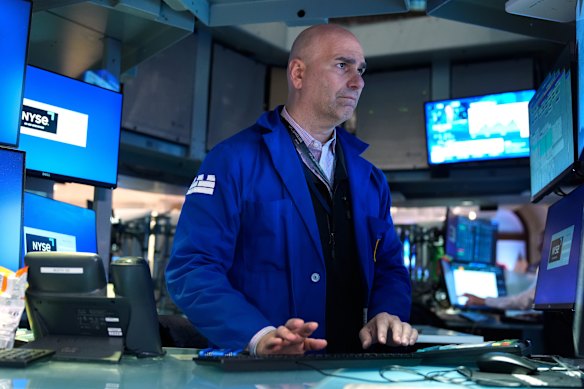
On Wall Street, the S&P 500 tumbled 1.8 per cent on Friday for its worst day since June, and it closed out a third straight losing week. The weakness for technology stocks dragged the Nasdaq composite down a market-leading 2.9 per cent, while the Dow Jones Industrial Average dropped 572 points, or 1.1 per cent.
The US stock market remains only 3.1 per cent below its all-time high, which has boosted the value of workers’ retirement accounts, but it’s become increasingly shaky as Tuesday’s midterm elections in the United States approach. Worries about AI in general have already become a concern for voters across political parties, and President Donald Trump has historically used the stock market’s performance as a measure of his own success.
Intel’s stock led the way lower and plunged 28.6 per cent for its worst drop since 1974. The chipmaker gave a forecast for profit in the final three months of this year that fell short of analysts’ expectations, as CEO Lip-Bu Tan said the personal-computer industry continues to feel pressure. The drop came even though Intel reported a stronger profit for the latest quarter than analysts expected.
Amazon fell 1.4 per cent after reporting a weaker profit for the summer than analysts expected. Potentially more concerning for investors was Amazon’s reporting that it burned through $US42.4 billion ($60.3 billion) of cash over the prior 12 months, according to a measure called free cash flow. It spent $US94.8 billion on property and equipment, primarily through investments in artificial-intelligence technology.
A day earlier, Alphabet’s stock dropped more than 12 per cent to its worst day on record and dragged the S&P 500 down after telling investors it burned through more cash during the summer than the spring. The company behind Google and YouTube cited similar, mammoth investments in AI.
Worries are rising about whether all the hundreds of billions of dollars will produce enough profit and productivity to make the investment worth it. At the same time, stocks of computer chip companies and other winners from the frenzy to build AI data centres have come under pressure on concerns that high interest rates may slow the further build out of data centres.
“We’re moving out of the hopes and dreams phase of the AI trade and into the ‘show me’ phase,” said Joe Tigay, portfolio manager at Equity Armor Investments, in a note to investors.
A drop of 4.2 per cent for Nvidia, the chip company that became the poster child of the AI frenzy, was the heaviest force pulling the S&P 500 downward, outweighing even Intel.
In the cryptocurrency industry, meanwhile, stocks tumbled following a hack on the world’s biggest crypto exchange. The price of bitcoin fell below $US77,000 from more than $US86,000 earlier this month, and a US-based blockchain intelligence firm said a North Korean unit was likely behind the attack that impacted more than $US6 billion worth of crypto at Binance.
Coinbase Global fell 10.6 per cent even though it reported stronger results for the latest quarter than analysts expected. Strategy, which says it owns about 4 per cent of the total supply of bitcoin, fell 7.8 per cent. It also reported a stronger profit for the latest quarter than analysts expected, while saying its chief financial officer will resign next week for personal reasons.
Binance customers pulled $US3.64 billion, or 2.1 per cent of its assets, as the world’s biggest cryptocurrency exchange went back online after the hack. Binance said withdrawals were stabilising after an initial spike and deposit volumes had remained “substantial”. The exchange said it had now covered 95 per cent of the $US6.3 billion of stolen assets.
Outside of tech, stocks were more resilient as many rallied after reporting stronger profits for the summer than analysts expected. Nearly as many stocks rose within the S&P 500 index as fell.
Expectations are high for US companies’ ability to make bigger profits, even though people around the world are feeling discouraged about high inflation and high fuel prices. Such expectations are what drove the S&P 500 to its record earlier this month.
In the bond market, Treasury yields eased in a signal that investors were buying US government bonds in search of something safer to own. The yield on the 10-year Treasury fell to 4.93 per cent from 4.98 per cent late Thursday and from more than 5.30 per cent earlier in the month.
Treasury yields fell even though oil prices bounced higher, something that usually drives yields upward because it worsens inflation.
Japan’s Nikkei 225 fell 2.1 per cent after the Bank of Japan decided to keep interest rates steady, echoing moves made earlier in the week by the Federal Reserve and the European Central Bank.
With AP, Bloomberg
The Market Recap newsletter is a wrap of the day’s trading. Get it each weekday afternoon.
From our partners
Disclaimer : This story is auto aggregated by a computer programme and has not been created or edited by DOWNTHENEWS. Publisher: www.smh.com.au



