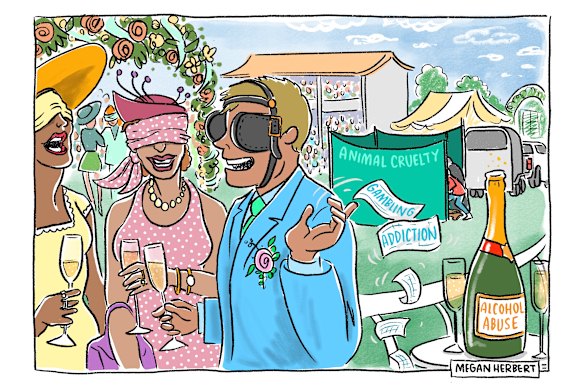
This paper’s reporting of the McKinnon Index shows a worrying lack of trust in the political system and politicians themselves (“Poll shows plunge in trust for politicians”, November 2). NSW voters will go to the polls on March 13. Between now and then we, the voters, have a great opportunity to engage in the process. Campaigning has begun. You will soon start seeing doorknockers and street stalls with your local candidates getting their faces out there and, if they’re smart, listening and responding to local people. I worked for a state politician for one four-year term and have been actively engaged in local campaigning for more than a decade. Two things amazed me. First, how few people engage with their local MPs and the day-to-day political processes. And second, how positive it is to chat to local people about local (or big) issues; sharing information and getting under the bonnet of sincerely held opinions and grievances. So if you would actually like to feel more engaged and connected, then look out for opportunities over the coming months to have an in-real-life conversation about issues that are of concern to you. You never know, you might walk away feeling more optimistic about our cherished democracy. It’s worth the time and risk, surely? Cathryn Callaghan, Croydon
The research foreshadows the need for a standalone subject of civics and citizenship in schools. Trust in democracy is based on knowledge and critical thinking. The 2027 NSW educational reforms provide only limited hours for topics with embedded principles of democracy. It is mandatory, but I suspect that chance learning is still a factor. We need to be more strategic about teaching our democracy if we want to entrench trust in its processes. Then all citizens will be skilled in critical thinking to bring political accountability. Anne Eagar, Epping
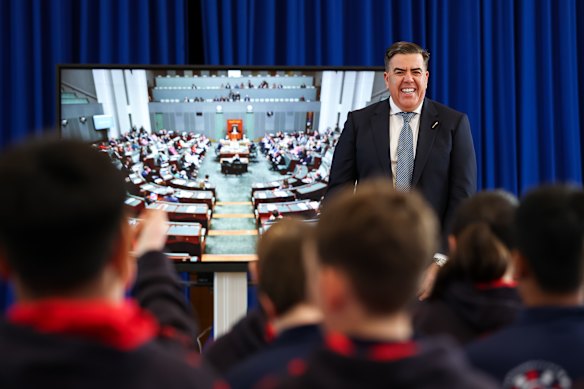
Even as the body she leads, the McKinnon Institute for Political Leadership, reveals an alarming dive in Australians’ respect for their elected representatives, Dr Susan Close presents a positive view (“Don’t let intimidation drive good people away”, November 2). More than 75 per cent of Australians “still believe democracy is preferable to any other system of government”, and more than 80 per cent “believe protecting it should be a priority”. Full marks to her organisation’s efforts to equip politicians with “the skills they need to govern well”. Given this era of polycrisis, there’s no lack of opportunity for the exercise of these skills. An outstanding instance would be if Prime Minister Anthony Albanese refused to cave in to the ogres of the AI industry and sell out Australia’s writers, artists, musicians and performers (“Tech’s national security case to gut copyright laws ‘is a bluff’”, November 2). Will he stand up for those who fire our imaginations? Will he play his part in rebuilding the nation’s trust in our political leaders? Only time will tell. Tom Knowles, Parkville (Vic)
Time to increase revenue
The commentary about the state of the federal budget is curious because it’s nearly all about spending. The latest is Finance Minister Katy Gallagher noting there are real pressures on the spending side that will be very difficult to avoid (“Search on for budget savings”, November 1). At present, and curiously, there is little or no commentary about revenue. If the prime target is a lower deficit and spending can’t be curtailed, then the only option is to increase revenues. The low-hanging fruit are an increase in the current GST and a 25 per cent tax on gas imports. The government is between a rock and a hard place because cutting essential services or increasing tax will both result in noisy criticism. Graham Hansen, Denistone
Your correspondent refers to the government as “a crew of socialists”. Really? (Letters, November 2). My understanding is that socialism is a political and economic philosophy embracing public or worker ownership of the means of production rather than private, corporate ownership. As far as I know, this cautious and unusually conservative Labor government has not nationalised anything lately nor returned corporate ownership to the workers. In fact, it’s recently been selling off public defence property and is retaining substantially privatised delivery of essential services such as childcare, aged care and the NDIS. It’s a centrist, pragmatic government committed to a capitalist economy. The use of the word “socialist” is rather like the scathing use of the word “woke”. Politically charged, inaccurate. Alison Stewart, Riverview
There seems to be a common opinion that the Commonwealth government could combat its spending excesses in part by raising the GST. It seems to be forgotten that raising the GST would require the agreement of all the states. And in any case, all the additional revenue would be distributed to the states unless they all agreed otherwise. So, of itself, a higher GST would be of no benefit to the Commonwealth unless it reduced other distributions to the states. And the states would surely just spend any additional funds anyway, thereby adding to inflationary pressures. Malcolm McCallum, Dulwich Hill
As your editorial says (“Governments must help RBA fight inflation”, November 2), we desperately need to address our budgetary problems. We do not want to follow Britain, France, Spain and Italy, countries that will soon face unwelcome visits from the International Monetary Fund (“The financial pain behind Europe’s riots”, November 2). Nor do we want fiscal policy working in opposition to monetary policy. Fortunately, we can address this problem by cutting expenditure and raising taxes. First, we should cut the NDIS (hint: pay more to the people who actually do the work, but cut out the middlemen who take two-thirds of the money). Second, close the loopholes used by multinationals to avoid tax. Third, insist on payment for our minerals and gas. And finally, tax retirement income properly. At present, a retired couple can have $4.2 million in superannuation (under the transfer balance cap). Last year, super earned 9.5 per cent on average, yielding earnings of $399,000 for the same couple – and this is entirely tax-free. Earnings on superannuation should be subject to income tax in the normal way, with a rebate during the accumulation phase. In retirement, all (and I mean all) people over 67 years of age should receive a higher tax-free threshold. This could be linked to the ASFA Retirement Standard for a “comfortable lifestyle”, which now stands (for home owners) at $78,998 a year for couples and $56,166 for singles. As a bonus, this could be done without disincentivising work. Indeed, some of the money saved could be used to lower income tax rates. Nicholas Reid, Hughes (ACT)
If the federal government sees the Reserve Bank’s setting of interest rates as a “blunt instrument” to try to limit inflation, a role it was presented with decades ago when governments felt it was political poison to do it themselves, why not hand the Reserve Bank the ability to set taxation policy. It wouldn’t be swayed by political repercussions and is likely to increase the nation’s revenue. Give the Reserve Bank more independent power to counter inflation so it isn’t squeezing the same people all the time. Mark Berg, Caringbah South
Give Greens due credit
Peter Hartcher was being a bit disingenuous in his “clever take-down” of and “colourful take” (Letters, November 2) on the Greens. He questioned their relevance, and claimed that Senator David Shoebridge failed to address any environmental policy in his first appearance at the National Press Club. What about the Greens leader voicing his support for a 25 per cent tax on gas exports? And saying that we need renewables, storage, electrification – but no new coal and gas? All very relevant environmental issues to me. Anne Wagstaff, Oatley
Given the odds and sods involved in both the current Coalition and in One Nation, a “government” by them, posited by your correspondent (Letters, November 2), will perhaps have the flavour “of Gina, by Gina and most definitely for Gina”. Tony Sullivan, Islington
Long-arms of the law a scary sight
The photograph of officers from the Armed Response Command, fingers on the triggers of long-arm assault rifles at Luna Park, was a most disturbing sight (“Post-Bondi policing costs $54 million”, November 2). I took my sons there regularly when they were little. It was a great day for us all. I am just thankful that they are grown men, and I do not have to explain such a horrible sight to them as little kids. Do the statistics and the reality justify this in Sydney? Evidence from countries where violence and murders are everyday occurrences leaves little doubt that loonies will always get through the net. I can’t help wondering whether it might be better to have trained undercover officers at high-risk venues. Has this been considered, or is that political power out of control? A man who I judged to be in at least his early 40s, who is training to be a policeman, brought me home recently. When he saw I live near the Emanuel School, we discussed the need for security guards at the entrances to carry guns, and for barricades along the footpath, restricting its use. We agreed that there is a justification for the guards to carry guns now – on hips in holsters, as they do – but that there was no need for them to do so 41 years ago, when the school opened in Randwick, nor was there a need for barricades back then. There is also a police presence. Ann Grant, Randwick
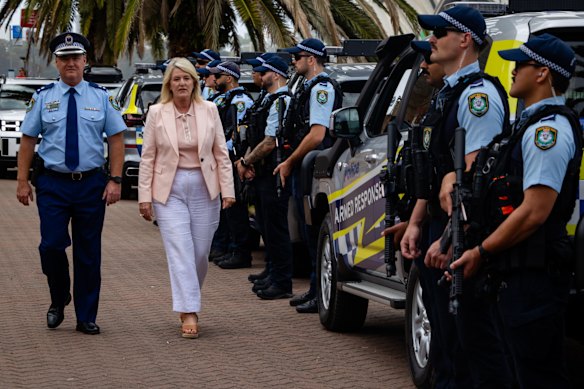
On Sunday, I saw police with long-arm rifles on patrol at Circular Quay. They did not make me feel safe. In fact, quite the reverse. Speaking to them, I discovered that a number of other people had made the same comment, and they rightly pointed out that they don’t make the rules. Criminals are smart enough to work out where these police will be on patrol, and plan to do their dirty deeds somewhere else. Maureen Partridge, Baulkham Hills
Consider the AI negatives
I hope businesses looking to replace human workers with AI are considering the broader implications of their decisions (“Inner-city workers at huge risk from AI”, November 2). If businesses across the economy make similar choices, how will this affect incomes and demand for their products and services? What happens to the economy if large numbers of people lose their livelihoods and we have more inequality and social unrest? And that’s ignoring the warnings from some of those closest to AI about its potential to wipe out humanity. Surely, it’s time for businesses and governments alike to look beyond the immediate commercial benefits and think about the bigger picture. Suzy Bessell, Cremorne
In Shane Wright’s article (“The existential risks the AI boom reveals – even to its investors”, October 31), he informs us that the Anthropic prospectus includes “that advanced AI systems could … pose catastrophic or existential risks to humanity, particularly if such systems were misused, replicated, weaponised, or allowed to operate with a high degree of autonomy”. You would think that any “catastrophic or existential risks to humanity” would be the product warning that takes it off the market. It seems not. There is insanity abroad. Katharine Maxwell, Rydalmere
Hitchcockian cliffhanger
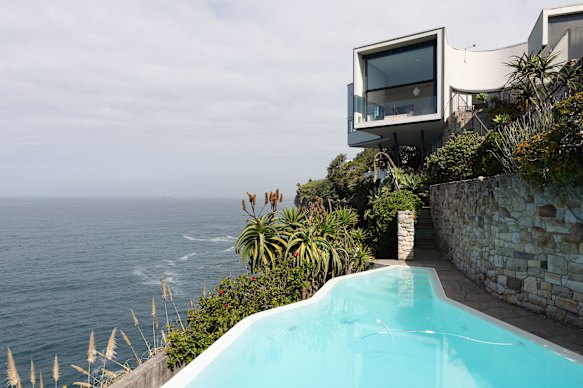
Quirky, not quintessential, the Holman House is drama personified, more Alfred Hitchcock, more James Bond 007 and Hollywood than Sydney, Australia, and the perfect location for a murder (“City’s most beautiful homes revealed”, October 31). It inelegantly flings itself outwards astride a 70-metre-high eroded retreating sandstone cliff. In stormy weather, it is battered by sea spray drenched in salt. On a visit to Sydney in 1962, English critic Dr Reyner Banham quipped, “The best thing about Australian architecture was the photography” in a clear reference to Max Dupain. Houses are much more than photographs, visual excitement wears thin over time, Holman has character in spades, but to live there day after day? Were he alive today, an astonished Robin Boyd would not hesitate to call it the epitome of Austerican. Philip Drew, Annandale
Roof won’t fall in
Lower house prices are exactly what most of us want and indicate success by our government (“Homes lose $9000 a month as RBA mulls rate increase”, November 2). As a home owner and Baby Boomer, I want to see younger people able to afford to buy a home of their own, not to be locked out of the housing market. My own home is therefore worth less, but I don’t care, as it’s still comfortable for me to live in, which is the only valid reason to own it. Judy Christian, The Ponds
Lame duck’s swan song?
With the US midterm elections imminent, we will soon know how accurate Daniel Hannan’s devastating indictment of Trump’s failings are (“Trump has passed the point of no return, and midterms are the beginning of his end”, November 2). The dictatorial Trump’s egregious relationships with Putin, Netanyahu and even North Korea, his role in the smashing of life and property in the Middle East and failure to end the war there, his economic incompetence, needless aggravation of Canada, churlish response to not winning the Nobel Prize and a great deal more have been exposed frequently in the Herald’s pages. It ought not be forgotten that Trump’s fomenting of the attack on the Capitol in 2021 resulted in loss of life, injury to innocents, looting and vandalism. That he got away with it has been to the detriment of the United States’ democratic allies and many of its citizens. He is unlikely to accept defeat in the midterms but, as Hannan argues, his propensity to wield so much power might, hopefully, be coming to an end. Ron Sinclair, Windradyne
There’s a kind of hush, all over the world, tonight. Jon Fogarty, North Avoca
By Wednesday (AEST), I hope to find America has done the right thing and turned President Donald Trump into President Donald (lame) Duck. Phil Bradshaw, Naremburn
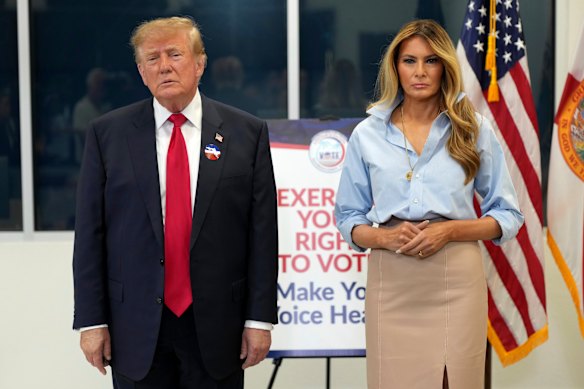
The ceasefire brokered by Melania Trump in Oleshky, Ukraine, has brought some welcome relief, enabling many trapped civilians to be evacuated to safety (“‘We are coming from hell’: Ukrainians celebrate after escaping kill zone”, November 2). Melania’s husband would surely be thrilled if her actions resulted in Melania being awarded a Nobel Peace Prize. Dick Pollitt, Mosman
Handy man
Sharon Howe has thrown down the gauntlet (Letters, November 2). My husband doesn’t praise my cooking; he does it all himself, including shopping for ingredients without needing me to write him a list. He also does most of the other myriad domestics around the house. He’s a fabulous handyman, and years ago we shared the parenting of our young children. I challenge anyone to come up with a better model. Margaret Grove, Concord
- To submit a letter to the Sydney Morning Herald, email letters@smh.com.au. Click here for tips on how to submit letters.
- The Opinion newsletter is a weekly wrap of views that will challenge, champion and inform. Sign up here.
Disclaimer : This story is auto aggregated by a computer programme and has not been created or edited by DOWNTHENEWS. Publisher: www.smh.com.au