Most of Germany’s Gen Z protests on Saturday were peaceful, but serious disorder in several cities dominated the headlines.
Tens of thousands of people took to the streets across Germany at the weekend under the banner of Gen Z regelt.
Most demonstrated peacefully, but disorder erupted in several cities later on. Violent incidents were most notably centred in Frankfurt, while confrontations also occurred in Cologne, Hamburg, Berlin and Stuttgart.
Here’s a look at what we know about who was involved, how serious the violence was, whether police tactics were proportionate.
Peaceful protests, violent aftermath
The broad pattern at Saturday’s protests was peaceful protest followed by disorder in a smaller number of places.
In Berlin, the main Gen Z regelt gathering at the Brandenburg Gate was attended by about 5,000 people and passed “almost without incident” according to police.
Munich’s demonstration was also largely peaceful, as were those in cities including Dresden, Chemnitz, Hanover, Rostock and Kiel.
Berlin also illustrates why events should not be lumped together. Later unrest there centred on a separate demonstration called Gen Z hat genug!, which reportedly had no connection to Gen Z regelt.
The distinction was less clear-cut elsewhere. In Frankfurt, Cologne and Stuttgart, demonstrators wearing masks, firing pyrotechnics and attacks on police were reported during or near to official gatherings before disorder intensified.
Under German law intentionally concealing your identity at an outdoor protest is a criminal offense.
In total, more than 180,000 people were said to have registered for demonstrations in over 30 cities on Saturday. But organisers Gen Z regelt later estimated national attendance at between 100,000 and 120,000.
Protest researcher Nina Kolleck told Tagesschau that warnings about violence probably deterred people, as did the decision by the Federal Student Conference (BSK) not to mobilise.
BSK deputy secretary-general, Erik Sczygiol, told ZDF that uncertainty about the decentralised organisers and the absence of one defining cause had also played a part.
How serious was the violence?
Frankfurt arguably experienced the worst disorder.
According to police and Hesse’s Interior Minister, Roman Poseck (CDU), 17 shops were damaged and five looted. Two blank-firing guns (Schreckschusswaffen) from a gun shop were stolen and later recovered.
According to Poseck, police made 54 arrests and more than 100 officers were injured.
READ ALSO: Inside Germany – Gen Z protests, Left Party scandals and the AfD email leak
At the same time, Frankfurt police operations commander Erik Hessenmüller said the “vast majority” had demonstrated peacefully and that the protest should be distinguished from what followed.
Tagesschau also reported attacks on officers and later disturbances in Hamburg, Bremen and Stuttgart. In Nuremberg, police said a violent group of 100 to 150 had mingled with roughly 2,000 peaceful demonstrators.
Cologne saw clashes, property damage and later violence around the cathedral and railway station.
The boarded shopfronts and warnings before Saturday were not wholly baseless, in other words, but nor does the available reporting support the impression of nationwide chaos.
Were police too aggressive?
Whether the police response was heavy-handed remains contested, particularly in Cologne.
According to taz, the planned march there became a stationary rally following lengthy negotiations between police and organisers. Police said only a stationary rally had been registered, while organisers disputed this.
The newspaper reported that flares and smoke bombs were subsequently set off in one part of the crowd. It also described an aggressive police response. A water cannon and riot-control vehicle reportedly pushed protesters closer together, while helmeted officers charged with batons drawn towards people who had already moved from the road onto the pavement.
Taz reported that the crowd included young people and parents with children.
The rally organiser, 18-year-old Lysianne Mondry, told the newspaper that she ended the event at about 4pm, after police warned that she could otherwise be held legally responsible for violence.
READ ALSO: Politicians slam violence that followed Germany’s ‘Gen Z’ demos
Police spokesperson Sascha Walmeroth disputed this account, saying the organiser had ended the event on her own initiative.
Police later established two containment areas. According to taz, roughly 600 people were held in one and about 100 in another until their identities had been recorded.
The paper reported that only one arrest had been made by late afternoon and that one officer was unable to continue working because of a hand injury. Those figures covered the daytime operation, not the later disorder around the cathedral and elsewhere in Cologne.
Migration enters the argument
In Frankfurt, the daytime march of up to 8,000 people (according to police estimates) had been largely peaceful, although it was stopped repeatedly because of masking and pyrotechnics before police dispersed it near the Konstablerwache.
Later, police said mobile groups moved through the city centre, attacking officers, erecting barricades and damaging or looting shops around the Zeil shopping street. Police arrested 54 people and more than 100 officers were reportedly injured.
Among politicians, it didn’t take long before the debate shifted towards the backgrounds of those allegedly responsible.
Poseck described the troublemakers as predominantly from a “migrant background”, while Federal Interior Minister Alexander Dobrindt (CSU) blamed “violent left-wing groups” and “troublemakers from the migrant community”.
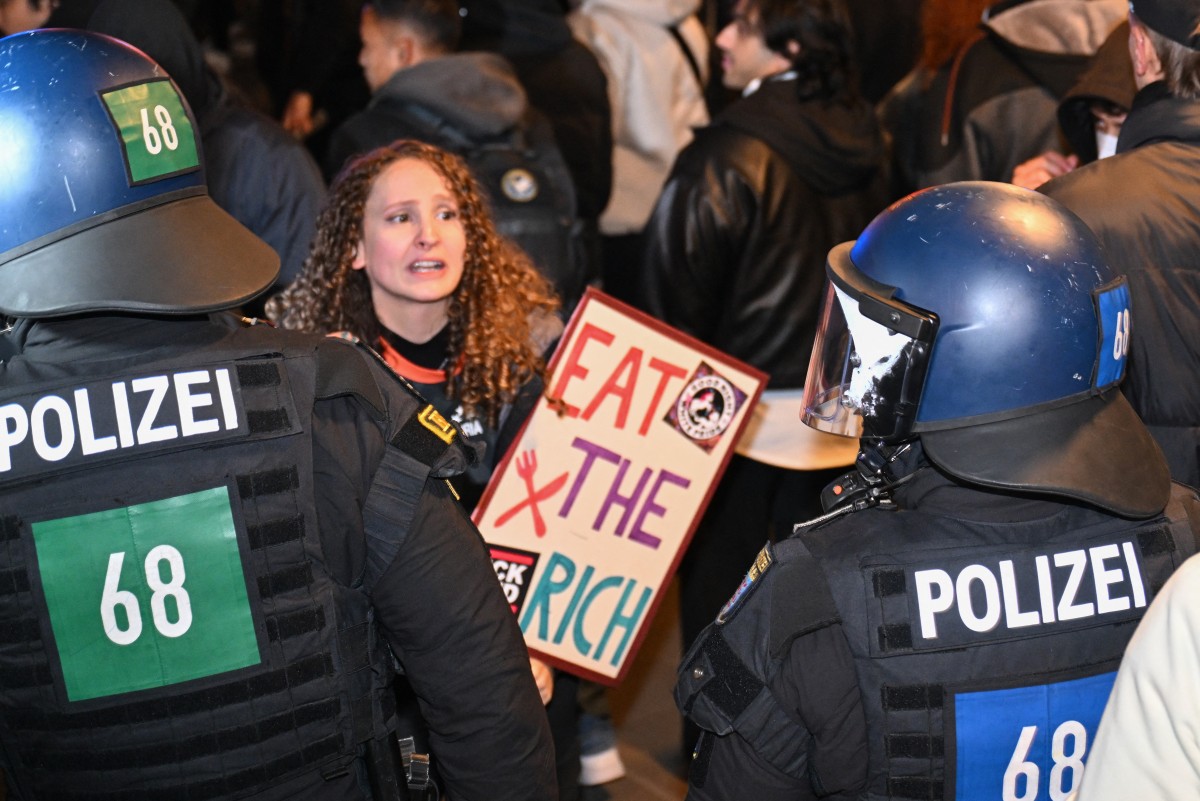
A woman holds a “Eat the Rich” placard as Riot Police clear a street blockade after a demonstration organised by “GenZ regelt!” in Frankfurt am Main on October 31, 2026. (Photo by Kirill KUDRYAVTSEV / AFP)
READ ALSO: German rioters loot shops as ‘Gen Z’ demos turn ugly
But most of those arrested in Frankfurt were residents of Hesse or surrounding states, while police reported no evidence that any offenders had travelled from abroad.
Defence Minister Boris Pistorius (SPD) challenged the terminology used by Dobrindt, asking whether “migrant groups” included German citizens and people whose families had lived in the country for three generations.
Frankfurt Mayor Mike Josef (SPD) added that many of the police officers and emergency workers who protected the city had migration histories.
Has anyone heard what the protesters were saying?
The core team behind Gen Z regelt consists of five people, according to Tagesschau, three of whom wish to remain anonymous because of concerns about their personal safety.
The Federal Student Conference cited this unclear structure when explaining why it stayed away, along with concerns over possible disorder and uncertainty about who might participate.
But while the organisation behind the protests remains opaque, the demands are not mysterious. The initiative calls for more funding for education, addiction treatment and psychotherapy; affordable living costs; fairer burden-sharing; stronger climate action; limits on surveillance; and opposition to compulsory military service.
Federal Education Minister Karin Prien (CDU) described these concerns as “legitimate and extremely relevant”. She said educational success in Germany remained too dependent on background and promised deeper dialogue with young people.
SPD politicians called for a national education summit, while Green Party leader Franziska Brantner said the federal government must respond.
Junge Union leader Johannes Winkel accused politicians – including his own CDU – of neglecting the younger generation.
So far, however, these are acknowledgements and proposals rather than implemented policy changes.
The political response has also included talk of tougher policing and possible restrictions. For example, Hesse’s Interior Minister Roman Poseck questioned whether another demonstration should be permitted in Frankfurt.
Gen Z regelt is now calling for actions at schools and universities and plans to join an international youth strike on November 20th.
Disclaimer : This story is auto aggregated by a computer programme and has not been created or edited by DOWNTHENEWS. Publisher: thelocal.de