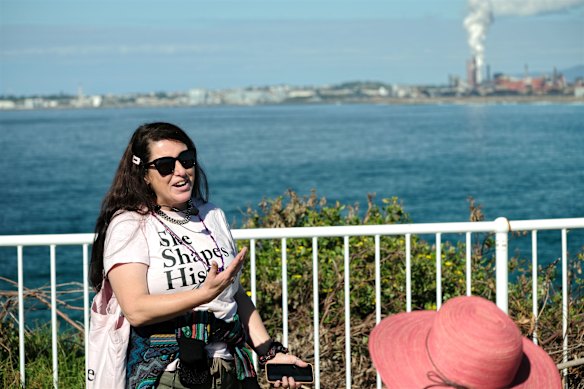

The first clue that this walking tour isn’t like any I’ve done before comes at Flagstaff Hill Lighthouse, Wollongong’s best-known landmark.
While tourists pose for photos, our guide Lindsay Burlton from She Shapes History leads us to a guard rail overlooking the ocean below.
“This is the second-oldest rock pool in NSW, possibly Australia,” she says, pointing out a rough-edge pool tucked against the base of the cliff. “Built in 1839 by convict labour, it was constructed specifically for women.”
Blow me over with a beach umbrella. I’ve been walking past this lookout for years, yet I’d only ever heard rumours of the Chains Bath, named for the iron chains that swimmers would hang onto when the ocean was particularly rough.
While a private pool sounds like a generous gift, Burlton explains that colonial officials were seeking stability among their male-dominated population and needed a way of attracting women to the area.
Sign up for the Traveller Deals newsletter
Get exclusive travel deals delivered straight to your inbox. Sign up now.
It’s difficult to imagine anyone making the descent, let alone in heavy Victorian clothing.
“It’s such a significant space for women in Wollongong’s history and yet it is completely unacknowledged. There’s no signage, nothing here telling the story,” says Burlton. “It’s an interesting parallel to women’s history in general.”
And that’s why She Shapes History was created – to uncover the hidden stories of women who helped shape our cities. It was founded in 2021 by Sita Sargeant and its tours include the Badass Women of Canberra, Melbourne, and Sydney. The Wicked Women of Wollongong is the latest instalment in the series of walking tours.
“I launched She Shapes History out of sheer frustration – and grumpiness – at how little recognition women’s historical contributions received in my home town of Canberra,” says Sargeant.
“I kept thinking, if we can’t even acknowledge the women who shaped our own cities and made us who we are, how are we ever going to respect them and their contributions today?”
Our next stop looks south along the beach towards the Port Kembla Steelworks, where a forest of chimneys rises above the shoreline. Here Burlton tells us about a group of iron-willed women who, in the 1980s, took BHP to the Equal Opportunity Tribunal – and won.
“The landmark victory became the biggest sex discrimination case in Australia,” she says. “Their determination changed the face of industrial relations forever.”
Just off Crown Street, we duck down the Ethel Hayton Walk, a laneway filled with ever-changing public art in the heart of the city’s arts precinct.
“A professional journalist, Hayton was wildly determined and completely committed to reshaping Wollongong from a coal city to one of arts and culture,” says Burlton. “Her contributions include the Wollongong Conservatorium of Music, the Wollongong Art Gallery, and even the Steinway concert grand piano in the Town Hall.”
Other remarkable stories include that of hotelier Hilda Condon, who used her ingenuity to help local inventor Evelyn Owen get the prototype for the Owen Gun – Australia’s most successful wartime weapon – into a manufacturer’s hands. And then there was Aboriginal rights campaigner Pearl Gibbs, who helped establish the Aboriginal-Australian Fellowship – a key force behind the successful 1967 referendum.
We finish on Crown Street Mall, the site where community activist Sally Bowen was central to bringing eight diverse groups together for Wollongong’s first International Women’s Day march in 1979. “They came as a coalition, marching hand in hand, waving signs and beating drums,” says Burlton. “‘Creative disorder’ they called it.”
A major triumph, it ultimately secured funding for the Wollongong Women’s Centre.
Despite living here, I knew very little (next to nothing) about these courageous women. Thanks to She Shapes History, they are finally being given the recognition they deserve.
Sargeant plans to take her tours to other Australian and international cities.
“My long-term vision is to completely transform how people think about history,” says Sargeant. “I want She Shapes History to be on the agenda wherever you travel because you want to see a city differently, understand what actually went into making it, and meet the women behind it.”
 Kerry van der Jagt is a Sydney-based freelance writer with expertise in Australia’s Indigenous cultures, sustainable travel and wildlife conservation, and a descendant of the Awabakal people of the mid-north coast of NSW.
From our partners
Disclaimer : This story is auto aggregated by a computer programme and has not been created or edited by DOWNTHENEWS. Publisher: www.smh.com.au