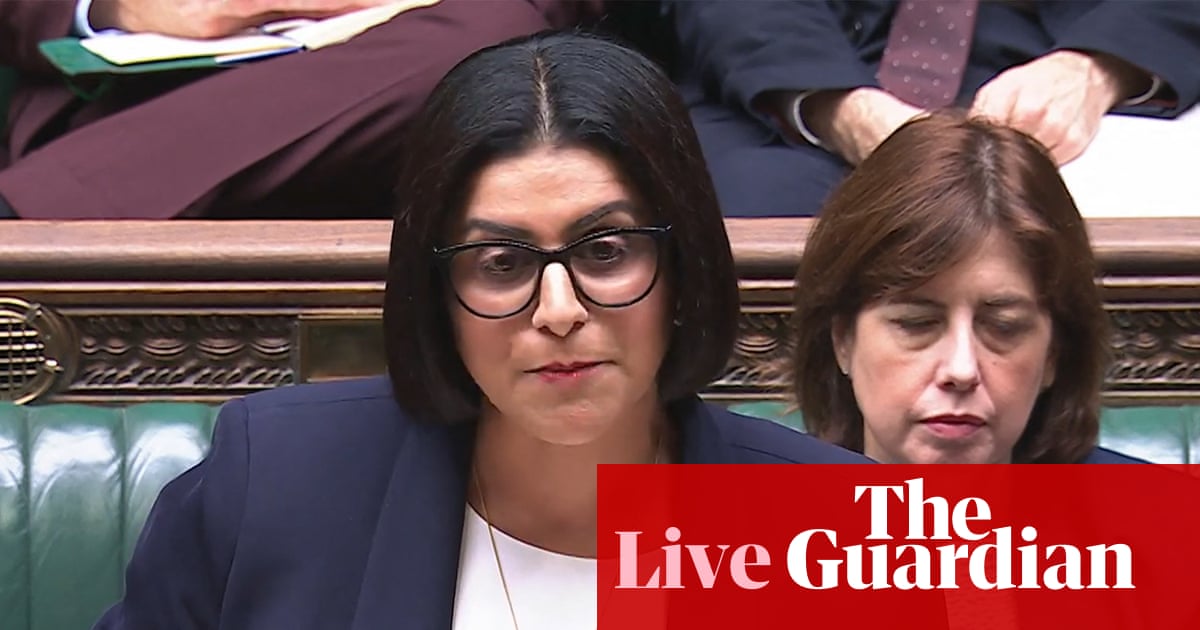
This announcement deserves recognition, but it cannot be the end of the story. We need protections that work in practice, certainty for workers and their families, and a system that allows care providers to retain the people our communities rely on every day.
But business organisations like the CBI expressed concerns (see 5.39pm), and charities were outraged by the proposal for some refugees to be made to wait up to 30 years for indefinite leave to remain (see 5.47pm). The Law Society also condemned the plans. Its vice president, Dana Denis-Smith, said:
The home secretary’s decision to change pathways to settlement retrospectively undermines the legal certainty that individuals, families and employers rely on. For those already on the path to settlement, the government decision to change the rules which people relied on when making important decisions about their future is unjust.
She also suggested the rules for refugees contravened the Refugee Convention.
Extending the qualifying period from five to 20 or even 30 years, for those that have no choice but to enter through unsafe means, backtracks on promises the UK has made under the Refugee Convention 1951 to help those seeking protection to integrate and build a new life. This obligation applies to all refugees, regardless of how they arrived.
Pippa Crerar and Kiran Stacey discuss the issue in the latest episode of the Politics Weekly UK podcast.
For a full list of all the stories covered on the blog today, do scroll through the list of key event headlines near the top of the blog.
The TUC has welcomed Shabana Mahmood’s decision to revise her plans. In a statement, Paul Nowak, the TUC general secretary, said:
This is a welcome rethink from the home secretary and shows the government has listened to care workers and their unions on key concerns.
Migrant care workers do valuable and essential work in our care sector. They work around the clock to provide care for our loved ones and keep the sector running – after recruitment and retention crises caused by years of underfunding.
That’s why it is important that the government has changed course. But this policy must now be put into place fairly.
We need a sector wide visa so workers can change employers, rather than having to put up with abuse, poor conditions and exploitation.
Sunder Katwala, director of British Future, a thinktank focusing on immigration, race and identity, has said that, in the light of its announcement today, the government should be more robust in confronting people calling for migrants to be deported. In a statement he said:
There may be no flagship government policy that has changed quite as much as this one as a result of public consultation. Those changes mean many thousands of people, anxious about losing legal status, will now have a pathway to settle in Britain.
Behind this complex policy debate is a political argument about whether people who have come to Britain should be allowed to stay and settle or not. The government has sided with the argument for settlement and integration. It will now need to make the case more publicly against opponents who are still voicing a politics of ‘send them all back’.
Britons are more likely to support (47%) than oppose (35%) making most migrant workers wait longer before they can apply for ILR, according to polling by YouGov.
Charities working with refugees have strongly condemned Shabana Mahmood’s proposal to make some of them wait up to 30 years for settlement. (See 4.25pm.)
Imran Hussain, executive director of external affairs at the Refugee Council, said:
Refugees are being asked to rebuild their lives on a status that expires every 30 months for what could be 30 years. That is unfair and unworkable.
These plans condemn refugees to decades of deep insecurity, unable to lay down roots in Britain and contribute their potential. And there is no evidence to suggest that harming refugee integration will act as a disincentive to refugees fleeing the Taliban or brutal conflicts like Sudan. It also creates another bureaucratic nightmare for a Home Office that already is struggling with poor quality initial decisions on asylum cases which is leading to avoidable costs and delays in the appeals system.
And Flora Alexander, executive director of International Rescue Committee UK, said:
A route to settlement that takes up to 30 years means people will be left in limbo for more than a third of their lifetime. Those who have fled conflict and persecution should have the chance to rebuild their lives, not put them on hold for decades.
Nigel Farage, the Reform UK leader, has said that anyone getting indefinite leave to remain (ILR) before the next election as a result of the plans announced today could lose it if be became PM.
He was not in the Commons for the announcement. Instead, he held a press conference where he said this was “a very major U-turn”. He went on:
Normal countries don’t give out work visas, allow you to bring dependents, automatically give you indefinite leave to remain, and then one year later citizenship. We are uniquely stupid in doing this, and we’ve been uniquely stupid in doing this for far too many years.
Our position is very, very clear: Anybody under this scheme that’s been opened today, and I believe today is just the opening of the door, anybody that goes through to ILR and citizenship under this scheme, we will review each and every single one of those citizenships if they are granted.
The CBI, one of Britain’s main business organisations, has suggested that Shabana Mahmood’s concession on care workers today means the rest of the measures announced might not be needed.
In a statement, Matthew Percival, the CBI’s future of work director, said:
Today’s announcement on settlement rules rightly recognises the importance of fairness and the contribution migrant workers make to the UK. But the decision to exempt health and social care workers fundamentally changes the case for the wider policy.
These proposals were introduced in response to a temporary spike in health and social care visas. If those workers are now outside the policy, the government should reconsider whether the remaining changes are still justified. Otherwise, the result risks being higher costs for the relatively small number of businesses using skilled worker visas, without addressing the problem the policy was originally designed to solve.
In the Commons, the first Conservative backbencher to speak in response to Shabana Mahmood’s statement was Edward Leigh. He accepted that the Conservatives were at fault in allowing immigration to soar when they were in office. In a jibe at the shadow home secretary, Chris Philp, he said that “some of us don’t have amnesia” and that “anybody who was serving as a Home Office minister at that time should wear sackcloth and ashes”.
Here is the list of “public service” jobs where foreign workers will continue to be able to apply for ILR after five years, as now, instead of having to wait 10 years, which will be the new norm. Anyone earning more than £50,271 will automatically be in this category. But people earning less than that will be included if they are doing one of these jobs.
You will notice that care workers are not on the list.
Under the plans announced last year, care workers were going to be in a special category where they were going to have to wait 15 years for ILR (because of their low income). That idea has been abandoned, and instead they are covered by the new, 10-year norm. (See 4.39pm.)
But Mahmood has announced what she is calling “transitional arrangements” that will apply to most care workers. (See 4.11pm.) The Home Office says:
Care workers who entered, or switched into, the route before publication of the immigration white paper in May 2025 will retain the existing five-year qualifying period for settlement where they meet the applicable salary (£25,000 a year), sponsorship and employment requirements. They will also need to meet the strengthened minimum requirements that will apply generally under earned settlement, including on criminality and English language, unless an exemption applies.
Care workers who arrived before May 2025 who do not meet these criteria will instead be given the chance to apply for a second, five-year visa. (See 4.11pm.)
Labour’s Diane Abbott told Mahmood she was in danger of creating another Windrush scandal. And she complained about the changes being retrospective. She said:
It is right that care workers are exempted from the new arrangements for [indefinite leave to remain]
But for the rest of the workforce, the retrospective nature of these new arrangements still seem to be unfair because you can come in legally, you can work legally and then have your residency rights turned upside down. How can that be fair?
Mahmood said she did not accept that the changes were retrospective.
On indefinite leave to remain and what she calls the retrospective nature of the changes, she will know I do not agree with that characterisation of those changes.
Any government needs to be able to make changes to immigration rules to reflect things that are happening, to reflect abuses that we can see in the system, to also be able to make additional changes based on assessment of numbers and costs.
Chris Philp, the shadow home secretary, responded to Mahmood on behalf of the Conservatives. He claimed she had performed a U-turn that would cost £10bn. (See 11.44am.)
The home secretary now proposes to allow every single care worker and their dependents who arrived prior to May 202 – a number running into hundreds of thousands – to stay in this country to stay in this country beyond the expiry of their visa, and in the case of 75% of them to stay permanently
How is it she can justify allowing people that she acknowledges arrived here fraudulently [to] stay forever, at a cost that she herself has admitted costs £10 billion? That is the cost. That is the cost of today’s U-turn.
Mahmood said her plans would save money, and lead to 500,000 people getting settlement later than planned. She said:
The cohort most likely to impose a cost will now, as a result of my measures, wait longer for settlement.
And that is why the [Department for Work and Pensions] say that these measures will save billions in the benefits bill.
And half a million people, 500,000 people, will settle later as a result of these reforms.
The Home Office has now published its new policy paper on earned settlement.
And here is its summary of the new rules.
And here are the rules for refugees.
Here is Rajeev Syal and Jessica Elgot’s story about the ILR announcement.
Disclaimer : This story is auto aggregated by a computer programme and has not been created or edited by DOWNTHENEWS. Publisher: theguardian.com