
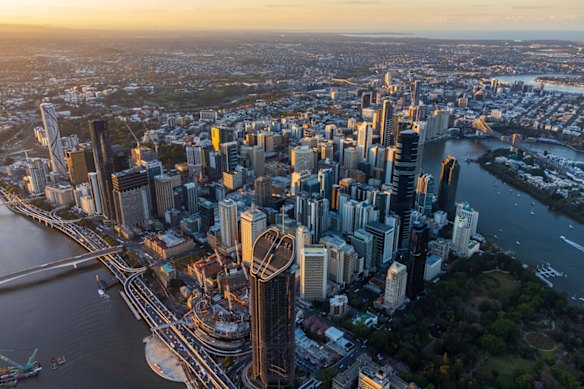
More than 40 per cent of the tasks performed by workers across Brisbane are vulnerable to AI automation, new analysis shows.
But researchers say that figure would rise to about 45 per cent with closer analysis of Brisbane’s CBD and inner suburbs, including South Brisbane, Fortitude Valley, Newstead, Milton and Spring Hill, where knowledge-intensive services such as finance, professional services, and information technology are concentrated.
The Gold Coast is the second most vulnerable area to AI automation in Queensland, the report by consultancy SGS Economics and Planning reveals, despite the city’s prevalence of jobs in tourism, hospitality and construction, which require a physical presence.
At least 37 per cent of tasks performed by workers on the Gold Coast are exposed to AI disruption, according to the report.
In Logan and Ipswich council areas, where a high share of workers are employed in retail, hospitality services and transport, the figure falls to 35 per cent.
That correlates with data showing that the most common job in the Logan suburbs of Kingston, Marsden and Park Ridge is a storeperson (someone who receives and sorts goods in a warehouse), while the inner suburbs of Bulimba and Newstead are dominated by sales and marketing managers.
It reflects a broader trend that the share of tasks vulnerable to AI automation declines with distance from capital city centres, and in the case of Queensland, also illustrates how connected the economies of Brisbane, the Gold Coast and Sunshine Coast are.
This is a departure from previous waves of economic disruption, especially the automation and outsourcing of manufacturing activities in the 1980s and 1990s, which hit employment in outer suburbs and regional areas hardest.
Alison Holloway, a partner at SGS Economics and Planning and the report’s co-author, noted the data for south-east Queensland was skewed by the size of the Brisbane City Council area.
Council areas in Sydney and Melbourne are much smaller by comparison, enabling a more granular analysis of inner-city suburbs with a high concentration of knowledge-economy jobs.
But Holloway said Brisbane’s professional heartland in the CBD was no less vulnerable to AI disruption than the city centres of Sydney and Melbourne, where 45 and 44.5 per cent of work tasks are at risk of automation, respectively.
“What we’re seeing in other capital cities is that city-based professionals in finance, technology and business services are most likely to see their jobs change, and these jobs in Brisbane are typically located in the inner parts of the local government area,” she said.
But AI innovation expert and the director of Griffith University’s Data Trust, Professor Dian Tjondronegoro, said the infrastructure demand and economic momentum ahead of the 2032 Olympic Games was creating some “breathing space” for Brisbane.
“I would say Sydney and Melbourne will have arguably higher exposure to AI disruption, because of the nature of the knowledge-based industries there,” he said.
“In Brisbane, we’re not that far behind, but our saving grace, if I may use that word, is the infrastructure work leading up to Brisbane ’32.”
He said Brisbane should seize upon the years before the Olympics to prepare for the ways AI automation will change work patterns.
“We need to remember that it is not about us being replaced by AI, but how people can work smarter and more efficiently with AI,” he said.
“To rehire is a lot more expensive than to reimagine a new way of doing things with AI,” he added, noting that last year Google rehired a swathe of software engineers it had made redundant two years earlier.
Research by the Department of Industry’s Office of the Chief Economist published in July found no evidence of broad labour market upheaval from AI in Australia, although employment in occupations more exposed to generative AI has grown more slowly than others.
Holloway said the effects of AI automation would have a “different spatial pattern” to previous economic transitions caused by technological change.
“Earlier waves of automation took on routine, manual tasks, so their effects were felt most in manufacturing suburbs and farming regions,” she said.
“AI can now take on parts of the cognitive work done in offices, and those jobs are concentrated in the professional heart of our cities.”
The analysis measured the exposure to AI automation of work tasks, not the probability of jobs disappearing altogether.
“In the past we’ve seen the closure of mines and things like car manufacturing, which has impacted whole communities, but this is now a different part of the economy and different locations that will be more affected,” Holloway said.

From our partners
Disclaimer : This story is auto aggregated by a computer programme and has not been created or edited by DOWNTHENEWS. Publisher: www.smh.com.au



