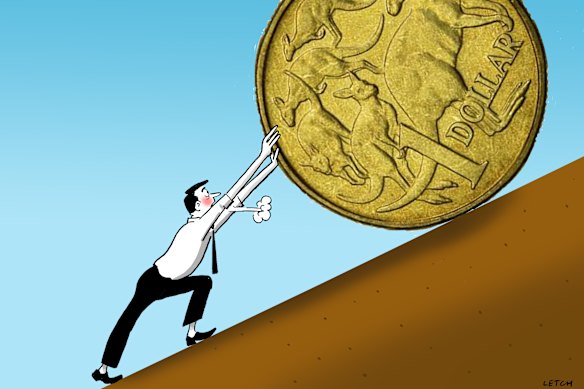
“What do they know that I don’t?” This is an unspoken question I often hear in conversations with people who are working to better their financial positions.
There is a curiosity about how people who are further ahead got there. What do they know? What did they do? Did they just get lucky? Sometimes, yes. But often, I find there are some fundamental differences in how people who are good at building (and keeping) wealth think about money compared with those who struggle. Here are some of those core differences:
More leverage, not more effort
You might have heard people talk about “leverage” in the context of property – that is, one of the major benefits of property over shares is that you can use leverage (borrow money from a bank). I’m talking about it in a bigger context though – not just loans.
So, what is leverage? In a sense, it’s anything – a tool, device, system – that can help you get more results (outputs) with less effort (inputs). If you lift a suitcase, it’s heavy. But put some wheels on it – and suddenly, it moves easily. The wheels give you leverage.
In a financial sense, there are many forms of leverage – automating your savings so you don’t have to manually keep on top of expenses; organising your cashflow into a streamlined system so you don’t need a budget; investing in assets so you don’t have to rely solely on your ability to earn an income; and using debt to grow wealth faster than you could alone.
The hard work is convincing yourself to stop chasing after the short-term fix, and start working on the long-term fix.
Leverage makes it possible to grow easier and faster than if you relied on your personal effort alone.
But this takes a shift in mindset. If you’ve been taught that success is dependent on more effort, then your automatic assumption will be: you need to put in more effort to get ahead – which might feel like an unattractive and even impossible option if you’re already exhausted by how hard you work. In reality, you need more leverage, not more effort.
Money is abundant, not scarce
There isn’t a limited supply of money. If you have $10,000 in the bank, that doesn’t stop someone else from also creating or having $10,000. Your having money does not somehow take away from someone else’s ability to also have money.
However, without realising it, many people tend to have a default assumption of scarcity – for example, I don’t have enough, there isn’t enough, there is a limited amount. You might also have beliefs that help you justify that experience of scarcity – for example, this is just how things are for people “like me” (people in my profession/with my educational background/with my challenges, etc).
So, you unconsciously keep making choices that keep you stuck in scarcity because you assume this is simply “how life is” and “how things are” – this is “normal”.
But think about how differently you would show up if your default assumption was: “There’s an unlimited supply of money out there, and anyone can learn how to access more of it – including me.” That opens up a whole new world of opportunity and possibility.
Making money v building wealth
Money was designed as an exchange of value. It is, effectively, a better version of bartering – instead of trading two sheep for one cow, you use money.
This means, it was never designed to be “kept”. It was designed to be spent. That’s why it loses value over time (thanks to inflation). Once, you could buy a car for a few thousand dollars; now, it’s tens of thousands. So, no matter how much you earn, it never feels like enough.
However, assets are a “store” of value – gold, real estate, stocks, they all have some characteristics that make it likely that they will increase in value over time. So, when you buy assets, you don’t have to run to keep up – the assets will grow on their own over time.
The analogy I like to give is: apples (money) v apple trees (assets). You can collect a tonne of apples, but they will eventually expire. But when you grow an apple tree, it will be slow at first, but over time, it will bear enough fruit that you won’t ever have to chase after apples again.
So, the hard work is convincing yourself to stop chasing after the short-term fix (more money), and start working on the long-term fix (building wealth by investing in assets). This can be difficult because (like all good short-term fixes) more money feels great in the moment, but then (again, like all good short-term fixes), you always need more.
The only way to get off that hamster wheel of chasing more is to stop chasing money and start building wealth.
Paridhi Jain is a money and mindset coach who combines practical strategies with mindset transformation to help clients create more freedom and fulfilment in wealth, work and life. Find Paridhi at: skilledsmart.com.au.
- Advice given in this article is general in nature and is not intended to influence readers’ decisions about investing or financial products. They should always seek their own professional advice that takes into account their own personal circumstances before making any financial decisions.
Expert tips on how to save, invest and make the most of your money delivered to your inbox every Sunday. Sign up for our Real Money newsletter.
 Paridhi Jain is a money and mindset coach who combines practical strategies with mindset transformation to help clients create more freedom and fulfillment in wealth, work, and life.
From our partners
Disclaimer : This story is auto aggregated by a computer programme and has not been created or edited by DOWNTHENEWS. Publisher: www.smh.com.au