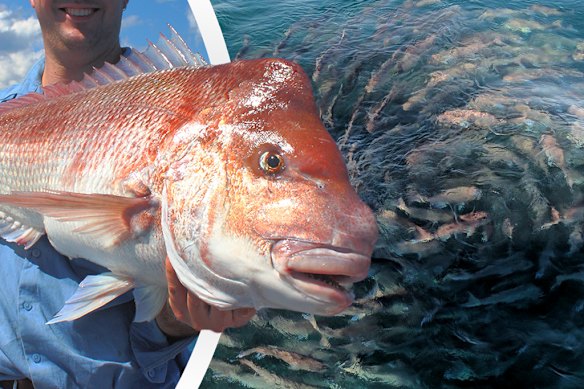

Recreational fishers will be able to fish for species including snapper and dhufish off the West Australian coast when a controversial ban lifts in September next year, but where they drop a line will be highly restricted and fishing will be restricted to winter months under changes flagged in an inquiry into the ban on Tuesday.
Late last year, the Cook government indefinitely banned commercial demersal fishing from Augusta to Kalbarri and demersal trawling in the Pilbara to tackle low stocks of beloved WA species. Recreational fishing for demersal species was banned until September 2027.
Department of Primary Industries and Regional Development top brass faced an Environment and Public Affairs committee inquiry into the ban on Tuesday, where one Fisheries boss revealed what recreational fishing of the popular species would look like after the ban.
In response to a question from committee chair Sandra Carr about what rules would apply to recreational demersal fishing beyond September 2027, Fisheries and Aquaculture executive director Nathan Harrison said: “It cannot go back to the way that it was.”
“If fishing is going to commence for the recreational sector, the critical discussion then becomes around what is the sustainable benchmark that you could apply to the recreational fishery to allow that fishery to continue to recover,” he said.
Harrison said prior to the ban, the commercial catch was between 220 and 240 tonnes of fish, while the recreational sector was catching around 220 tonnes as well.
He said the total tonnage of fish being caught needed to be less than 100 tonnes annually to ensure the species continued to recover, but he understood that would be challenging given there were 130,000 licensed recreational fishers in the state – and 30,000 of those caught demersal fish.
“When you look at 30,000 people, 100 tons is actually not many fish,” he said.
Harrison flagged seasonal closures – likely in the warmer months – would be used to keep this catch down.
“The window of fishing that’s available to the recreational sector when it does reopen would have to be fairly small to allow that catch of 100 tons,” he said.
“To try and avoid the key spawning times for dhufish and pink snapper, which traditionally spawn over the summer months … you may have a limited winter fishery to manage that catch to 100 tons.”
Harrison also reiterated there would be mandatory reporting for the recreational sector requiring fishers to report their catch as soon as they got back to the boat ramp.
The ban was met with backlash from the commercial fishing sector, which questioned the science behind the ban, saying anecdotally it did not match what they were seeing on the water.
Commercial fishers also criticised the compensation on offer from government for their licenses, which the Cook Government budgeted $20 million for.
During the inquiry, the committee heard 13 commercial fishers had negotiated a deal with the government to buy back their licenses, 13 more negotiations were under way, and 27 more had opted to launch a class action against the government.
About $6 million of the fund has been spent so far.
The issue has resulted in high-profile protests from commercial fishers like East Bunbury man Brendan Bardowski, 37, who was fined for dumping shark heads and fish guts outside WA Fisheries Minister Jackie Jarvis’ electoral office in December.
In her evidence to the committee, which was established in February this year, director general Heather Brayford lamented the social media discourse over the ban, warning the evidence her team provided would likely be “twisted” on social media and used to attack staff members.
“Based on what we’ve seen, today, it’s highly likely that the aspects of our evidence today may find their way to Facebook or other platforms, and will be twisted and turned by those seeking to discredit the department and, in some cases, to personally attack the individual staff members,” she said.
Harrison reiterated his agency was concerned about the total biomass of demersal fish off the WA coast.
Biomass is an estimation of the total weight of fish in an ecosystem and Harrison said pink snapper was 20 per cent of its original biomass and Dhufish was lower than along some parts of the WA coastline.
He said the problem was there were no old fish left.
“We have aged over 60,000 fish … the stock assessment is showing that we have actually no old fish left in the population,” he said.
“So you don’t get the same number of juvenile fish joining the fishery each year.
“So that’s something that adds to that risk around that assessment in relation to commercial scale fishing.”
The department revealed it was using drone trials to ensure the ban was being complied with and fisheries offices had about 20,000 interactions with fishers.
 Hamish Hastie is WAtoday’s state political reporter and the winner of five WA Media Awards, including the 2023 Beck Prize for best political journalism.Connect via X or email.
From our partners
Disclaimer : This story is auto aggregated by a computer programme and has not been created or edited by DOWNTHENEWS. Publisher: www.smh.com.au