
The NSW government is seemingly complicit in a quiet takeover of publicly funded hospitals by a Catholic Church group, and there is a risk that patients will be left unable to access legal procedures that the church does not agree with – something already an issue at the Calvary-run Mater hospital in Newcastle (“Fears over Catholic influence in hospital”, November 3). Like the nursing homes, if they are taking public patients and public money, Calvary should commit to allowing legal procedures on its premises regardless of its religious bias. And we, the public, should be imploring the NSW government not to allow this subtle eroding of our rights. Debbie Ditchfield, Darling Point
I am horrified at the thought of Calvary Health Care taking over four hospitals in Sydney and two in the Hunter following the collapse of Healthscope. It has taken a huge amount of blood, sweat and tears to extricate the Northern Beaches Hospital from a private operator to return it to public hands. The last thing we need is for the Minns government to enter into contracts with Catholic Health Care, thus risking equitable access to essential basic health care, including assisted reproductive health technology, termination of pregnancy and voluntary assisted dying. Dr Stephanie Short, Woy Woy
I have a fear that a Catholic takeover of some of our best hospitals will limit choice for many – particularly the right to VAD. I’ve had a number of friends die peacefully, surrounded by their loved ones, at a time of their choice. It has been a positive experience for them and assisted others with their grief. A transfer to Catholic health would restrict this choice. Dr Katriona Herborn, Blackheath
Patients should not lose access to lawful medical services simply because their hospital has been taken over by a religious organisation. Religious freedom does not give anyone the right to impose their beliefs on others, particularly in matters of reproductive and end-of-life health care.
The NSW government has the authority to regulate hospital licensing and protect patients’ rights. If it allows religious doctrine to determine which medical services remain available, the government is complicit in the erosion of those rights. Marina Cardillo, Beecroft
Cancer patients in Newcastle face difficulty accessing VAD because Calvary already runs the Mater hospital. This change to Catholic ownership should not prioritise the religious beliefs of private institutions over the rights of dying patients. The licence transfer should be made only on the condition that Calvary must allow access to VAD in all its hospitals – public and private.
Rose Bird, Woy Woy
Everyone in NSW has the legal right to access voluntary assisted dying. The state government should not allow organisations such as Calvary Health Care overriding this because of its religious beliefs and denying this to their patients. Dianne Elliott, Newport
Address public woes
Our prime minister is overseas at CHOGM (“Democracy, MPs at risk amid rising violence: PM”, November 3) and speaking of reduced social cohesion and the need to turn down the “emotional temperature” following attacks on politicians, most recently Helen Haines, Independent MP for Indi. Surely it would be useful to look at why people are so angry and disconnected. Many commentators write of people feeling they don’t belong to society and are not being heard. Working people are being badly affected by rises in interest rates, but big companies have minimal tax on their exports, for example, gas. The discrepancy in GST revenue between the eastern states and WA needs addressing. Public facilities such as government schools, hospitals and health care are underfunded. The federal government could help state governments here to reduce inequity. Minimally regulated building of data centres close to people’s homes causes anxiety. These things must be addressed to “turn down the temperature”. Jan Marshall, Brighton (Vic)
Survival is the fittest
Peter Hartcher (“Epic contrast of control and chaos”, November 3) presents the disturbing development of how the world’s two greatest powers are adopting two increasingly polarising and diametrically opposing positions. But to become the winner in a global contest, having such irreconcilable extremes places humanity at a defining moment. With the evolution of multicellular life having taken billions of years to reach the level of human intelligence we have today, it threatens to extinguish us all with nuclear weapons. So the question I put to both leaders is this: If you want to prove to the world that you are the best, why not place the survival of humanity as the greatest prize towards which both you and your entire nation can aspire? Vincent Zankin, Rivett (ACT)

Peter Hartcher’s thoughtful analysis of the pervasive and ruthless dictatorship under the iron rod of Xi Jinping is a sad indictment of a system that was supposed to work for its people. We mock the chaos that is now the USA but at least it is still possible to mitigate Donald Trump’s power by vote. China, when we visited it briefly in the 1980s, was a fascinating and friendly country. Now it is not. Nola Tucker, Kiama
Peter Hartcher actually makes the case for the adoption of aspects of the Chinese model. As scathing as he routinely is of China’s alleged repressive, one-party system, coercive rock-solid supportive foundation and standardised reporting across media outlets, I detect a wistful enviousness for the same here, minus the actual repression. Before we careen into the identical extremes of the USA’s political barbarism, sham voting system and chaos, and the wholesale rioting of democratic Europe, perhaps we ought to take a few leaves out of the China book and see that it might not be quite so bad as painted by the Western propaganda machine. Like our own, the Chinese system may not be perfect, but it is relatively stable, non-aggressive at the international level, and very successful, more so than the West, at doing many things right. Frederick Jansohn, Rose Bay
Vote not assured
Many Americans who voted for Trump feel betrayed and abandoned by the man who was going to make everything great again (“Judgment day for Trump’s reign of error”, November 3). These people may not vote for him in the midterm elections, but that doesn’t mean they will support the Democrats. Given the American level of disengagement with the electoral process, I fear that many of these Trump supporters will simply not vote at all. The world might be facing a situation where this tacit support for the incumbent serves only to strengthen the status quo. William Galton, Hurstville Grove
” loading=”eager” src=”https://static.ffx.io/images/$zoom_0.344%2C$multiply_0.7725%2C$ratio_1.5%2C$width_756%2C$x_1%2C$y_0/t_crop_custom/q_86%2Cf_auto/dae655a484f6060bffff7fd89ca407f3fdbc5b67″ srcset=”https://static.ffx.io/images/$zoom_0.344%2C$multiply_0.7725%2C$ratio_1.5%2C$width_756%2C$x_1%2C$y_0/t_crop_custom/q_86%2Cf_auto/dae655a484f6060bffff7fd89ca407f3fdbc5b67, https://static.ffx.io/images/$zoom_0.344%2C$multiply_1.545%2C$ratio_1.5%2C$width_756%2C$x_1%2C$y_0/t_crop_custom/q_62%2Cf_auto/dae655a484f6060bffff7fd89ca407f3fdbc5b67 2x” class=”sc-d34e428-1 ldCIuB”>
History tells us that Trump won’t accept a Democrat win. He has already laid the groundwork for claiming the elections are being rigged by the Democrats, although he has gone all out to rig them himself. There’s the gerrymandering and claims of non-citizen voting, for example. No doubt, the Republican Party will support his endeavours to declare the election invalid. They are a spineless lot who have indulged Trump’s every whim, no matter how illegal or corrupt. In any case, it’s unlikely Trump will get away with it this time, considering the wave of public anger over the economy, the illegal Iran war and his blatant corrupt behaviour. Graham Lum, North Rocks
Patient needs always come first
Unless the “learned colleges” and the AMA can guarantee that accessible and affordable access for everyone to a doctor can be provided now and into the future (“Medicos urge Minns to put halt on new powers for pharmacy prescriptions”, November 3), the only option any government has is to allow other health providers such as pharmacists to meet the demand. Health care, like all industries, has to modernise. The future of health provision will be “task specific” rather than “role specific”. Dealing with the medical workforce shortages by expanding the roles of other healthcare providers in nursing and allied health is good for patient care. If it is good for the patients, it is good for the medical profession. Dr Andrew McDonald, Drummoyne

I believe some of the concerns raised by doctors are overstated. Allowing pharmacists to prescribe for common conditions such as nausea and vomiting, reflux, rhinitis, musculoskeletal pain, acne, and to initiate the oral contraceptive pill presents relatively low clinical risk when appropriate protocols are followed. Many patients are already familiar with these medications and their use. Citing a single pharmacist error in the UK does not discount the government strategy aimed at improving access to healthcare, particularly in regional and rural areas, where doctors are often in short supply and patients urgently need support. It would be unrealistic to suggest that medical practitioners never make mistakes. Furthermore, many doctors, including specialists, now use AI-based tools to support clinical decision-making and improve efficiency. Pharmacists wouldn’t be different if they used the same tools to complement their professional judgment. The focus should be on appropriate training, governance and patient safety, rather than the professional rivalry. Mukul Desai, Hunters Hill
Police are off the pace
Your correspondent (Letters, November 3) is on the money when she notes that “criminals are smart enough to work out where these police will be on patrol, and plan to do their dirty deeds somewhere else”. It’s the same with speed cameras, whether permanent or temporary: drivers slow to below the speed limit until they’re past the camera, then accelerate to whatever speed they were doing. Human behaviour rarely changes. David Gordon, Cranebrook
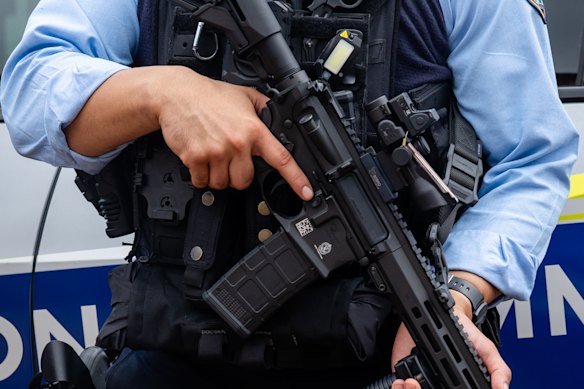
Long-armed rifle-carrying police “protection” of our society arguably does not make us safer but creates the very antithesis of the intended secure scenario – a society that is constantly wary and hyper-vigilant for disaster, like dry kindling just waiting for a match to be thrown, and one which goes against all we aim for as civilised human beings. Yes, we live in a different and more violent world today, but the confronting sight of patrolling rifle-armed police gives the impression of a society that is less protective, more intimidating. Less caring, more aggressive. We are already in a state of hyper-machismo. We don’t need this knee-jerk addition to add to our paranoia. Judy Finch, Taree
I do wish I felt safer with the Armed Response Group appearing in public places with their menacing long-arm assault rifles. I understand that in Britain such a group exists and can be on the scene when needed very quickly, but they do not intentionally display their presence, forewarning possible miscreants. It seems like the creeping Americanisation of our cities and, with masks, the ARC would not be very dissimilar to deportation agents. The more lethal our weapons, in a domestic arms race, the more lethal could be the response of those from whom we are supposedly being protected. Violence will always beget retaliatory violence. Bernard Moylan, Bronte
Wrong number
Have you ever tried changing your mobile number or replacing a lost phone? It’s a nightmare. You have to contact every organisation you’ve ever dealt with, answer endless security questions and spend hours listening to hold music. I think it’s easier to die than to get through this bureaucracy. Whoever designed this system deserves a life sentence. Mokhles Sidden, Strathfield
Fun in the sun

I live in a cul-de-sac in a small regional town and enjoyed a great afternoon on Monday when half a dozen of the local children ventured out to ride their pushbikes and scooters just after the rain stopped. What a joy that they were not tied to their small screens and active thumbs, and having fun in the sun. Ken Osborne, Bowraville
Hubby heroes
I challenge anyone to come up with a better description than the Duck’s Feet for the supportive partners described by your correspondents (Letters, November 3). I have bestowed this exalted title on my husband, thanks to his invisible efforts beneath the surface, handling the hard, unglamorous work that allows lucky me to glide smoothly and effortlessly through life. Joy Nason, Mona Vale

I could champion my partner too, although it’s me who praises his cooking (he does it all). He doesn’t agree with all my arguments, ensuring I have to pay heed to his, I initiate “why don’t we …” and he makes sure the activities happen by researching, booking stuff, and getting us there, and he’s an involved and loving grandfather despite two of the three living overseas, and he mostly puts up with my often prevailing pessimism and moods by being otherwise. Sadly, his hair is not a contender. Jennifer Fergus, Croydon
Your correspondent challenges readers to name a man who outdoes her husband at shopping, cooking, cleaning, home repairs and parenting. My wife is surely drafting her nomination of me as I write. I’d ask, but she’s busy finishing the shelves that I started in 2019. Nick Andrews, Bellevue Hill
- To submit a letter to the Sydney Morning Herald, email letters@smh.com.au. Click here for tips on how to submit letters.
- The Opinion newsletter is a weekly wrap of views that will challenge, champion and inform. Sign up here.
Disclaimer : This story is auto aggregated by a computer programme and has not been created or edited by DOWNTHENEWS. Publisher: www.smh.com.au