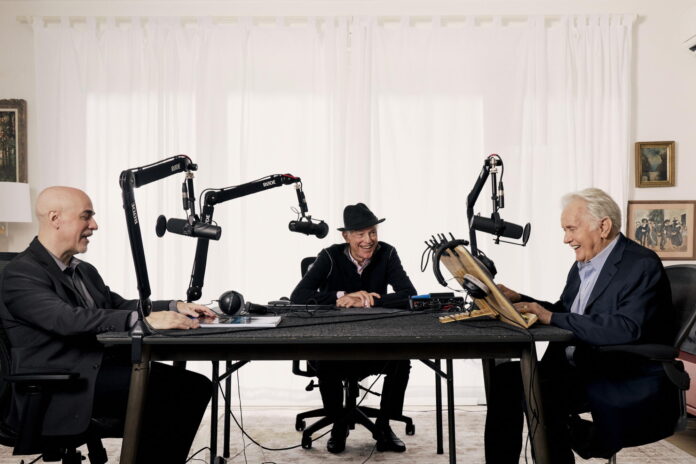
Three guys walk into a bar. One is a composer whose heroes are Aaron Copland and John Williams; one is a former U.S. history teacher who takes photos of American landscapes and faces; the other is a Hollywood lion and social activist known for playing an idealist (and ideal) American president.
These three men — Peter Boyer, Joe Sohm and Martin Sheen — have created “American Mosaic,” an optimistic shot across the bow that pairs Sohm’s celebratory images of the country with declamations by great minds of history, as narrated by Sheen, all set to Boyer’s propulsive and tuneful orchestral music. The 40-minute work has been performed by major orchestras around the country as part of the celebration of America’s semiquincentennial, and will premiere Wednesday in film form — the images and narration over a recording of Boyer’s score by the Hollywood Cinematic Orchestra — at the Ojai Film Festival.
The piece is an exuberantly hopeful and unabashedly patriotic look at America and its possibilities that seems downright defiant in such a deeply cynical and divided time in the nation’s history. Yet all three men remain optimistic despite the odds, sure that Americans would rather feel hopeful than defeated, uplifted rather than downtrodden.
To borrow another setup for a joke: How many patriotic optimists does it take to turn on a light bulb?
Composer Peter Boyer, left, director Joe Sohm and actor Martin Sheen in a recording studio at Sheen’s Malibu home.
(Anthony Avellano / For The Times)
“What’s your alternative?” Sheen says, laughing, sitting on the back porch of his Malibu home. “Come on, we came from a place, and we stood for something else — and so we know the truth, and we know what nourishes people. And it’s not hate and division, it’s not sarcasm. You know, the country belongs to all of us.”
The project was conceived by Sohm, who roamed America for 40 years in an RV with his wife and a camera. His photos have been published everywhere including the New York Times and CNN, and he recently took aerial drone and time-lapse video of the country’s skylines and natural grandeur. Sohm is a longtime fan of Boyer’s music, and in 2023 he reached out to the composer about teaming up for the country’s 250th.
The self-described “photo-historian,” 78, was inspired by a 1788 Benjamin Franklin quote: “I have sometimes almost wished it had been my destiny to be born two or three centuries hence.” Sohm wanted to show Franklin what he might see if he time-traveled to present-day America.
Sohm’s vision, per “American Mosaic,” is pure, black tar positivity: bald eagles soaring over magnificent vistas, gleaming farmland, small town cheerleaders on parade, tall ships sailing past the Statue of Liberty. This deluge of uplift is a collage of the photographer’s lifework, but he also adds: “I had Peter’s music to work from — and his music didn’t suggest darkness.”
Indeed, Boyer’s lifework feels of another era both stylistically and philosophically. He composes fanfares, tone poems and program music that are unabashedly tonal, tuneful and resolving. Warm lyrical melodies glide across orchestration dappled with glistening chimes, or on engines of snare drums and heroic brass.
Boyer is consciously writing in a tradition of Copland, Williams and Leonard Bernstein — of cinema-size emotion, of proud melodicism and earnest love of country.

Composer Peter Boyer, right, and actor Martin Sheen at Sheen’s home in Malibu. The pair have been working together on “American Mosaic,” which will premiere at the Ojai Film Festival.
(Anthony Avellano / For The Times)
“The word that I keep coming back to is ‘authentic,’” says Boyer, 56, who lives in Altadena. “I try to have an authentic voice compositionally, and that voice is very much informed by those three in particular.” He also cites Samuel Barber, Charles Ives and William Schuman as influences. “Having spent so much of my formative years studying that repertoire,” he says, “I try not to sound exactly like anybody else, but somehow it seeps in.”
Boyer’s previous work includes the jubilant “Rhapsody in Red, White and Blue” for piano and orchestra, the more introspective “Ellis Island: The Dream of America” — and “The Dream Lives On: A Portrait of the Kennedy Brothers,” a sentimental paean for trumpet, chorus and orchestra that was narrated by Robert De Niro, Morgan Freeman and Ed Harris during a 2010 Boston Pops performance.
It’s a body of nostalgic American hopefulness that, to a cynic, may seem hopelessly out of touch with the reality of our fractured times.
“I’m well aware that it’s tough to have this kind of optimism in this age,” says Boyer. “And even though I personally often feel a sense of despair with what is happening in our country and in the world, somehow I feel as though musically what I have to offer is something of value.”
Hundreds of performances, dozens of commissioning orchestras and many famous actors would seem to agree.
Boyer, who wrote a piece for Joe Biden’s 2021 inauguration performed by the United States Marine Band, says he and Sohm debated whether to include aspects of our present darkness and division in “American Mosaic,” but firmly settled on soaring above politics. At one point they had a section that featured Sohm’s photographs of presidential candidates over the decades — but “it took you out,” Boyer says, “and we didn’t want to do that.”

Actor Martin Sheen is known for his portrayal of the iconic screen President Josiah Bartlet in TV’s “The West Wing.”
(Anthony Avellano / For The Times)
“I’m as close as they get,” Sheen quips.
Sheen’s is a voice affectionately associated with President Josiah Bartlet of “The West Wing,” although he has also taken on the darkness of the Vietnam War (“Apocalypse Now”) and the Kennedy assassination (Oliver Stone’s “JFK”).
Sheen narrated “American Mosaic” live in March during a Cincinnati Symphony performance in his native Ohio. (The work has been performed by other co-commissioning orchestras including the Detroit Symphony, Nashville Symphony and the National Symphony Orchestra, who premiered it at the Kennedy Center in February before that venue’s politically controversial closure.)
The actor, 86, recently returned home from political rallies in Iowa where he spoke in support of USAID at a World Food Prize event in Des Moines. Sheen is outspoken about his loathing of President Trump and an administration that has “grave robbed” the Kennedy Center and killed essential aid for starving children in other parts of the world. Sheen has been arrested more than 60 times throughout his life for protesting various causes, and was a friend of the labor leader Dolores Huerta, whose image sits on a table in his dining room.
His political concerns and active vigilance are accompanied by a stubborn smile and frequent laughter. Sheen embodies the joyful spirit of “American Mosaic” — even as his stances on issues are much more pronounced — and he says he believes Americans are thirsty for the project’s gladdening message.
“We’re so much better than this,” says Sheen, after lamenting some of Trump’s effects, and noting that “American Mosaic” celebrates the country he still believes in. “You cannot come out of there without weeping joy,” Sheen says. “It could not have come at a better time, at a more important time. I mean, it’s like celebrating the end of something and the start of something, and it’s so powerful. It’s such a mighty celebration.”
Sheen, Sohm and Boyer all testified to the tearful response they’ve witnessed in performances in various cities. (Later this month, the St. Louis Symphony will perform “American Mosaic” with John Goodman narrating.)
Sohn says the phrase he’s heard repeated more than once is: “‘This is the America I love, and this is the America I want to live in.’ … We are flirting with a zeitgeist, and we’re able to say in visuals and music and words — not what people want to hear, it’s like what they need to hear.”
Sheen — born Ramón Estévez, the son of a Spanish émigré who worked in an Ohio factory — argues that Americans are inherently hopeful.
“If you choose optimism, if you project optimism, you’re going to be optimistic,” Sheen says. “What is the alternative?”
‘American Mosaic’ at the Ojai Film Festival
Where: Libbey Bowl, 210 S. Signal St., Ojai
When: Wednesday, Nov. 4, 7 p.m.
Tickets: Free
Contact: ojaifilmfestival.com
More to Read
Disclaimer : This story is auto aggregated by a computer programme and has not been created or edited by DOWNTHENEWS. Publisher: latimes.com