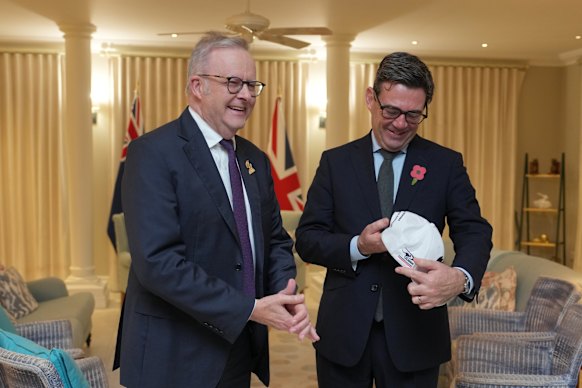

St John’s, Antigua and Barbuda: Anthony Albanese has signalled a tighter policy on spending in a looming budget update and challenged Opposition Leader Angus Taylor to agree to reforms that would improve the nation’s finances, after the Reserve Bank lifted interest rates on Tuesday.
Albanese said the interest rate decision confirmed his view that the government needed to look for savings in the half-year budget to be released next month.
“It makes our decision, that we were looking for savings, it confirms it,” he said. “As we have done in each and every budget.
“I make this point: a range of savings that we have put forward have been rejected by the Coalition, and a range of expenditures have been called for as well.”
As an example, Albanese cited the government policy to change the rules on private health insurance to ease pressure on the budget, which were opposed by the Coalition out of concern about the impact on households.
The Coalition is also divided over whether to approve the free trade agreement with the European Union, something Albanese wants the parliament to pass.
“You can’t oppose the private health insurance changes at the same time as you’re calling for changes to fuel taxation, which would have an impact on inflation, and you can’t oppose the European Free Trade Agreement,” Albanese said of the Coalition’s stance.
“The European Free Trade Agreement will make goods to Australia cheaper. That has a downward impact on inflation. It is just one of the reasons why the European Free Trade Agreement should be supported by everyone across the board.”
While Albanese has often said he would not comment on domestic issues while at overseas summits, his press conference at the Commonwealth summit was his first chance to respond to the Reserve Bank decision.
Economists have urged the government to run a tighter fiscal policy to help ease pressure on inflation, heightening the importance of the mid-year budget update as a chance to take policy action.
Albanese, however, argued that international factors were big contributors to higher inflation given the war in Ukraine, the wars in the Middle East and their impact on higher oil and gas prices.
He cited Reserve Bank governor Michele Bullock to argue that his government’s policies were not responsible for higher inflation – an argument Treasurer Jim Chalmers has also made.
“She has spoken about international pressures as well as domestic demand,” Albanese said in Antigua.
“I’m sure that Michele Bullock would have acknowledged that oil prices have had an impact, as Jim Chalmers did yesterday.”
During her Tuesday press conference, Bullock said: “We’re not tightening monetary policy because of the direct impact of oil prices on inflation.
“I know there is confusion in the community so I want to be very clear: monetary policy cannot impact global oil prices; rather the tightening in monetary policy is to address domestic capacity pressures.”
Bullock warned that households would feel the pressure from higher interest rates after lifting the cash rate to 4.85 per cent, the fifth increase this year.
“It is going to make people feel like it’s a recession because they feel poorer,” she said. “Their spending can’t grow very quickly because their incomes aren’t growing very quickly.
“This is a manifestation of the lack of productivity growth and the fact that we’ve had this massive supply shock imposed upon us, and we’re all poorer.”
The “massive supply shock” has come from global factors including foreign wars and their impact on oil prices, highlighting the international as well as domestic pressures on the economy.
Opposition Leader Angus Taylor has accused the government of having a “spending addiction” and blamed domestic policy for fuelling inflation and forcing the central bank to lift rates in a bid to bring prices under control.
This masthead reported on Tuesday that the government’s expenditure review committee met earlier this week to prepare for spending cuts to be contained in the mid-year budget update due in early December.
More to come
Cut through the noise of federal politics with news, views and analysis. Subscribers can sign up to our weekly Inside Politics newsletter
 David Crowe is Europe correspondent for The Sydney Morning Herald and The Age.Connect via X or email.
From our partners
Disclaimer : This story is auto aggregated by a computer programme and has not been created or edited by DOWNTHENEWS. Publisher: www.smh.com.au