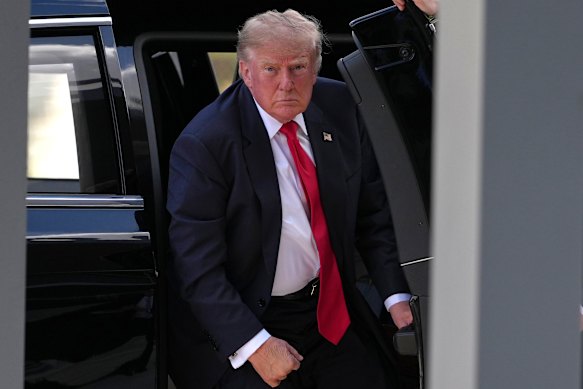
For the best part of two years, Donald Trump has had complete control of the US government. The midterm elections could knock out one, if not two, of the pillars supporting that dominance.
But will elections he labelled “the most important in our lifetime” have any practical consequences?
If the polls are right, there will be a Democrat “blue wave” giving them control of the House, with a chance of also gaining a slim majority in the Senate. Republican majorities in both congressional chambers have been two of the three pillars that have allowed Trump to reign almost unchecked.
The elections, however, won’t touch the other, more central, foundation of his second term – one made even more powerful by decisions of a US Supreme Court he stacked with conservative judges: His executive power.
Trump has wielded that authority with abandon, aided by a supine Congress and an administration staffed by sycophantic enablers. They have allowed him to assume authority over matters that, constitutionally, lie with the legislature.
If the Democrats are as successful as the polling suggests, Trump’s executive authority, including the power to veto bills enacted by Congress (unless the Democrats were able to acquire or negotiate a super-majority in the Senate, which is unlikely) won’t be directly affected.
‘If we didn’t win, I veto everything. I’ll be vetoing, vetoing…and then at some point, we’ll probably make deals.’
Donald Trump on the midterms
It might, however, be limited or influenced – either by measures that Trump sees as popular and that might remove political baggage for the Republicans in the lead-up to the 2028 general elections, or by threats to the funding of his administration.
Democrat control of the House would allow them to cancel funding for some of Trump’s programs and withhold funding for anything new Trump wants – like the 44 per cent increase in funding, to $US1.5 trillion ($2.1 trillion), that he has sought for the “Department of War”. Or they could simply let all funding for the government run out, which will happen on December 11 unless Congress agrees and Trump approves a new budget bill.
There also leverage in the US debt ceiling, although voters tend to take a dim view of those who wield it.
The current debt ceiling, raised in July last year, is $US41.1 trillion. It will probably be reached towards the middle of next year on current trends, with an actual default date (after US Treasury resorts to “extraordinary measures”) early in 2028.
Debt-ceiling brinkmanship could pressure Trump into agreeing to at least some Democrat demands, like the restoration of the subsidies in the Affordable Care Act that his administration cut last year.
Trump has vowed that he will be “Mr Veto” if Republicans lose control of Congress: “If we didn’t win, I veto everything. I’ll be vetoing, vetoing,” he said in an interview published this week.
He went on, however, to say “and then at some point, we’ll probably make deals.”
The Democrats do have a potential pathway to enact at least some of their legislation, assuming they can either obtain a majority in the Senate or, as they have done on occasion during this term, attract some Republican support.
For markets, the likely outcome of the election – regardless of how the Democrats fare in the Senate – is, thanks to the presidential veto power, a gridlock where nothing much of substance occurs between now and the change of administration in early 2029.
Midterms have always been good for the sharemarket. The average gain of about 15 per cent over the 12 months after the election has – for more than three quarters of a century – been about double that of non-midterm years.
This year is a little different, though.
Historically, the lead-up to the elections has produced double-digit falls in US share prices ahead of the big post-election bounce. This year, while prices have fallen from their peak a month ago, when they were up 15 per cent year-to-date, they are still about 10 per cent higher than at the start of the year.
The bond market tends to be less affected by midterms, although it – like the sharemarket – tends to do best when there is gridlock and therefore reduced potential for major policy moves. Markets don’t like uncertainty. They price in risk, which is reduced when there’s a stalemate within Congress or between Congress and the White House.
The other thing that might make this election different for financial markets is the degree of concentration within the sharemarket, and the blow-outs in US budget deficits and federal government debt that Trump has presided over.
About 40 per cent of the value of the sharemarket and most of its gains this year are now focused on stocks directly involved in the boom in artificial intelligence, with a similar level of contribution to America’s GDP growth.
Anything detrimental to the AI sector would threaten sharemarket stability. Trump has had a laissez-faire approach to AI. The Democrats will try to impose some level of regulation and safety protocols on the sector.
The bond market would see a gridlock as lowering the risk of further increases in government spending and in the deficit of 6 per cent of GDP and net government debt that has just passed 100 per cent of GDP, although investors will be wary of the Democrats’ aspirations for increased medicare and other social spending, and its implications for America’s already unsustainable deficits and debt.
While Trump’s domestic agenda might be curtailed if the Democrats gain control of at least one of the congressional chambers, he will retain the executive powers that he has wielded beyond what has been regarded as their normal constitutional limits, as well as his authority over American foreign policy.
It is improbable that he will allow Congress to reassert its responsibility for tariffs or its exclusive power over declarations of war. Indeed, it is more likely, if his domestic agenda is stymied, that he will double down on tariffs and military actions abroad.
Threats of denial of funding won’t have any influence over his trade policies, although they might limit what the Department of War might be able to execute.
The Democrats – with the probable support of some Republicans – will, however, be looking to provide more assistance to Ukraine and reverse measures that Trump has taken recently to buy Russian diesel and relax sanctions on Russia.
The other dimension to the election that will colour the way Congress and the administration operate, regardless of the outcome, is that Trump will essentially be a lame duck president.
Republicans will be very focused on their fate at the 2028 elections, particularly if there is a blue wave this week.
Even the most acquiescent and sycophantic members of Trump’s administration with concerns about their reputations or political ambitions will have to reconsider how they approach the next two years.
They can either distance themselves from the administration or, for would-be presidents like JD Vance or Marco Rubio, start putting their personal ambitions above their subservience to Trump. That could provide some level of check on the presidency, or at least encourage more Republicans to defy Trump.
The threat to those personal ambitions would be magnified if, as they have presaged, the Democrats initiate a wave of investigations and hearings into the administration, its officials and the Trump family. Another impeachment of Trump, while downplayed by Democrat leaders, is still possible.
Congressional Republicans, who with only rare exceptions, have rubber-stamped everything Trump has asked for, will have to start thinking about their own job security.
That could produce an opportunity for the Democrats. Any significant support for Democrat bills from Senate Republicans would increase pressure on the White House.
While the two-third majority vote in the Senate that would overcome Trump’s veto is improbable, it also isn’t completely inconceivable – there are, for instance, many Republicans who would vote to end the war in the Middle East, or provide more support for Ukraine and less for Russia.
Whatever the outcome of the elections, they will produce a punctuation point for Congress and the administration. They will also impact financial markets, and potentially – for good or bad – America’s relationships with the rest of the world.
An end to the turbulent Trump era of American politics is in sight – and the election outcome will shape how the next two years play out.
The polls suggest we’ve probably experienced peak Trump, but what comes next remains to be thrashed out by him, his cabinet and the new Congress. It could be a rocky two years.
The Market Recap newsletter is a wrap of the day’s trading. Get it each weekday afternoon.
From our partners
Disclaimer : This story is auto aggregated by a computer programme and has not been created or edited by DOWNTHENEWS. Publisher: www.smh.com.au