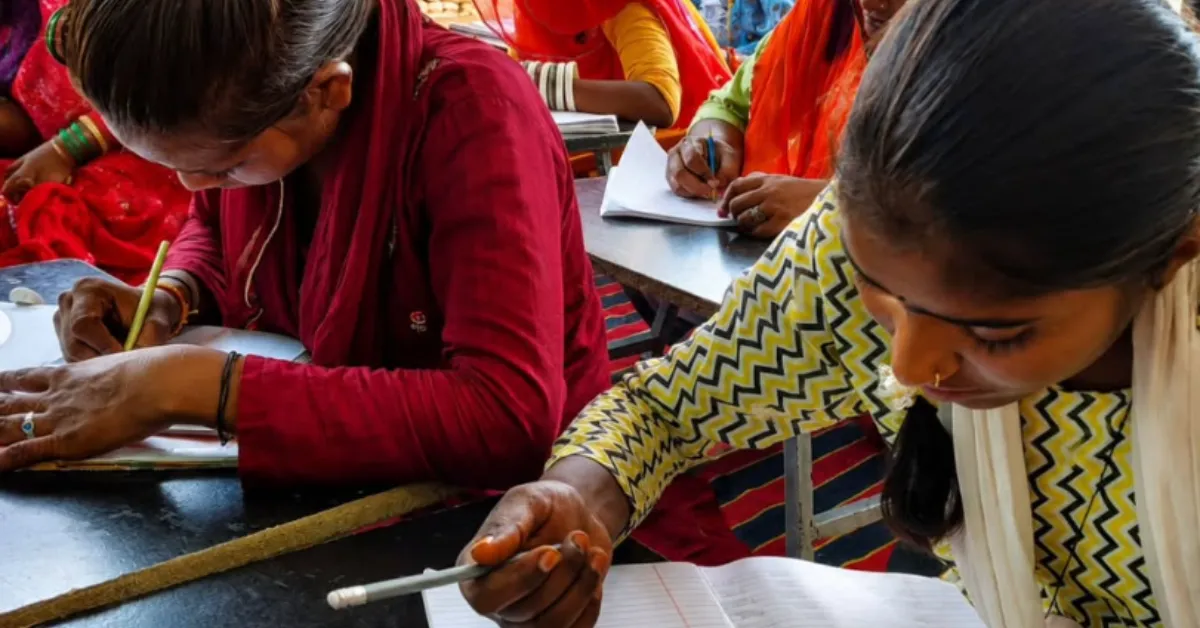
At 14, Monica Jod had already begun to understand that the life being planned for her was not entirely hers.
She had come to Sambhali Trust after being denied the chance to study. At home, she grew up hearing that a boy was the light of the family: “Ladka Ghar ka chirag”. The women around her did not support her wish for education either.
Marriage, like so many other decisions affecting girls, seemed to belong to the family.
But Monica did not accept that this was where her choices ended.
She left home four times over the course of her life. Each time, she was trying to move further away from the idea that a woman’s place was fixed by marriage, family expectations and domestic responsibilities.
Years later, at 35, Monica works with women who are trying to make the same journey.
Some arrive at Sambhali Trust after being caught in a marriage arrangement where leaving one household can have consequences for another woman.
“Their marriages are not treated as separate relationships. They are tied together by a custom known as atta-satta,” says Govind Singh Rathore, founder of Jodhpur-based Sambhali Trust.
In parts of Rajasthan, a woman’s marriage is a family bargain.
“A daughter is married into one household while a daughter from that household is married to her brother, or another male member of her family. The two marriages are negotiated together. What happens in one can affect the other,” Rathore explains.
And that is where the arrangement can become a trap.
Your marriage does not belong only to you
This is the part of atta-satta that is often missed when the custom is described simply as an exchange of marriage relationships.
Its most consequential feature is not only that two marriages are arranged together, but that one woman’s choices can be used as leverage against another.
Rathore has spent years working with women caught in such situations. He says the practice remains particularly prevalent in parts of western Rajasthan even today, including the desert districts of Barmer, Bikaner and Jodhpur.
The consequences, he says, can be devastating.
“Women as young as 19 are married to men in their 50s or 60s, and their lives often spiral into cycles of abuse, violence and neglect,” he says. His own family members have been impacted by it.

“I was married at 15, when my wife was just 14. We later had a social marriage when I was 19 and she was 18,” Rathore recalls.
His own experience, he says, is part of a larger reality. He remembers a German visitor observing, “There are no adolescent girls in Rajasthan!” It showed how many girls are pushed into adulthood before their time, burdened with responsibilities and denied the freedom to experience adolescence.
When marriages become linked
Families may believe that exchanging daughters reduces the financial burden associated with marriage, including dowry or dahej.
But reciprocity has another side.
Imagine a woman leaving her husband. Under an ordinary marriage, the dispute would concern her, her husband and their respective families. In an atta-satta arrangement, her decision can be presented as a breach of an agreement between households.
Her family may be told that if she does not return, the other family will send their daughter back.
“If one woman faces violence, another woman can automatically become vulnerable to violence too,” Rathore says.
The cost of saying no
The custom continues not because every family necessarily sees women as commodities, Rathore says, but because the arrangement is woven into economic and social structures that can be difficult for families to challenge.
“People are looking at everything materially,” Rathore says. “But a girl is not a material object.”
For families with limited resources, the promise of reducing marriage expenses can make atta-satta appear rational. But what begins as an economic arrangement can create a form of social indebtedness in which women are expected to honour an agreement they never made themselves.
“Women are naturally looking for some kind of respite, some way out of difficult circumstances. But the same system can turn against them,” he says.
Rathore recalls a case that came to Sambhali Trust involving a young woman whose family had entered into an atta-satta arrangement.
Certain conditions had been attached to her brother’s marriage, and she had agreed to the arrangement. But soon after her brother got married, she left home with the man she wanted to be with.
Her decision did not end the matter.
According to Rathore, members of her community hunted her down, while her parents came under pressure to settle the dispute through the local panchayat. The family was expected to pay a substantial amount as part of the settlement.
Rathore also says local intermediaries or agents involved in facilitating such arrangements can demand amounts running into Rs 10–15 lakh, after which a woman may still be forced back into a marriage she does not want.
A custom under scrutiny
The practice came under legal scrutiny in Rajasthan this year when the Rajasthan High Court, while hearing a matrimonial dispute, criticised atta-satta and described the arrangement as a form of “mutual hostage-taking” between families.
The observation put into words the problem faced by women working with such cases.
The Better India reached out to Kumkum Thanvi, a counselling psychologist and psycho-oncologist working with Sambhali Trust’s Nirbhaya Initiative. Launched in 2014, the initiative is an emergency assistance system that connects survivors with in-house psychologists, medical teams and legal advisers to guide them through rights education and court processes.
Thanvi says, “It usually takes three to four sessions to help families understand that if one marriage is facing difficulties due to incompatibility, conflict or violence, it does not mean that the other marriage should also be ended. This is one of the major challenges associated with the atta-satta marriage practice. Legally, we follow the same legal procedures and provide the same legal guidance as we would in any other marriage-related case.”
But what happens when a woman approaches the Trust seeking to leave an abusive marriage?
“First, I try to understand the woman’s situation, explain her rights, assess her immediate safety needs and help her explore the options available to her, without pressuring her into any particular decision. This could include approaching the police if she faces threats, physical violence, harassment, confinement or coercion; seeking protection under the Domestic Violence Act, 2005, in cases of domestic abuse; or approaching the District Legal Services Authority (DLSA) for free legal assistance, including guidance on separation or divorce.”
But knowing one’s rights does not automatically make leaving possible.
Thanvi identifies financial dependence, concerns about children’s custody and education, family pressure and the prospect of lengthy legal proceedings as some of the biggest barriers women encounter.
“Simply telling a woman to leave her marriage is not enough,” she says. “She also needs to know where she will go, how she will support herself and her children, and who will stand by her afterwards.”
That is the point at which custom collides with individual freedom.
Rathore, too, believes this is why the issue cannot be addressed only through individual interventions.
“That is why there is no point blaming the police or the families entirely,” he says. “The real solution has to begin with changing the mindset.”
‘You cannot give away girls in the name of tradition’
Rathore sees education and economic independence as central to that change.
One argument used to justify atta-satta is that exchanging daughters can ease the financial burden of marriage and dowry. But Rathore says that reasoning obscures what is being exchanged.
A woman is not an economic counterweight to another marriage.
The situation becomes more serious when children are brought into such arrangements.
“Girls as young as nine or 10 are being bound into atta-satta arrangements,” he says.
Rathore also points to Rajasthan’s skewed sex ratio as one of the factors contributing to the continuation of reciprocal marriages. With fewer girls available within communities, families can increasingly turn to arrangements such as atta-satta to secure marriages for their sons.
But stopping the practice requires more than telling families not to exchange daughters.
It requires giving girls and women alternatives. “People need to understand that a daughter is not something that can be exchanged,” he says.
The way out begins before the crisis
This is where Sambhali Trust’s work moves beyond rescuing women from individual marriages.
The organisation’s name, Sambhali, refers to the “rising of deprived women”. Its approach centres on helping women and girls become independent enough that they no longer need the organisation to survive.
Education is one part of that work. Vocational training is another.
For women facing domestic violence, the organisation runs a shelter home service where they can find a safe place to stay while receiving counselling, support and advice. It also assists women who want to pursue justice through the courts.
A woman who has access to these things has more choices.
“The ultimate aim should be to make women independent,” Rathore says. “They should reach a point where they don’t need Sambhali anymore.”
But nearly 19 years since Sambhali Trust began working with women and girls in Rajasthan in 2007, the need for its intervention remains evident in the cases it continues to handle.
Between April 2025 and March 2026, the Trust received 956 helpline calls, handled 188 cases through psychological counselling and legal guidance, and provided temporary shelter to 14 high-risk survivors.
Among them was 19-year-old Nisha (name changed), whose brothers attempted to force her into an atta-satta marriage in April 2025 to secure a bride for themselves in return.
When Nisha resisted, she faced severe physical and emotional abuse, leaving both her and her mother without support. She eventually approached the National Commission for Women, which helped secure her rescue and placement with Sambhali Trust. Under the care of project psychologist Dr Deepti, she found a safe space to recover and speak about the future she wanted. “I want to study, not marry,” she said.
During an intensive family mediation session, Nisha faced further pressure from relatives to return home. But she stood her ground and chose independence. Today, she remains under the Trust’s protection and is pursuing the education she was nearly forced to give up.
Monica chose differently
Monica knows what that independence can mean because she had to build it herself.
At 14, she came to Sambhali Trust after being denied the opportunity to study. The women in her own family did not support her either. But her father, along with Sambhali Trust founder Govind Singh Rathore, encouraged her to pursue education and build a life of her own.
Monica left home four times over the course of her life.
“I was trying to escape the idea that her future had already been decided,” Monica tells The Better India. “I wanted to come out of the thinking that women are nothing.”
Years later, her efforts earned her the Gargi Puraskar, a recognition for girls who perform exceptionally in education. The Gargi Puraskar (Gargi Award) is a Rajasthan State Government incentive scheme that rewards meritorious female students who secure exceptional scores in their Class 10 and 12 board examinations.
When she told Rathore about the award, he encouraged her to attend the ceremony. Monica was hesitant.

Rathore told her, “Go, and take your mother with you.” Her mother went.
For Monica, the moment marked a change in their relationship. Years of conditioning began to loosen, and her mother finally told her: “You do what you want. I will not force you into marriage. Live your life.”
That sentence had been missing from Monica’s childhood: permission to decide for herself.
Today, at 35, she works with women who arrive at Sambhali facing restrictions she once experienced.
Some are victims of atta-satta. Monica helps them navigate the process when they need to file complaints or follow up on cases. She tells them to build the ability to choose.
“If education stops, learn vocational skills. Learn anything you can,” she says. “Even if you earn Rs 2,000 or Rs 3,000, earn something. And keep some of that money for yourself. Save at least Rs 200.”
A little savings can mean the ability to make a phone call, travel somewhere, seek help or make a decision without asking someone else for money.
“Education and money can only help us,” she says.
Monica also understands why many women do not immediately recognise that they have a choice.
“Women don’t have exposure, so they don’t realise the worth of freedom,” she says.
That is perhaps the deeper challenge facing atta-satta.
The custom does not survive only through the moment a marriage is arranged. It survives through the expectations surrounding that marriage: the belief that a daughter must protect the family’s agreement, that a sister must bear the consequences of her brother’s marriage, and that another woman’s future can be used to keep her from leaving.
Breaking that chain therefore requires changing what women believe they are allowed to ask for.
For Monica, the answer began with a classroom she had once been told she could not enter.
Disclaimer : This story is auto aggregated by a computer programme and has not been created or edited by DOWNTHENEWS. Publisher: thebetterindia.com