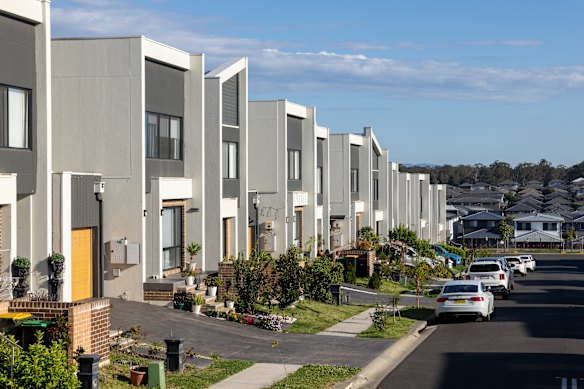
Sydney’s property market was a badge of pride, with the weather, harbour, coast and mountains making our city Australia’s best “des res”. But unaffordability has turned it into something of a bleak house.
The share of average household earnings needed to service a new mortgage on a median-priced home has reached 30.7 per cent – far more than the rest of Australia and the highest level since the 1990s. The media has been inundated with worried householders hit by the latest twin-edged interest rate hike that makes it harder for them to make ends meet and further restricts economic activity.
The citywide median house price peaked late last year at $1.8 million, and while it has since fallen to $1.66 million, that is still way higher than Brisbane’s $1.15 million, Australia’s second most expensive city.
Many Sydneysiders with a mortgage are under financial pressure. But the burden falls disproportionately on householders who bought during the property market peak years.
Despite the recent downturn in property prices, many would-be home buyers still find themselves priced out of the market.
The Herald’s Matt Wade caught the zeitgeist in his latest article, showing housing affordability has become an increasingly important factor influencing household formation and family size in Sydney.
New analysis by KMPG shows high property prices and cost of living pressures have combined to drive down the number of babies born in parts of Sydney that previously had relatively high birth rates. As house prices rose in more affordable Sydney suburbs between 2019 and 2024, the numbers of births in many of those areas fell.
As a result, many couples opt for a relatively small, affordable home which, in turn, limits the number of children they can consider while each year a steady flow of young families leaves Sydney for more affordable locations. And renters, the forgotten people of interest rate rises, are being squeezed from all sides.
As far as the RBA is concerned, interest rates are the only lever it has to pull on inflation. Announcing the latest hike on Tuesday, governor Michele Bullock said inflation was too high and it had to be dragged back down into the RBA’s 2 to 3 per cent target range.
But governments have many options. Reducing spending is the biggest lever at their disposal. We noted this week that the Minns government was still in deficit despite running a parsimonious budget. It is now time for the Albanese government to show some spine on economic policy.
The Mid-Year Economic and Fiscal Outlook next month is an opportunity to revamp budget settings to include spending cuts to cap the level of interest rates as part of a panoply of measures to lift the economy out of the doldrums.
It cannot come quick enough for Sydney.
Many Sydneysiders have been stranded between vaulting mortgages and pay packets that cannot keep up. The five interest rate increases this year have already taken a significant economic toll. The government must act to avoid further damage.
 The Herald’s View – Since the Herald was first published in 1831, the editorial team has believed it important to express a considered view on the issues of the day for readers, always putting the public interest first.
From our partners
Disclaimer : This story is auto aggregated by a computer programme and has not been created or edited by DOWNTHENEWS. Publisher: www.smh.com.au