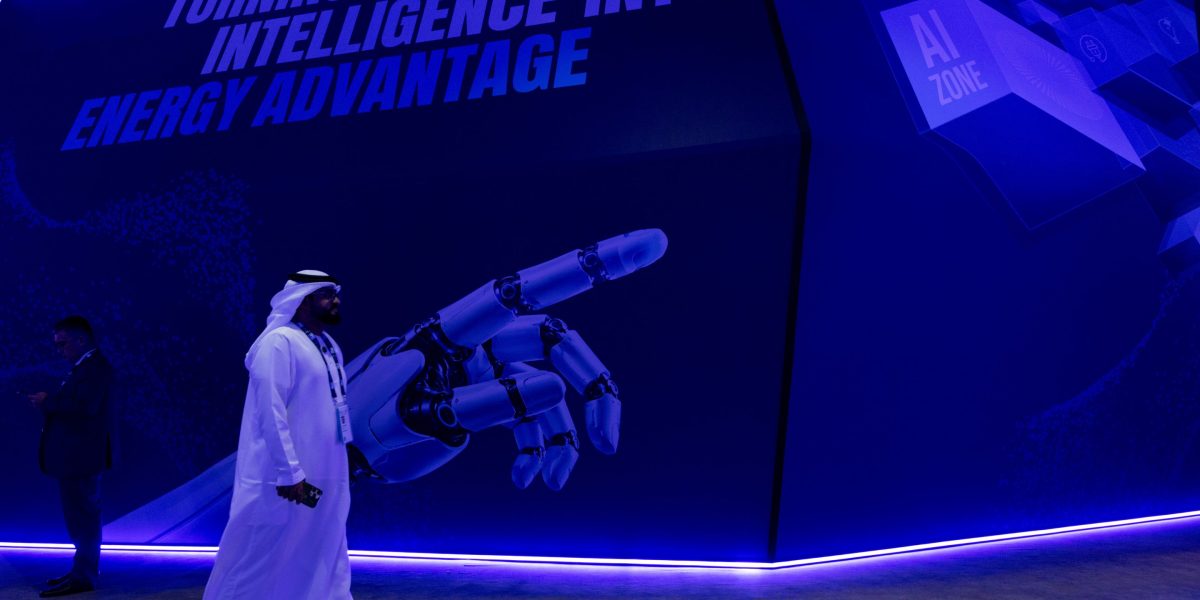
Many of the biggest names in the oil and gas industry have converged on Abu Dhabi this week to attend the emirate’s flagship annual energy conference, ADIPEC, with energy security a priority as the industry grapples with ongoing supply disruptions amid heightened geopolitical tensions.
Concerns over renewed U.S. strikes on Iran and the prospect of retaliatory action by Tehran have gripped oil markets in recent days. They also led both Exxon’s CEO Darren Woods and Chevron’s upstream president, Clay Neff, to withdraw from attending ADIPEC, citing security concerns.
But overall, the turnout has been strong, with heavyweights such as BP’s CEO Meg O’Neill, Baker Hughes CEO Lorenzo Simonelli, and Halliburton’s chairman and CEO Jeff Miller, all flying in to speak at the event.
Shell, TotalEnergies, Eni, ExxonMobil, Chevron, and Occidental Petroleum were also present among the 2,260 exhibiting companies. More than 120 U.S. companies are exhibiting this year, second only to China in number. In total, the event is expected to draw around 239,000 visitors from 170 countries.
Dr Sultan Al Jaber, UAE minister of industry and advanced technology and Group CEO of ADNOC, took to the podium during the event’s opening ceremony on Monday to set the tone for the days ahead.
“Energy leadership is not measured by what you produce in good times, it is measured by what you deliver in hard times,” he said. “The choices we make today will determine the energy landscape a decade from now.”
He urged increased investment in energy infrastructure and AI to strengthen the industry’s long-term resilience against future disruptions, noting how AI has become essential to ensuring operational continuity.
“AI must be built in, not bolted on,” he said. “In a crisis, the speed of insight and the speed of decision-making is the difference between continuity and disruption.”
Earlier that morning, ADNOC signed a deal with OpenAI and G42, an Abu Dhabi-backed AI firm, to become the world’s first energy company to deploy OpenAI’s Frontier platform to build and manage AI agents. It plans to use the technology to transform its oilfield development, well management, and commercial operations.
Referring to OpenAI CEO Sam Altman, who was seated in the front row at the ceremony as guest of honor, Al Jaber said: “Sam, from the moment ChatGPT was born, the world has asked what energy can do for AI. And now, together, we will find out what AI can do for energy.”
BP’s CEO Meg O’Neill also outlined her company’s focus on AI in a speech delivered on the first day of ADIPEC.
“Understanding the macro impact of these investments and technologies, and what it means for global energy demand is really important, and we spend quite a bit of time on that, trying to sift through the myriad of forecasts which range from gentle growth to something that is astronomical and hard to figure out, and how they underpin our investment decisions,” she said.
O’Neill explained that the two main areas where BP is focusing its AI efforts are sub-surface analysis, including seismic processing and reservoir management, and the application of physical AI to improve facility operations, reduce costs and maximise resource flows through its systems.
Nine out of 10 energy leaders (89%) increased their AI spending over the past year, while 63% expect returns from existing investments to match or exceed their costs, according to the Powering Possible report, the third annual study conducted by ADNOC, its international investment arm XRG, and Microsoft.
The report, published last week, also noted how the proportion of energy leaders ranking AI among their top two corporate priorities has increased to 62%, up from 42% a year earlier, as the industry increasingly embraces agentic AI.
In addition to AI and energy security, conversations over the last few days have focused on addressing some of the sector’s most pressing challenges, including shifting trade routes to rising electricity demand and the investment needed to build resilient energy infrastructure.
Speaking to Fortune contributor Inzamam Rashid on the sidelines of ADIPEC, Dr Carole Nakhle, CEO of Crystol Energy and Secretary General of the Arab Energy Club, described the scale of this year’s energy disruption as “unprecedented”.
“We are all sailing through a very thick fog,” Nakhle said. “Resilience doesn’t get parachuted in overnight; it requires investment over years and decades.”
Melissa Hancock
And as ever, thanks for reading, and do keep in touch with your thoughts and ideas.
melissa.hancock@fortune.com
Aramco results
Aramco earnings soar as refining margins and oil prices offset wartime disruptions
Saudi state oil giant Aramco reported a net profit of $36.25 billion in the third quarter, a 34.5% increase compared with the same period a year earlier, as higher crude oil and fuel prices offset supply disruptions.
Adjusted net income in the third quarter was $31.2 billion, comfortably beating a $28.7 billion analyst consensus estimate compiled by Bloomberg.
In addition to the ongoing blockade of the Strait of Hormuz, Aramco’s facilities have come under attack from Yemen’s Iran-aligned Houthis.
Despite the attacks, supply reliability was 97.8% in the quarter, down from 99.9% a year earlier and 98.4% in the second quarter.
“This strong supply reliability was achieved despite some disruptions to the East-West Pipeline during the quarter, as Aramco was able to quickly restore loadings in the western region using the pipeline’s multiline configuration,” Aramco said.
Saudi Arabia’s oil production stood at around 8 million barrels per day (bpd) in September, down from just over 10 million bpd before the war, according to secondary sources cited in OPEC’s latest monthly report.
Aramco CEO Amin Nasser said the company plans to increase oil production to full capacity in the fourth quarter, adding that the company had increased supplies both from the Red Sea and the Gulf.
In Aramco’s results statement, Nasser emphasized the company’s ongoing efforts to expand overseas storage capacity and identify alternative export routes, further bolstering its global supply network.
Aramco’s adjusted earnings before interest and tax (EBIT) in the downstream division soared by 234% year-on-year, driven by stronger refining margins.
Other energy majors also posted bumper third-quarter earnings, driven by a spike in refining profits and elevated oil and gas prices. Exxon more than doubled its year-on-year third-quarter profit to $15.4 billion while Chevron’s earnings increased to $9.9 billion from $3.5 billion a year ago.
‘Business, not bunkers’
“Business as usual”: Bob Diamond remains bullish on the Gulf
Amid reports that the U.S. may resume attacks on Iran, former Barclays CEO Bob Diamond tells Fortune that business activity across the region continues strongly and that he remains bullish on the Gulf.
“If you take the time to get here and you’re on the ground, it’s business as usual. People are investing. The region isn’t hiding in their bunker; they’re doing business,” Diamond told my colleague Kamal Ahmed on a call from Bahrain where he has been attending the Gateway Gulf investment conference.
Diamond was in the kingdom to announce the opening of Panmure Liberum’s first regional office. His investment vehicle, Atlas Merchant Capital, acquired Panmure Gordon for £15.5 million ($21 million) in 2017 before merging it with Liberum in 2024.
Bahrain offers an attractive base for building an advisory business, according to Diamond, because of its highly-regulated banking sector. Middle-market and family-owned businesses “are dying for cover,” he said, adding that the kingdom also offers a gateway to the rest of the GCC.
He also highlighted Bahrain’s opportunities in fintech, particularly stablecoins and asset tokenization.
You can read Kamal’s full interview with Diamond here.
Landmark visit
Oman-China relations at “new historical starting point”
Oman’s Sultan Haitham bin Tariq Al Said concluded a landmark visit to Beijing on Monday where he met Chinese president Xi Jinping. It marked the first-ever visit by an Omani head of state to China since the two countries established diplomatic relations in 1978.
During his talks with Sultan Haitham, Xi said relations between the two countries were at a “new historical starting point,” while Sultan Haitham said Oman was open to striking a preferential trade and investment agreement with China.
The two leaders witnessed the signing of a currency swap arrangement, and multiple agreements and strategic investment partnerships with Chinese institutions and companies worth several billion dollars.
The agreements cover efforts to attract Chinese industrial and technological capabilities to Oman, as well as the establishment of joint investment funds across various fields, including renewable energy, AI, digital technologies, space, and defence.
Key among these was a preliminary terms agreement between the Oman sovereign wealth fund and China’s Silk Road Fund to establish a joint investment fund with capital of 307.6 million Omani rials (RO) ($800 million).
Preliminary statistics from the National Centre for Statistics and Information indicate that total trade during the first seven months of 2026 reached RO 5.4 billion ($14.04 billion), with Omani exports to China of about RO 3.9 billion ($10.14 billion), and imports from China of approximately RO 1.4 billion ($3.64 billion).
Imports from China accounted for 13.73% of Oman’s total commodity imports over the same period. China remains Oman’s largest trading partner, while Oman is China’s fourth-largest trading partner among Arab countries and its fifth-largest supplier of crude oil.
In light of the ongoing blockade of the Strait of Hormuz, China views Oman as an increasingly strategic trading partner, given that many of its ports lie outside the strait.
The Big Number
$1.5 billion
Bahrain-based global private equity firm Arcapita Group plans to invest $1.5 billion across the Gulf’s industrial and logistics sector over the next two years. The planned investment comes on top of the more than $2 billion in industrial real estate assets the firm already manages across the region.
The 3 things we enjoyed reading this week
- Saudi Arabia’s business model, which relies heavily on international executives and corporate professionals commuting from neighboring Gulf countries to Riyadh, is being disrupted by the escalating regional conflict. Following Houthi attacks that forced the closure of Riyadh’s main airport, many business travelers have struggled to reach the capital, with some resorting to lengthy road journeys via neighboring countries. However, some executives remain determined to maintain a physical presence, believing that showing up during a crisis could give them a competitive advantage.
- The falconry season in Abu Dhabi, which runs from 20 October to 31 January, is about much more than hunting–it is a cherished Emirati tradition that brings families and friends together through shared experiences in the desert. Passed down through the generations, the practice preserves the UAE’s cultural heritage. Modern technology, including GPS trackers and digital licensing, has made falconry more accessible, while regulations help protect wildlife and ensure sustainable hunting practices. Growing interest among younger Emiratis suggests the tradition remains very much alive.
-
Gulf countries have an opportunity to turn the Syrian refugee crisis into a driver of regional economic growth, rather than relying on increasingly stretched humanitarian aid. With more than 3.8 million Syrians still living in neighboring countries, this article calls for greater economic inclusion through employment rights, access to finance, business opportunities, and freedom of movement. Syrian refugees could play an important role in Gulf-backed infrastructure and trade projects across the Levant, bringing valuable skills, commercial networks and expertise that could also support Syria’s eventual reconstruction.
Disclaimer : This story is auto aggregated by a computer programme and has not been created or edited by DOWNTHENEWS. Publisher: fortune.com