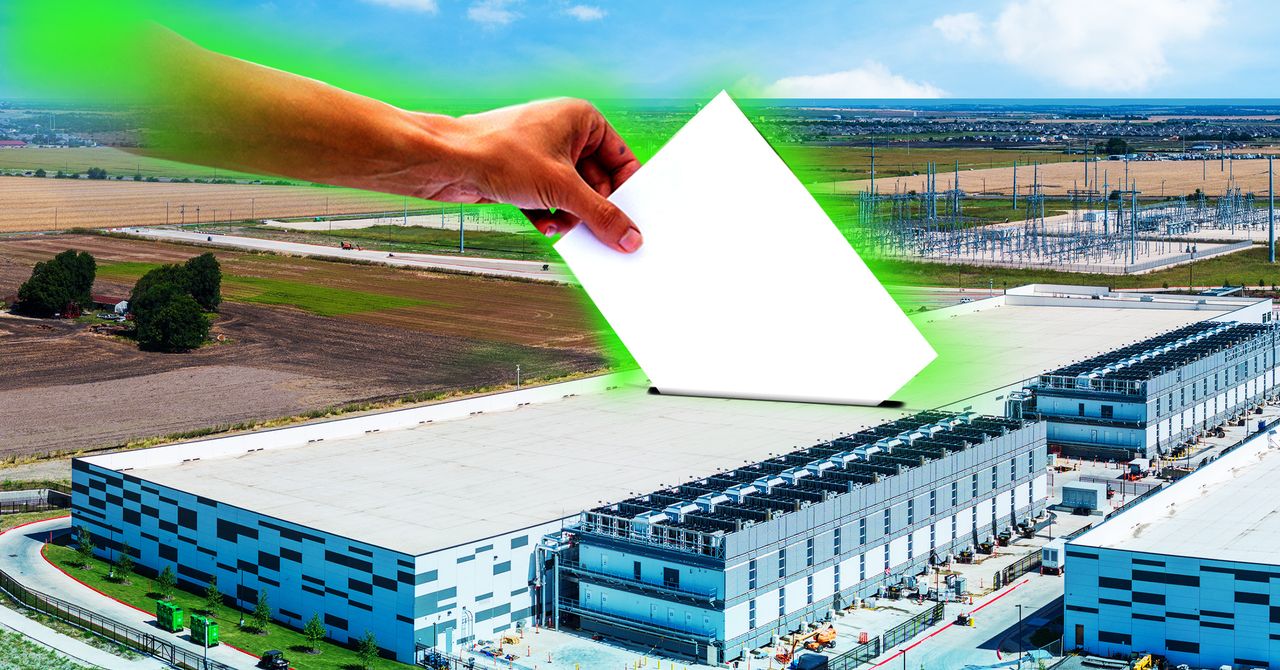
It was a bad night for data centers. In Ohio, Democrat Sherrod Brown, who has aired ads for months calling his opponent “the face of data centers in Ohio,” cruised to victory to flip a Senate seat. Democrat Chris Pappas, who when seated will be the nation’s first openly gay male senator, mentioned his opposition to data centers in his victory speech and drew massive boos from his crowd in New Hampshire—even though the state has no large-scale data centers under construction.
Elsewhere, two separate Republicans named Derek and Derrick, whose Democratic opponents labeled them “Data Center Derek” and “DC Derrick,” suffered losses in House races in Ohio and Wisconsin.
As part of last night’s shocking blue tsunami, voters selected candidates with tough policies on data centers at all levels of government, in a clear rebuke to the industry’s buildout in states across the country. Almost a quarter of all voters told NBC News that data centers were “crucial” to their vote, while nearly two-thirds said it was either a major or minor factor.
“The revolt against data centers was one of the top issues of the 2026 election, and in a few years we will look back on it as just the early tremor of a much bigger AI earthquake upending American politics,” Greg Casar, the Texas Democratic congressman, said in a statement.
“Data centers and AI as a technology are fundamentally linked in many voters’ minds,” says Alexander McCoy, a Democratic strategist working on AI. “So you can address all of the different concerns with data centers with regards to their energy or their noise, or their pollution, and there would still be significant concerns about what these projects are enabling and the effect is having on opportunities, prices, jobs, society.”
Perhaps some of the biggest shocks for the industry came in the governor’s mansions. In stunning upsets, voters elected Democrats Keisha Lance Bottoms in Georgia and Gina Hinojosa in Texas, while putting Cindy Holscher on the cusp of a potential win in Kansas. All of these candidates campaigned not just for increased regulations on the industry, but for data center moratoriums. A pause on data centers in Texas and Georgia especially, two of the biggest hubs for development in the country, could have serious implications for the hundreds of projects planned for each of those states.
“I think we will see the end to favorable tax breaks, and it’s clear that people like Greg Abbott were harmed by their history of giving those financial incentives to AI companies and data center developers,” says McCoy. “I think we’ll likely see the appointment of regulators in various administrative bureaucratic bodies that pose more scrutiny on these projects and an increase in the enforcement of environmental protection regulations.”
Simply being anti-data center wasn’t enough to boost some candidates—especially Republicans. In Wisconsin, Republican Tom Tiffany, who hit Democrat David Crowley early on in his campaign with ads dubbing him “Data Center David Crowley,” lost his race. (Crowley got more aggressive on the industry as the campaign went on, indicating he would support a pause two weeks before election day.) So did incumbent Mike Lawler in New York’s 17th congressional district, who aired ads slamming his opponent’s past statements that New York “needs” data centers, conceded his race even though the Associated Press has yet to call it.
Throughout the campaign, data centers proved to be a bipartisan topic of concern, and caused fractures within the parties themselves. Earlier this year, WIRED reported how many of Donald Trump’s MAGA loyalists disagreed with the president’s support for AI companies and data centers.
But it’s undeniable that anger about data centers helped elect Democrats. In the weeks leading up to the elections, the Democratic Congressional Campaign Committee ran ads that highlighted Republicans’ support for data centers or the backing they had received from AI companies.
“Voters aren’t stupid. The data center story is a corruption story. It’s an affordability story. It’s a Big Tech CEOs influence story,” says Sacha Haworth executive director of the Tech Oversight Project. “That’s what voters understood when they cast their ballots and that’s why Democrats routed Republicans so, so hard last night, because Republicans could not tell the same story.”
Many of the candidates who won on stricter data center regulations did so despite massive injections of cash from the AI and data center industries to their opponents. In South Carolina, Building the Future, a new industry super PAC, spent $1.5 million to support Darline Graham; she lost last night to Democrat Annie Andrews, who favors a moratorium. (Andrews registered the URL DataCenterDarline.com in late September to hit Graham on her industry connections.) Building the Future also injected more than $1.5 million into the Kansas gubernatorial race to support Republican Ty Masterson against Holscher. And Michigan Democrat Will Lawrence, who made regulations on AI and data centers a cornerstone of his campaign, has declared victory (though without an AP announcement) over Republican Tom Barrett in one of the most expensive races in the country. Barrett had gotten $340,000 from Elon Musk’s America PAC over the course of the race.
“Despite poll after poll making it clear that the conservative rural working-class base was concerned about data centers and the impact of AI, too many politicians in Washington chose big AI’s money over their own base,” Amy Kremer, chair of Humans First, an advocacy group pushing for democratic oversight of AI, said in a statement.
In data center ballot measures across nine states, voters rejected future construction plans, approved moratoriums, and called for greater consultation with and accountability to local communities. Ten states put forth more than 40 questions about data centers on local ballots, according to Ballotpedia, including 21 in Ohio alone. Questions ranged from outright moratoriums to rezoning questions to restrictions on development. Just one county appears to have allowed for more data center development on their ballot, according to Americans for Responsible Innovation president Brad Carson, who was tracking ballot developments throughout the night.
Tech companies appear to be smelling blood in the water. On the day of the midterms, The Hill reported that environmental groups and Big Tech companies were working together as part of a “Responsible Data Center Development Collaborative” to create a framework for data center development. McCoy calls this kind of collaboration the “right next step.”
Meanwhile, as the results rolled in, Musk posted on X, “Data centers in space looking pretty appealing right now.”
Disclaimer : This story is auto aggregated by a computer programme and has not been created or edited by DOWNTHENEWS. Publisher: wired.com