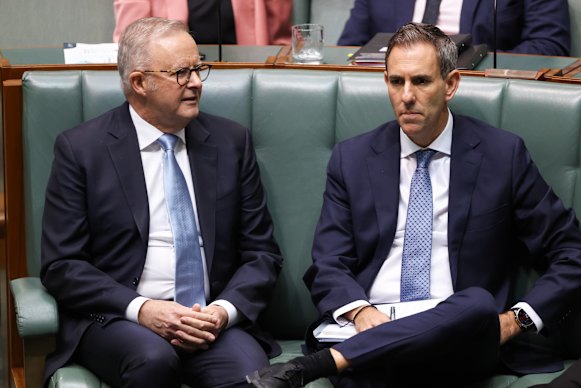
Under-pressure ministers are hunting for billions in Senate-proof spending cuts to tame inflation and interest rates, dodging the increasingly hostile Coalition and Greens blocs as Barnaby Joyce tips populists will benefit from Australia’s darkening economic future.
Fresh data from Deloitte Access Economics showed an unprecedented $1.4 trillion infrastructure wave driven by green energy and AI data centres was now outpacing the mining boom era and making inflation worse, handing Anthony Albanese a mandate to slow capital expenditure when he returns to Australia.
The prime minister will chair two meetings of the expenditure review committee on Monday when he returns from a Commonwealth summit in the Caribbean. The RBA’s decision to lift rates to an 18-year high on Tuesday, and its gloomier forecasts of years of high inflation and depressed wages, intensified scrutiny of Labor’s spending record.
Several people involved in preparing December’s budget update told this masthead Labor did not want spending cuts that would create protracted brawls, only to be torpedoed in the Senate anyway.
The edict opens the door to internal department cuts, scaling back existing programs and savings bills tailored to win Coalition or Greens support.
Albanese, speaking about the rate rise on the sidelines of a Commonwealth summit in Antigua, signalled a tighter policy on spending in the December budget update and challenged Opposition Leader Angus Taylor to agree to reforms that would improve the nation’s finances.
Albanese said the interest rate decision confirmed his view that the government needed to find savings in the half-year budget, to be released next month.
“It makes our decision, that we were looking for savings, it confirms it,” Albanese said of the rate rise. “As we have done in each and every budget.
“I make this point: a range of savings that we have put forward have been rejected by the Coalition, and a range of expenditures have been called for as well.”
Labor sees the Coalition’s more combative stance in the Senate as a reaction to One Nation, underlined by Angus Taylor’s refusal to endorse tougher asylum laws in September.
Greens leader David Shoebridge, striking a harder line than predecessor Larissa Waters, joined the Coalition to protect a Howard-era private health sweetener that would have saved the budget $3 billion.
Labor also had to walk back a $750 million measure to introduce a $5000 cap for health services for veterans after a public campaign. It was one of several budget U-turns that have punched an approximately $11 billion hole in Labor’s budget.
“You can’t oppose the private health insurance changes at the same time as you’re calling for changes to fuel taxation, which would have an impact on inflation,” Albanese said of the Coalition’s stance.
This masthead reported last week that ministers worried it would be difficult to make up the $11 billion, challenging the prospect of net savings.
After the Reserve Bank raised rates for the fifth time this year, governor Michele Bullock said many Australians would start to feel like they were experiencing a recession. Bullock, whose rates-setting board was split six-three on this week’s decision, said the bank would “take stock” before it determined future rate rises.
She said the bank was aiming to combat domestic constraints that existed before the US struck Iran. But, she added that the lengthy war exacerbated the situation and risked embedding higher prices.
The bank has been grappling with an AI boom that promises to supercharge Australia’s future productivity. The data centre build-out is competing with new wind, solar and battery projects, as well as road and rail projects, to drive up prices.
“This boom is happening close to our major cities, so data centres are competing directly with housing and infrastructure for workers and materials,” said Deloitte partner Sheraan Underwood. “There’s also less room to absorb it than during the mining boom.”
The firm’s report shows road and rail as the biggest component of the record $1.39 trillion pipeline. Second is energy transmission. Coming in on top are 37 data centre projects worth $141 billion, up 36 per cent over the past year.
Underwood said: “Inflation is above the Reserve Bank’s target, and the construction sector is already dealing with a historically large volume of work.”
Digital economy minister Andrew Charlton is expected to talk up the long-term value of AI at an ACTU summit, making the point that the AI boom is “central” to cushioning Australia against future inflation outbreaks.
Opposition Leader Angus Taylor told ABC TV that Australia’s rate rises were an outlier. “We’ve had five interest rate increases in Australia, and that has not been true of any other advanced country in the world,” Taylor said.
Joyce, who is the treasury spokesman for a party with a widely criticised policy agenda, said the RBA’s forecast for below-trend growth meant that “people are more receptive to what we have to say in that space”.
“In the established parties, it’s very hard for them to make changes,” he said, claiming the gloomier forecast made people more open to radical solutions such as gutting the climate change department.
“Labor doesn’t want to change. The Coalition speaks about change but never actually affirms it. We will get forced over time into a brutal realignment of resources to create productivity growth.”
Also at the Commonwealth Heads of Government Meeting, British Prime Minister Andy Burnham agreed to do further work on potential changes to rules for backpackers heading to Australia for work after Albanese raised the issue in their talks at the summit.
Albanese said Burnham was “very constructive” about the issue when they spoke in a formal meeting and later over dinner.
Any revision would require the UK and Australia to rework the current trade deal that exempts British holidaymakers from regional work requirements.
Cut through the noise of federal politics with news, views and expert analysis. Subscribers can sign up to our weekly Inside Politics newsletter.
 Paul Sakkal is Chief Political Correspondent. He previously covered Victorian politics and won a Walkley award and the 2025 Press Gallery Journalist of the Year. Contact him securely on Signal @paulsakkal.14.Connect via X or email.
 David Crowe is Europe correspondent for The Sydney Morning Herald and The Age.Connect via X or email.
From our partners
Disclaimer : This story is auto aggregated by a computer programme and has not been created or edited by DOWNTHENEWS. Publisher: www.smh.com.au