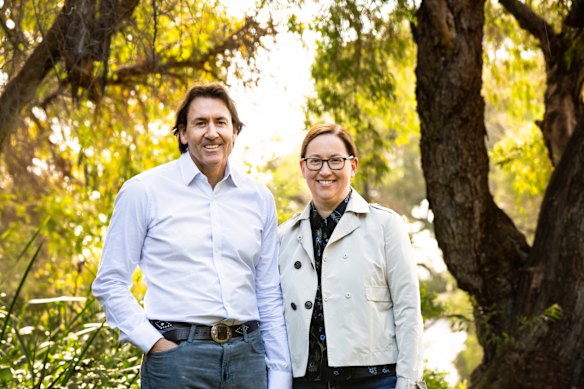

Perth billionaire couple Alexandra and Julian Burt are making one of the biggest gifts to environmental causes in Australian history, announcing a donation of more than $120 million to be shared between 10 organisations by the end of the year.
Alexandra Burt – the granddaughter of Peter Wright of Hancock and Wright prospecting fame and a businesswoman in her own right with interests in agriculture, winemaking and tourism – was worth an estimated $7.86 billion jointly with her sister, Leonie Baldock, on the AFR Rich List this year.
Julian Burt, a descendant of Sir Archibald Burt, Western Australia’s first chief justice, was last year made a Member of the Order of Australia for his service to the arts, the church and the environment.
The donations are through the couple’s charitable fund, the Wright Burt Foundation, which also supports the arts and heritage, education and community causes.
In an exclusive interview with this masthead, Julian Burt said it was unusual for the couple to talk about their philanthropy.
“We both prefer not to draw too much attention to ourselves,” he said. “We just like to probably be a little bit more quiet about it all. Only because my wife and I don’t like a lot of publicity. I suppose it’s just a natural thing for us not to sort of want to let everyone know what we’re doing.”
Alexandra Burt said in a recorded video statement that she hoped speaking about the gift would encourage others in philanthropy, as well as in the corporate sector and government, to identify where they could do more to help the environment.
Australian Wildlife Conservancy, Bush Heritage Australia and Greenpeace will each receive $25 million.
Great Southern Land Conservancy, a new charitable organisation founded by former NSW National Parks and Wildlife Service head Atticus Fleming, and BirdLife Australia will each receive $10 million.
Aussie Ark, Conservation Partners, the Great Barrier Reef Foundation, Rainforest Rescue and South Endeavour Trust will each receive $5.33 million.
Julian Burt said the couple wanted to share the donation because “it’s a big number” and the environment was a cause close to their hearts.
“We thought the environment was pretty critical right now, and it’s turned out to be really good timing.”
Julian Burt
“We just have a lot of passion for bark and leaves,” he said. “My parents would attest that’s been a passion for me since I was six years old. I kept ant farms, and raised pigeons when I was eight, and kept redback spiders in jars.”
His wife did not keep pet ants or spiders, Julian Burt said, but she always had an environmental consciousness. He pointed to the big sustainability improvements she made at the family winery in the Margaret River after inheriting from her father, Michael Wright, in 2012.
Alexandra Burt’s grandfather, Peter Wright, was Lang Hancock’s business partner, and part of the 1963 deal with Rio Tinto to transfer their Pilbara iron-ore mining leases in exchange for 2.5 per cent royalties, a deal that has made billions for both families.
Julian Burt said he supported the role of the mining industry, which was critical to Western Australia’s wealth. “And let’s be frank, it’s done well for Alex’s family,” he added.
“As a metaphor, [the wealth] has come out of the ground, and we’re putting it back into the ground, and that’s what we want to do,” Julian Burt said.
Julian Burt said he supported Australia’s transition to renewable energy, though he thought fossil fuels would remain in the mix for the short to medium term. The couple did not derive any wealth from fossil fuels, he said.
Australia’s Environment Report 2025, published by the Australian National University and the Terrestrial Ecosystem Research Network, recorded 39 new additions to the threatened species list in 2025, taking the total to 2175, with climate change the main threat to nine out of 10 newly listed species.
“We thought the environment was pretty critical right now, and it’s turned out to be really good timing, with everything that’s happening,” Julian Burt said.
“There’s a lot of negative publicity out there about wildfires, temperature rises in Europe, and biodiversity loss. It’s just nice if something like this comes out and, hopefully, it makes people feel a little better.”
Julian Burt said the foundation had done due diligence on all the organisations and their leaders long ago. The size of each gift was proportional to the size of the organisation and whether it would be able to immediately put the money to good use, he said.
The recipients are mostly focused on conservation, ecosystem restoration and saving threatened species. The exception is Greenpeace, which has a campaigning focus.
“It was a different choice,” he said. “There is a relationship there as well. They’re a good organisation, and under the leadership [of David Ritter], there’ll be some real sensible and practical and good outcomes.”
Great Southern Land Conservancy chief executive Atticus Fleming said he thought the $120 million donation could be the biggest conservation gift in Australian history, or at least in his 30 years working in the sector.
Australian Environmental Grantmakers Network chief executive Claire O’Rourke, whose organisation was not involved in the Wright Burt Foundation donation, said it was a really significant gift for the environment.
“It’s exciting to see,” O’Rourke said. “It’s also not outrageously surprising because we do see those growing trends of interest amongst philanthropy in committing to environmental causes, and I think that’s because philanthropy is recognising that a healthy environment is essential to safeguarding our communities, protecting our health, ensuring our food security, and delivering economic growth for the country, too.”
While O’Rourke said philanthropic giving was lower in Australia than some other countries such as the United States, the proportion going to environmental causes was higher.
Get to the heart of what’s happening with climate change and the environment. Sign up for our fortnightly Environment newsletter.
 Caitlin Fitzsimmons is the environment and climate reporter for The Sydney Morning Herald. She was previously the social affairs reporter and the Money editor.Connect via email.
From our partners
Disclaimer : This story is auto aggregated by a computer programme and has not been created or edited by DOWNTHENEWS. Publisher: www.smh.com.au