The UK has agreed to “structured dialogue” in the next year with Caribbean nations affected by the slave trade and its legacy, Commonwealth leaders have said.
Gaston Browne, Antigua and Barbuda’s prime minister, said there was a “consensus” in discussions between governments about a way forward on slavery reparations at the Commonwealth heads of government meeting (Chogm).
“There’s camaraderie and where we have issues that potentially could have divided us, we’re able to come to a consensus on the way forward,” he said.
Browne also praised UK prime minister Andy Burnham for being “very assertive in addressing [the] issue”.
“Perhaps there are some who believe that he may have dodged the issue as a relatively new prime minister. I think he has shown a significant amount of courage and goodwill, and I can tell you that he has developed a lot of goodwill with the Caribbean nations.
“And this structured dialogue that he has proposed, we are hoping that it will take place sometime within the next 12 months. We have also agreed in principle that by the end of this year, or early next year, that the whole framework for the dialogue would be established.”
Browne said the region would not be making “unreasonable demands on the United Kingdom”.
Burnham announced on Friday that he wanted to begin a structured dialogue and was open to Britain apologising, but ruled out reparations.
Instead, he proposed discussions on debt resets for smaller Commonwealth nations and announced £40m ($54m) for critical infrastructure in the Caribbean over the next three years.
A 10-point plan drawn up by the Caribbean Community’s reparations commission, which outlines the region’s vision for reparations, specifically asks for “debt cancellation” – not debt restructuring – and “monetary compensation”, arguing that former colonies’ “existing debts are intergenerational and are ultimately and intimately tied to centuries of colonial extraction”.
Asked whether Caribbean nations would urge Burnham to approach the talks with an open mind on reparations, Browne said: “We see the prime minister as an open-minded person, and the issue certainly will be raised.
“On the commencement of the structured dialogue, he has taken his position and we are very clear on our position that reparations are important, that reparations must be part of this structured dialogue and we remain very optimistic that we will come to a consensus on the issue.”
Leading figures in the Caribbean reparatory justice movement have said that debt relief and development assistance from the UK cannot be a replacement for reparations for centuries of slavery.
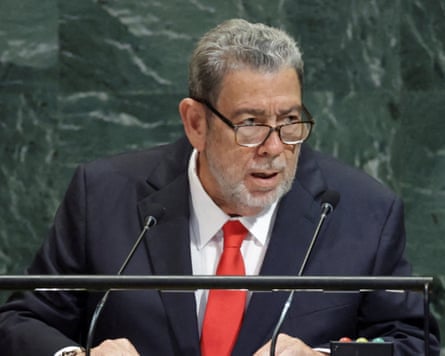
Ralph Gonsalves, a former prime minister of St Vincent and the Grenadines and a senior figure in the reparatory justice movement’s Repair Campaign, said: “When I listened to Andy Burnham, and I listened to the king, and they’re talking about what is helpful is not reparations, but for them to work on specific things like debt relief, and education and health, and climate change infrastructure.
“Now, all those things are within the 10-point plan. But they are also within the sustainable development goals of 2015, which we all signed on to at the United Nations,” he told the Guardian.
He added: “There are things in the reparatory justice 10-point plan which deal with issues … the first one is the ecology, and then psychological repair. And for people like members of the Rastafari faith, or brothers and sisters who may wish repatriation, that’s something we have to work out with African countries, those who want to go back. But there are financial implications in that. So you’ll have to have a separate carve-out on the basis of the 10-point plan.”
Labour MP Bell Ribeiro-Addy, chair of the House of Commons’ all-party parliamentary group for Afrikan Reparations, said the question was fundamentally about “agency”.
Speaking at an event on Tuesday to launch a “global reparations caravan”, which will travel across countries to educate and engage people in the reparations movement, she said: “So when it comes now to reparative justice, and as we move forward in the movement, I have to be clear with everybody, it has to be about agency, not making deals here and there, because agency was the crime. When you think about what was taken from people of African descent when they were enslaved, it was their agency, their right to decide all of these different things about their lives.
“So when reparative justice arrangements are being made, it absolutely has to be made with those who were affected, because if it is done to us, it is not reparations. I don’t know what it is, but it is not reparative justice.”
Gonsalves said the danger of reducing reparatory justice to development assistance was that such assistance remained discretionary on the UK’s part. “We have to understand the specificities of reparatory justice as distinct from general sustainable development goals. They’re shaping the discussion only within the frame of sustainable development goals,” he said.
Prof Kingsley Abbott, a human rights lawyer and director of the Institute of Commonwealth Studies at the University of London, also stressed the importance of harmed communities having a decisive say in what reparations should entail.
Speaking at the global reparations caravan launch on Tuesday, he said: “It’s for you to say. It’s your story. It’s your lived experience. But it’s time to start listening to those who continue to suffer from those crimes even today. It’s time to listen to you and to listen and learn from you.
“I reflected on my work as a human rights lawyer in different parts of the world. And in that time, I’ve met with many different victims of serious human rights violations, atrocity crimes, and their families and their descendants in places like Guatemala, Colombia, Nepal, Myanmar. And here in Antigua tonight, I’m meeting with all of you.
“Wherever those victims of those terrible crimes and their families were from, and whatever their faith, whatever their ethnicity, whatever their beliefs, they all had one thing in common. When I met with them, they all said that they wanted justice. And they wanted not only justice, but they wanted to be made whole again.”
A spokesperson for the Foreign Office said: “The prime minister wants to build stronger relationships to renew the relevance of the Commonwealth in a new era. We will do that by facing our past together and focusing on a future where every person living within it has equality, security and hope.
“We are already committed to working with Commonwealth partners on issues facing the world, including the role of private finance in tackling global debt issues, addressing the climate crisis, and supporting economic development. We will continue to do so.”
Disclaimer : This story is auto aggregated by a computer programme and has not been created or edited by DOWNTHENEWS. Publisher: theguardian.com