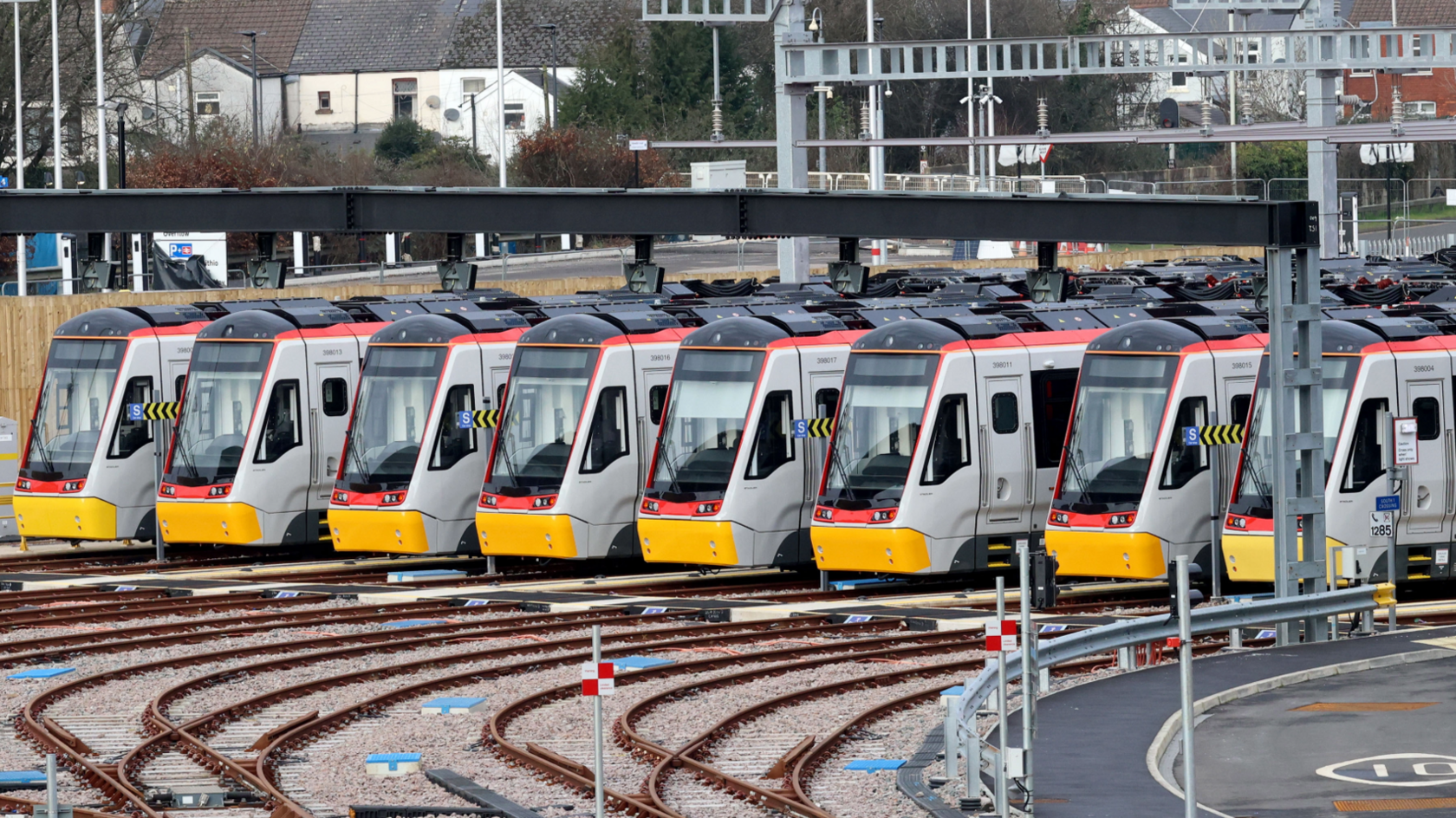
£200m taxpayer-funded trains sit barely used for three years
-
Published
A new fleet of publicly funded trains that cost more than £200m still remain mostly unused more than three years after the first one was delivered.
They were initially promised to be fully up and running by 2022 but Transport for Wales’ boss has said it might not be until the end of 2027 when their tram-trains will be in full service.
Data obtained by the BBC reveals that less than half of the 36 fleet – what TfW call the “final piece” in their £2bn South Wales Metro project – have passed rigorous statutory testing.
TfW chief executive James Price said he wants trains that work “100% well, 100% of the time” before putting them into full service.
 Image source, Getty Images
TfW’s flagship scheme to transform an old Victorian railway into a turn-up-and-go rapid transit service, similar to the London Underground and Manchester Metrolink, is Wales’ single-biggest infrastructure project since devolution in 1999.
It has been hit by delays and rising costs and the Welsh government-owned rail operator has missed numerous self-imposed targets to bring the tram-trains into full service across the south Wales valleys.
Officially known as Class 398 Citylink multiple units, they were ordered from Swiss manufacturer Stadler in 2018 and the first arrived in Wales in March 2023.

The King and former Prime Minister Keir Starmer have been on one but barely any passengers have.
Six tram-trains, worth about £8m each which can run both on urban streets and rail, are currently in passenger testing across the valleys network.
But they have been temporarily removed from service on occasions for what TfW described as “teething issues” and “early reliability challenges” because of “software” problems.
Commuters have now been told they will not be fully in service across the whole 105-mile (170km) network until 2027 – five years later than originally promised.
“It’s definitely frustrating,” said TfW boss Price.
“Everyone would want something to work first time, wouldn’t they? It’s frustrating but not unexpected.”
Passengers have been told the doubling of services from two to four trains an hour will begin between Cardiff and Aberdare, Merthyr Tydfil and Treherbert by the end of 2027 – a pledge passengers were also initially told would happen by 2022.
Commuters on those routes have had new trains since 2024 when TfW introduced their class 756 units onto the old valley line after years of delays and complaints about old rolling stock.
“They got delivered earlier and the reliability was better,” said Price.
“That meant that we weren’t able to test the trams against the original date. The key thing for me was getting new trains into service and maximising value for money.”
Sixteen of TfW’s 36 tram-train fleet have passed testing to ensure the three-carriage units are safe to run on the UK rail network – with 20 yet to complete the scrutiny required by the rail regulator.

Those tests on some of the vehicles started in 2024 – and data obtained by the BBC via a Freedom of Information request shows they can take anything between six weeks and two years.
“Trains are not a mass-produced vehicle and you only experience problems when you bring them into service,” said Price.
“I don’t accept there is a problem with the tram-trains but the biggest issue is a software issue. That’s because the whole fleet is controlled by one big software package and we’ve tried to automate as much of the train as we can.
“The good thing when automation is fully working, any improvements we make with the trains can be delivered through software rather than hard engineering.
“That will be cheaper, quicker and more reliable because if you do it on one train, all the other trains will behave in the same way.”
 Image source, Transport for Wales
TfW said they didn’t launch the tram-trains with a “big fanfare” and opted for a customer testing approach as they feared they “might come out of service”.
“What we want is trains that work 100% of the time, 100% well,” said Price.
“We’ve been achieving 95% on-time reliability on the valleys network and that’s the high standard we want to achieve before bringing something into passenger service in large numbers.”
Price said he met Stadler’s chief executive recently in Germany for talks in a bid to speed up the tram-train rollout.
Stadler has said it is “working closely” with TfW to address “minor issues” in what they have described “one of the UK’s most advanced battery tram-trains”.
“Testing and validation activities have progressed in phases, resulting in the identification and implementation of normal refinements, including software updates, as part of the fleet introduction process,” a spokesperson said.
TfW said part of the delay is because the line electrification infrastructure was only finished in March because of hold ups caused by Covid and supply chain impact caused by the Ukraine war.
 Image source, Geograph | Gareth James
But one railway expert reckons the tram-trains are maybe just too complicated.
“It’s a pretty ambitious project,” said rail engineer and broadcaster Gareth Dennis.
“The challenge of having such complicated trains trying to do everything to reduce the cost of the infrastructure requires a lot of stuff to be working on the train. All of that has to be tested to make sure it always works.”
The line infrastructure will tell the trains what to do through a series of beacons and TfW claim the South Wales Metro will be one of the most technologically advanced railway networks when the tram-trains are in full service.
While 100% of the network is fully electrified, only two-thirds has traditional overhead electric wires.
 Image source, Transport for Wales
By not electrifying the entire track and using on-board batteries for non-electrified sections, TfW say they’ve saved about £400m and years of time.
But Dennis fears the tram-trains are “being delivered as part of cutting some corners” like not doing complete overhead wire electrification” as he believes TfW try to get new services delivered quickly.
“It is the case that this is the first deployment that has pulled all this stuff together – being a tram, a train, having a battery and discontinuous electrification,” added the host of the #railnatter podcast.
“But that isn’t necessarily a very good idea and that’s why it’s not common.”

But TfW have said that technology already works on the bigger 756 trains, the temporary stop-gap before the nippier, purpose-built vehicles are rolled out.
Opposition politicians in Wales have questioned why most of the tram-trains are “just sitting in a depot gathering dust”.
“Taxpayers deserve to know what has gone wrong, how delays have turned into years and the costs are spiralling out of control,” said Reform’s shadow transport minister Jason O’Connell.
TfW, who took over the running of the £5bn Wales and Borders franchise during Covid, say their south Wales valleys upgrades have been “quick”.

“If you think we didn’t get hold of the lines until 2021 and by 2025 most of the work was substantially complete,” said Price.
“And today we basically have 100% new trains – it’s not as quick as we originally said but compared to any other project in the UK, it’s very quick.”
TfW have said introducing the tram-trains fully into service and operating four trains an hour on the three lines between Cardiff and Aberdare, Merthyr Tydfil and Treherbert is the “final piece of the South Wales Metro jigsaw”.
“The reason for, I guess, the relatively slow pace is that we need to train quite a few hundred crew then do signalling work at Queen Street station in Cardiff,” said Price.
“I do fully expect to see four trains an hour by the end of next year definitely.”
The Welsh government said TfW had already delivered “transformative improvements on the valleys network” and new trains would eventually “unlock turn-up-and-go” services across the valleys and Cardiff.
“Whilst some issues have delayed the introduction of the new tram trains TfW remains on target to complete the full rollout by the end of next year,” it added.
More top stories
-
-
Published22 hours ago

-
-
-
Published22 hours ago

-
-
-
Published17 hours ago

-
Disclaimer : This story is auto aggregated by a computer programme and has not been created or edited by DOWNTHENEWS. Publisher: BBC