Updated ,first published
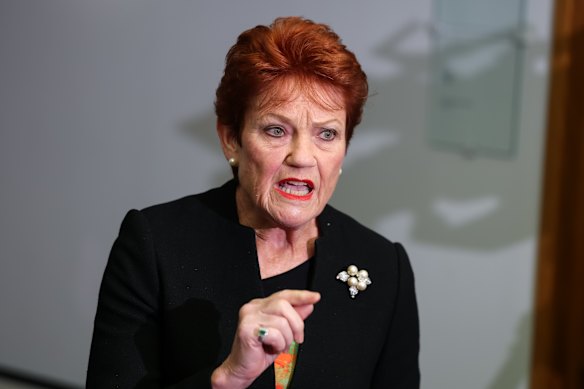
One Nation leader Pauline Hanson has won her bid to challenge a controversial hate speech law in the High Court, in a case set to test the limits of the Constitution’s implied freedom of political communication.
“Special leave to appeal is granted,” six High Court justices ruled in a one-line statement released on Thursday afternoon.
The decision sets the stage for a legal stoush over Section 18C of the Racial Discrimination Act, which conservatives have opposed for more than a decade and the Coalition once tried to repeal.
It is Hanson’s final chance for a court victory. In July, the Full Federal Court upheld findings that the One Nation leader’s “piss off back to Pakistan” tweet, sent to Greens Senator Mehreen Faruqi in 2022, was racist hate speech.
“This case has always been bigger than me and bigger than one tweet,” Hanson said in a statement on Thursday. “Australians must be able to speak their minds, question their government and disagree with each other without being frightened into silence.”
Section 18C makes it unlawful to engage in speech reasonably likely to offend, insult, humiliate or intimidate on the basis of race. Hanson’s lawyers argue any law that makes her tweet “unsayable” would break “the flow of political communication between the elected and their electors in a way that goes well beyond its purpose”.
In a statement, Faruqi vowed not to back down.
“Bring it on,” she said. “The highest court in Australia can now determine once and for all that people in this country are protected against racism. People of colour, migrants and Muslims deserve to feel safe in the place they call home.
“In times like these where we are being attacked and demonised, our legal system must be able to provide protection against vilification.”
Attorney-General Michelle Rowland said 18C’s “importance to social cohesion is perhaps greater than ever” but declined to comment further while the case was before the court.
Shadow attorney-general Michaelia Cash said Australians should be protected from racial vilification.
“They should also be able to engage in robust political debate. Getting that balance right matters in a free democracy,” she said.
The Hanson and Faruqi dispute dates to the death of Queen Elizabeth in 2022. In a tweet, Faruqi said: “I cannot mourn the leader of a racist empire built on stolen lives, land and wealth of colonised peoples.”
Hanson replied that she was appalled by the attitude of Faruqi, who had immigrated to Australia and taken “every advantage”. “It’s clear you’re not happy, so pack your bags and piss off back to Pakistan,” she tweeted.
Hanson, who is calling for a referendum on adding an explicit free speech clause to the Constitution, has called for the abolition of 18C for more than a decade. “You can’t say or do anything anymore, otherwise you’ll be dragged off to the law courts,” she told the Senate during a 2016 debate on the law.
In finding against Hanson, the Full Federal Court said Section 18C restricted a relatively narrow segment of political communication with the aim of preventing harm. The court also found most “genuine political communication” would be captured by the “fair comment” exemption in section 18D, so long as it was made reasonably and in good faith.
“Insult and invective are a normal feature of political debate, but it does not follow that they are so central to the free flow of ideas that complete freedom must be preserved,” the three judges held.
Chief Justice Stephen Gageler along with Justices Michelle Gordon, James Edelman, Jacqueline Gleeson, Jayne Jagot and Robert Beech-Jones granted Hanson leave to appeal on Thursday.
The seventh justice, Simon Steward, a trenchant critic of the implied freedom of political communication, only returned to the bench this week after several months’ sick leave.
Legal conservatives such as Steward have argued the freedom is not rooted in the Constitution and that political communication matters are better dealt with by parliaments. But High Court majorities have held for decades that the freedom is implied because voting in a democracy requires some degree of free political speech.
Dr Jemimah Roberts, a lecturer at Macquarie University Law School, said despite some recent high-profile wins, the general history of implied freedom cases showed “it’s actually very rare in Australia for these challenges to be successful”.
“Judges are very aware of both the importance of limits and their appropriate role, but also public perception,” she said.
Cut through the noise of federal politics with news, views and expert analysis. Subscribers can sign up to our weekly Inside Politics newsletter.
 Patrick Begley is an investigative reporter for The Sydney Morning Herald. Contact him securely on Signal @patrickbegley.33Connect via X or email.
 Brittany Busch is a federal politics reporter for The Age and The Sydney Morning Herald.Connect via email.
From our partners
Disclaimer : This story is auto aggregated by a computer programme and has not been created or edited by DOWNTHENEWS. Publisher: www.smh.com.au