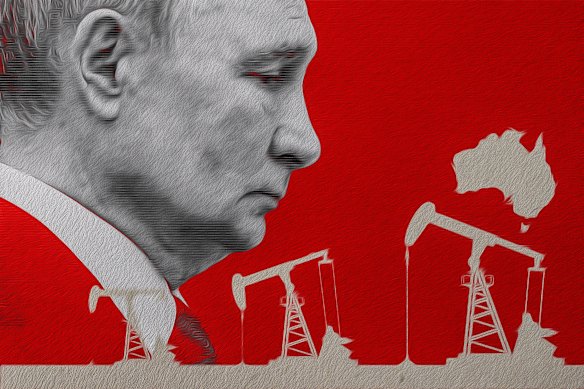

An international coalition of organisations has written to Prime Minister Anthony Albanese demanding urgent legislation to stop petrol and diesel refined from Russian crude oil in third countries entering Australia.
The B4Ukraine Coalition – a group of nearly 100 civil society organisations campaigning to strip Russia of economic resources for its war – estimates Australia has imported $16.5 billion worth of petroleum products made partly from Russian oil since Moscow’s full-scale invasion of Ukraine in 2022, potentially generating $1.7 billion in tax revenue for the Kremlin.
The call comes as Australia’s forestry industry raises separate concerns that up to 100,000 cubic metres of imported timber products each year could contain Russian-sourced material, exposing further weaknesses in Canberra’s sanctions enforcement.
The coalition accused the federal government of failing to act despite repeated warnings and an August Senate inquiry calling for stronger sanctions enforcement. Australia imported an estimated $480 million worth of fuel made from Russian crude oil in the first seven months of this year alone, according to figures cited in the letter.
“With two months having passed since the report’s publication, and 12 months since we first called for action, we are concerned that the Government has yet to outline concrete steps to address this issue,” executive director Nezir Sinani wrote.
The coalition wants Australia to ban imports from any refinery or port that has received Russian crude or refined petroleum products in the preceding six months, closing a loophole that allows Russian oil to enter Australia through blending, re-exporting or further processing.
Australian Federation of Ukrainian Organisations chair Kateryna Argyrou said Australia was falling behind its closest allies, with European restrictions redirecting Russian-linked fuel towards other markets.
“Our allies have shown a ban can work. With Europe now closed to this fuel and our door still open, Australia is becoming a dumping ground for blood oil,” she said.
The European Union prohibited fuel refined from Russian crude oil in third countries in January, followed by Britain in May.
Research by the Kyiv School of Economics found European imports of petroleum products from 11 refineries processing Russian crude oil fell 69 per cent in the three months to April following the EU ban. Indian refineries cut exports of Russian-derived fuel to Europe by 97 per cent, redirecting almost all such products elsewhere.
Australia became an increasingly important destination for Indian refineries and remained the primary market among countries sanctioning Russia for fuel exported from Brunei’s Hengyi refinery.
At Hengyi, Russian crude oil reportedly accounted for 68 per cent of the oil processed for products exported to Australia in the first seven months of 2026, up from 24 per cent during the corresponding period in 2024.
Australia banned direct imports of Russian crude and petroleum products in 2022, but the restrictions do not automatically prevent Russian oil being refined elsewhere before being exported to Australia.
Argyrou rejected suggestions tougher sanctions would threaten Australia’s fuel supplies, adding that Europe and the UK incorporated transition periods, and Australia could do the same.
“A phased ban with a clear timetable is very different from no ban at all,” she said. “Relying on fuel made from Russian oil isn’t fuel security either.”
Meanwhile, the Australian Forest Products Association has joined the Nationals MPs in demanding tougher action following Senate estimates evidence that the Department of Agriculture, Fisheries and Forestry does not necessarily consider Russian timber a breach of Australia’s illegal logging laws.
A departmental trial found that about one in four timber products tested did not match their declared species, origin or both. Yet the department confirmed it had tested no consignments for Russian content this year and had the equivalent of just 2.2 full-time staff working on compliance.
Association acting chief executive Richard Hyett said Russian-sourced timber could be entering Australia’s construction industry through blended products including plywood.
“This latest evidence suggests significant volumes of Russian timber continue to find their way into the Australian market, despite existing sanctions,” he said.
Energy Minister Chris Bowen has previously declared Australia neither needs nor wants Russian fuel and that Moscow should not be rewarded for its invasion of Ukraine.
But campaigners argue those declarations require enforceable restrictions, urging Albanese to commit to a ban on Russian-derived fuel, introduce legislation and establish an implementation timetable.
“Closing this loophole would ensure that its trade policy better reflects that commitment and that Australian fuel imports do not continue to help finance Russia’s war of aggression,” the B4Ukraine letter states.
 Rob Harris is the national correspondent for The Sydney Morning Herald and The Age based in Canberra. He is a former Europe correspondent.Connect via email.
From our partners
Disclaimer : This story is auto aggregated by a computer programme and has not been created or edited by DOWNTHENEWS. Publisher: www.smh.com.au