Large language models are already communicating with humans in dozens of languages everyday. Turns out it may not be a stretch to use them to talk with dolphins, too.
That’s the premise of research by Denise Herzing, the founder and director of the Wild Dolphin Project. Herzing first began thinking about how the marine mammals communicate while on a 1985 trip to the Bahamas to study Atlantic spotted dolphins after hearing their telltale clicks and whistles.
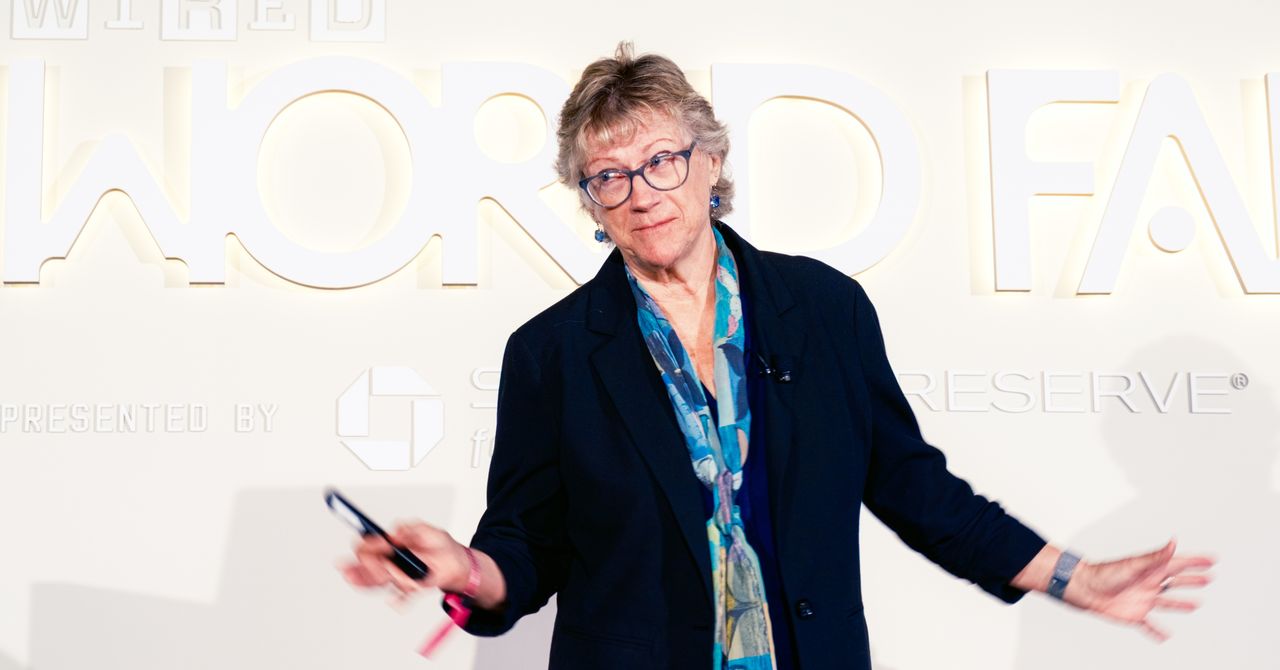
It’s been a 40-year wait, but AI is finally allowing Herzing to untangle what dolphins are saying, she told the audience at WIRED World Fair. Her research group has gathered countless hours of video and audio footage of dolphins, and it’s now working with scientists at Georgia Tech as well as Google DeepMind to give structure to dolphins’ language—if not fully translate it yet.
“With AI, we can find patterns,” she said, adding, “This is a powerful new tool. I’ve personally been waiting for it.”
The team has used some of that research to even attempt two-way communication by rigging up an underwater, wearable computer that can play dolphin sounds. That includes using sounds to indicate items like a scarf and habitat like sargassum—a seaweed. Two researchers would model behavior—one researcher would play the scarf sound, for instance, and then the other would play with it—and then see how the dolphins responded.
One of the challenges, though, is decoding communication from mimicry. “Even though we had these whistles and are labeling toys, there’s a big difference between mimicking and understanding the function,” Herzig said. “That’s hard to do in the wild.”
Working in a sanctuary or more controlled environment might help researchers suss out the difference, she said.
What dolphins are actually saying to each other remains a bit of a mystery. While Herzig’s team has done a job of finding patterns, a two-way conversation remains a ways off. That’s because while humans have made pretty decent headway in understanding dolphin social hierarchies and behavior, there’s more work needed to really enable a conversation.
“We might have the data and the structure, but what does it mean in dolphin culture?” she said. “That’s going to be an exploration on its own.”
Being able to talk with dolphins would, of course, be very cool. (Who hasn’t dreamed of talking with animals after all?) But ultimately our attempts to understand dolphins could help us understand more about ourselves and our relationship with the planet. Herzig said that when she asks people what they think dolphins would say to us, the most common response is along the lines of “the dolphins would say ‘Why are you messing up our ocean?’”
That answer, she said, “tells you how we are thinking about the world.”
Disclaimer : This story is auto aggregated by a computer programme and has not been created or edited by DOWNTHENEWS. Publisher: wired.com