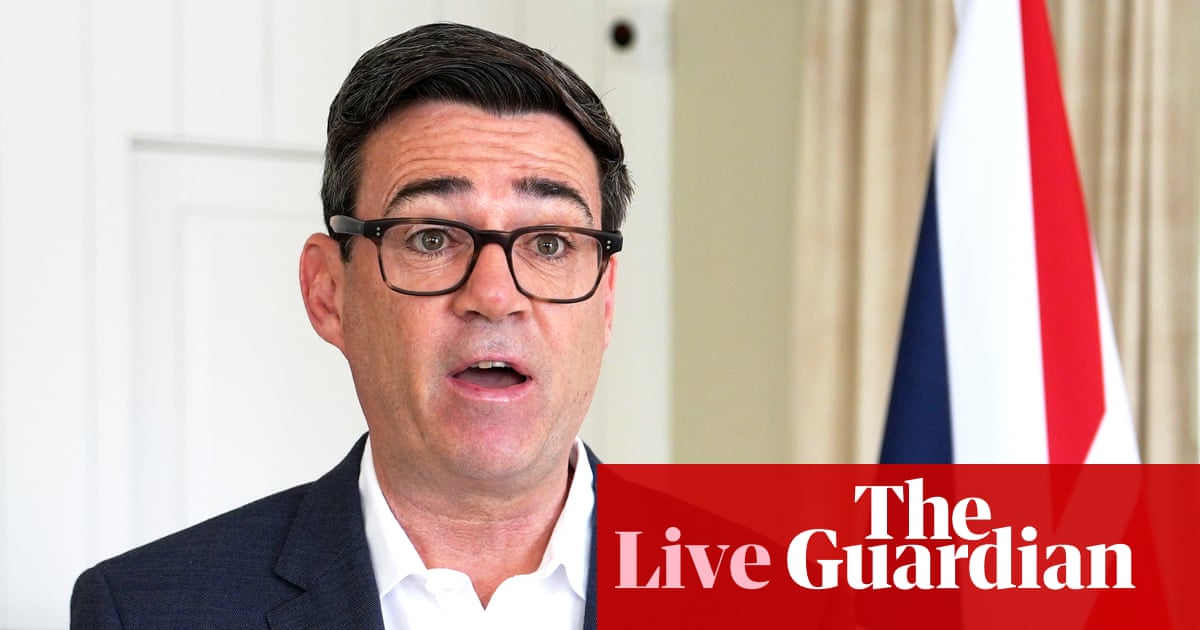
Andy Burnham has confirmed that his long-awaited 10-year plan may be delayed.
In his speech outside No 10 on the day he became PM, Burham declared that “later this year” he would “bring forward a new plan for Britain, a 10-year plan, laying out a path from where we are now to where I believe we all want Britain to be”. The document has been described as the core policy statement coming from No 10 this year, with some insiders briefing that the budget was relatively low-key because key announcements were being held back for the 10-year plan.
But we may have to wait a little longer then expected until we see it. In an interview with Hugo Gye from the Economist, when asked when it would appear, Burnham said:
We may go into the new year, to be honest … December or January, I think we will need to leave that open.
Burnham was speaking after Ailbhe Rea in the New Statesman published an article yesterday suggesting that, even when the initial 10-year plan announcement comes at the end of this year (or in January), that won’t be the final word. Rea said:
Yet, with expectations high, some familiar with the process are already worried that the Ten-Year Plan may be another kicking of the can. I can reveal that it may not be the long, comprehensive document that we might have expected, and will be the beginning – not the end – of a long consultation process.
It will be a speech, delivered by the prime minister before Christmas, to tick the box of a plan delivered “later this year”, accompanied by a document that may be “slimmer than expected”. It will mark the beginning of a six-to-nine-month process of consulting with the public, think tanks and everybody else about government priorities – as well as kickstarting work across government to define what some of its plans will look like in more detail. That process, in turn, will set the priorities for the spending review, itself a procedure that will take months. Suddenly, critics fear, we are looking at a government spending well over a year discussing its plans without taking the major action to address them.
Nigel Farage has claimed that he regards falling behind in the opinion polls as “perfect”.
Speaking on GB News, the Reform UK leader argued that it was easier for a party to campaign when it was not in first place.
For about 15 months from the spring of 2025 Reform UK had a clear lead in the polls. For much of that time, it was more than 10 points ahead of the party in second place (mostly Labour). But Labour regained its lead in most polls after Andy Burnham became PM and the Politico poll of polls now show Reform UK in joint second place with the Tories.
Commenting on this on GB News, Farage said:
What I do know in politics is, it’s much easier being slightly behind than being ahead. When election day is eight furlongs away, you want to come up on the rails …
Let me assure you, I have led parties that have been ahead and behind and being tucked in behind, if that’s what the public think, it’s absolutely perfect … Being ahead was terribly difficult.
In his Economist interview, Andy Burnham also said that he would not be inviting Vladimir Putin to the G20 summit in Manchester next year. Donald Trump has invited Putin to the G20 summit in Miami later this year.
But Burnham did say he was hoping Xi Jinping, the Chinese president, would attend. Hugo Gye writes:
[Burnham] points out that Mr Xi visited Manchester in 2015, and promises that “he will see a big difference”. The city has developed quickly, thanks in part to Chinese cash. This economic collaboration could be a pattern for future UK-China dealings, the prime minister suggests: “We proceed carefully, but I’m sure there is a real opportunity there.”
In his interview with the Economist, Andy Burnham said he wanted to “recast the arrangement” that the UK has with Mauritius for the transfer of the sovereignty of the Chagos Islands.
Quite what this means remains unclear. Hugo Gye, who interviewed Burnham, says the PM sees “the US-Denmark deal over Greenland as one possible model for the fate of Diego Garcia”. But that deal was about expanding the US military presence on Greenland. At the moment the US already has full access to Diego Garcia, which is much more of a US military base than a British one (although its use for bombing missions is subject to UK approval).
Keir Starmer’s government agreed to transfer sovereignty of the Chagos Islands to Mauritius in return for guarantees that the UK and the US would still be able to use the Diego Garcia military base for at least 99 years. Starmer judged this was the best way of ensuring the base (the only asset of value to the UK on the otherwise mostly unoccupied Chagos Islands) could survive in British hands. Without a sovereignty deal, there is a risk of international courts ruling Britain’s claim to the Chagos Islands is unlawful.
Originally Donald Trump approved this deal. But he changed his mind after the Starmer refused to support his war against Iran, in part because British rightwingers like Nigel Farage were urging him to veto the deal because they object in principle to sovereignty of UK territory being surrendered.
Andy Burnham has confirmed that his long-awaited 10-year plan may be delayed.
In his speech outside No 10 on the day he became PM, Burham declared that “later this year” he would “bring forward a new plan for Britain, a 10-year plan, laying out a path from where we are now to where I believe we all want Britain to be”. The document has been described as the core policy statement coming from No 10 this year, with some insiders briefing that the budget was relatively low-key because key announcements were being held back for the 10-year plan.
But we may have to wait a little longer then expected until we see it. In an interview with Hugo Gye from the Economist, when asked when it would appear, Burnham said:
We may go into the new year, to be honest … December or January, I think we will need to leave that open.
Burnham was speaking after Ailbhe Rea in the New Statesman published an article yesterday suggesting that, even when the initial 10-year plan announcement comes at the end of this year (or in January), that won’t be the final word. Rea said:
Yet, with expectations high, some familiar with the process are already worried that the Ten-Year Plan may be another kicking of the can. I can reveal that it may not be the long, comprehensive document that we might have expected, and will be the beginning – not the end – of a long consultation process.
It will be a speech, delivered by the prime minister before Christmas, to tick the box of a plan delivered “later this year”, accompanied by a document that may be “slimmer than expected”. It will mark the beginning of a six-to-nine-month process of consulting with the public, think tanks and everybody else about government priorities – as well as kickstarting work across government to define what some of its plans will look like in more detail. That process, in turn, will set the priorities for the spending review, itself a procedure that will take months. Suddenly, critics fear, we are looking at a government spending well over a year discussing its plans without taking the major action to address them.
Yesterday the pro-Brexit Guido Fawkes website published a list of items that it said could be banned as a result of Andy Burnham’s reset with the EU. It was based on items that have been banned under EU regulations passed since the UK left. Under the deal on food exports that has been agreed (but not yet published), the UK will have to align with EU sanitary and phytosanitary rules. And any further move to bring the UK closer to the EU could result in further regulatory alignment.
One of the items on the Guido Fawkes list was smoky bacon flavouring in crisps.
In an interview on Times Radio this morning, Stig Abell, the presenter, asked Angela Eagle, the environment secretary, if she would be happy to see smoky bacon crisps banned in the UK as a result of closer relations with the EU.
Eagle replied:
Oh, Stig. I mean, really, we’ve had EU straight bananas, and now we’re talking about banning smoky bacon crisps. I think you should get a life.
This is actually about ensuring that we can do business with our closest neighbours.
We’ve got huge potential growth in our economy if we allow our farmers and food producers to be able to export into Europe again without all the huge uncertainty and the costs and frictions that Brexit brought us.
This will be a deal that improves that situation and it will enable this economy to grow and for us to have higher levels of prosperity than we’ve had before.
If you want to obsess about smoky bacon crisps, I suppose that’s your choice.
When Eagle was referring to “straight bananas”, she was referring to one of the most famous myths propagated by Brexiters like Boris Johnson before the 2016 referendum claiming the EU wanted to set rules for bendy bananas. The EU does, in fact, have product standardisation definitions that ensure wholesalers can know what they are buying, but these don’t amount to a ban.
As Guido Fawkes points out Eagle did not say smoky bacon crisps wouldn’t be banned.
In another interview, Eagle also defended rejecting calls from British farmers for a 24-month transition to the new food export arrangements.
She said the new deal would bring “huge economic benefits”, adding:
The transition is a balance between getting and accessing those benefits as quickly as possible, but dealing with some of the transitional issues that you have to deal with whenever you’re moving from one system to another.
The Bank of England has raised interest rates for the first time in more than three years to combat rising inflation, as the Iran war continues to put upward pressure on energy costs, Heather Stewart reports. The widely expected move, which took the Bank’s base rate from 3.75% to 4%, was the first rise since August 2023.
Government plans for eight new regional water councils in England have been dismissed as a “cover for inaction” by the Liberal Democrats.
The proposals are being presented by the government as part of Andy Burnham’s devolution mission and they are intended to give all parts of England the advantages Greater Manchester has had from its regional water planning.
Explaining the proposals, the Department for Environment, Food and Rural Affairs says:
Eight new regional water councils will bring local leaders, customers and businesses together to set the priorities for their region, helping shape billions of pounds of investment in water and flood infrastructure.
Decisions about the water system are taken nationally, despite communities facing very different challenges. From Lake Windermere, where discharge of sewage has damaged local tourism, or in Cambridge, where drought and water shortages have stalled growth – local areas have not had enough influence over the decisions that directly affect them.
The new councils will change that, giving communities and local leaders a stronger voice over priorities including sewage and water quality, flooding, drought and future water supplies. Mayors will also receive new powers through the strengthened Water Bill to hold water companies to account for their performance.
Referring to the Manchester experience, Defra says:
Existing regional partnerships have already shown what can be achieved when decisions are shaped around local needs. Greater Manchester’s Integrated Water Management Plan has brought together planning, regulation and investment, with improved drainage helping support town-centre regeneration. In East Anglia, Water Resources East has brought partners together to tackle severe water scarcity, including the constraints it places on sustainable growth in Greater Cambridge.
But Tim Farron, the Lib Dem environment spokesperson, said the government should be going much further. He said:
The government has dressed up these water boards as community empowerment but it’s clear already that this is just a cover for excusing the next decade of inaction on water. The secretary of state [Angela Eagle] herself couldn’t spell out a single power these councils will have to stop our waterways being trashed – and there’s no sight of the long promised water bill to deliver reform.
What bill payers really need now is a new Clean Water Authority with the muscle to end the sewage scandal, ban unjustified bonuses and hold water executives legally accountable.
So-called honour-based abuse recorded by police in England and Wales has risen to a record high, the Press Association reports. PA says:
This kind of abuse can include female genital mutilation (FGM) and forced marriage.
There were 3,145 honour-based abuse-related offences recorded by forces in the two nations in the year to March.
This was up by 7% from 2,949 the previous year, data published by the Home Office showed.
The latest figure is the highest recorded since the year to March 2021, which the department said is the earliest year for which comparable data is available.
The Home Office cautioned that, as the data only covers offences reported to and recorded by police, it “is likely to only represent a fraction” of the actual offences committed.
It described honour-based abuse as a “hidden crime”, with victims sometimes reluctant to go to police or other authorities.
Improvements in police training and recognition of these kinds of crimes are also likely to be a factor in the rise in reports, the department added.
Here is a chart from the report with the overall figures.
And here is a table and a chart showing what these offences are.
Protesters across Europe are planning two days of action against datacentres this week with demonstrations taking place in 15 countries, Dan Milmo reports. The planned protests include an event in the Brick Lane area of east London, where a datacentre development has met local opposition.
Britons did not get to vote in the US midterm elections, but if they had, it is not hard to guess what would have happened. New research out today from the British Social Attitudes (BSA) survey shows that, under Donald Trump, Britons now regard the US as a greater threat to world peace than North Korea and China, and about as dangerous as Iran.
This is not great news for Reform UK, whose leader, Nigel Farage, used to boast about his friendship with Trump and some of whose policies are directly inspired by the Maga playbook.
Perhaps not surprisingly, BSA also found that, by a margin of more than four to one, people are now more likely to say Britain’s interests are best served by closer links to Western Europe than to the US. On this measure, British opinion is more supportive of Europe over the US than at any time in the past 40 years.
Again, these are also bleak figures for Brexiters in Reform UK and the Conservative party who argued that leaving the EU would be a good move because Britain would be better off aligned with the US.
In their London Playbook briefing for Politico, Andrew McDonald and Megan McElroy quote a Reform UK source downplaying the problems caused to the party by Trump’s toxicity on the grounds that Farage has been trying to distance himself from his old pal for a while now. They report:
Farage’s long friendship with Trump is something else bound to keep rearing its head. But we’ve been hearing much less about discussions or meets between the pair for some time. “A distancing has already been going on,” a senior Reform official told my colleague Sam Blewett. “I don’t think this [the US midterm election results] is going to change anything fundamentally. Reform is looking to be a UK government and though the US is important and has massive implications for international policy, nonetheless that doesn’t alter what Reform needs to focus on, and that’s U.K. interests.”
Efforts to reduce the proportion of young care leavers in England who are at risk of or end up homeless will ensure this group “don’t face a cliff edge just when they need support most”, the government has vowed. The Press Association reports:
There are more than 6,000 households with a care leaver aged 18-24 owed homelessness support by councils, according to official data.
The government estimates 2% of care leavers in this age group are deemed to be owed help from local authorities for homelessness each quarter, and is now pledging to halve that proportion by the end of this parliament in 2029/30.
Difficulties faced by care leavers were highlighted in a report published in August which found young adults who left care had a death rate around four times higher than the general population – having often been left alone “with no safety net and with catastrophic consequences”.
On turning 18 years old, people leaving care in England often lose “significant levers of support”, the government-commissioned report concluded as it warned the so-called “care cliff” must be addressed.
The government has set out the new target in a care leaver homelessness reduction action plan.
Josh MacAlister, the children’s minister, said:
Too many care leavers step into adulthood without a strong support network around them, and homelessness can be one of the tragic consequences.
We’re changing children’s social care from top to bottom, making enduring relationships the focus of the system and expanding support for care leavers to help ensure they have a place to call home.
Nigel Farage is holding a press conference later to formally announce that Angus MacIntyre, an RAF wing commander with a military career spanning 40 years, will be what Reform UK is calling its “shadow armed forces minister”.
That means he’s the party’s armed forces spokesperson. You are only a proper shadow minister if you are a member of the official opposition, which at the moment is the Conservative party. Farage has been criticised for some time for not having a defence spokesperson, and MacIntyre’s title implies Farage is still looking for someone who could be defence secretary in a Reform UK government. The actual armed forces minister is Louise Sandher-Jones, a junior member of the Ministry of Defence’s ministerial team.
Announcing MacIntyre’s appointment, Farage said:
Having someone of Angus’ stature and calibre speak for us on defence shows how seriously Reform UK takes protecting the interests of Britain’s military.
Angus has more experience than the entire government defence team combined. He is representative of our drive to bring into politics people with high-level and real-world experience – as opposed to career politicians – to run government departments.
In its news release, this is what Reform UK said about MacIntyre’s experience.
MacIntyre is a senior RAF regimental officer with a military career spanning 40 years. He stood down as a commissioned wing commander in the Royal Air Force in order to become the party’s shadow armed forces minister.
His 40 years of military service alone exceed the combined total of Labour’s entire defence team, with just two of their five ministers serving over 31 years between them. They also surpass the Conservatives’ shadow defence team, where five of seven have served for a collective 35 years …
A chief of the air staff’s fellow, MacIntyre earned an MA in applied security strategy at the University Exeter. He later spent a year in Mogadishu with the UN Headquarters in Somalia, negotiating between the UN and Somali National Army.
He also spent 12 months in the Pentagon as a joint staff J5 strategic planner, contributing to the five US global campaign plans and the global pandemic and infectious diseases framework, and helped integrate the US Space Force and Space Command into joint staff planning. He holds all three of the UK’s space qualifications.
Most recently he completed the Changing Character of War Course at Pembroke College, Oxford, and has lectured on Nato deterrence at All Souls College, Oxford.
Ministers are seeking to end the “wild west” of parked ebikes blocking pavements, as they attempt to crack down on antisocial behaviour such as cyclists jumping red lights, Peter Walker reports.
Good morning. Andy Burnham is back from the Commonwealth summit, but the Commons is on mini-recess until Tuesday, and there is not much in the political diary for today. But Nigel Farage, the Reform UK leader, will be holding a press conference, which means reporters will have the chance to ask him why his eve-of-poll “I don’t go with the consensus that Trump is going to get smashed” prediction turned out to be so wrong.
Another recent claim from Farage has been that, if the UK were to reapply to join the EU, it would have to sign up to the euro. This allegation was never taken particularly seriously by people who actually know how the EU works; while new members are theoretically obliged to sign up to the euro, six of the 27 current members do not use it, one has a formal opt-out (Denmark), and there is plenty of precedent to suggest the EU would easily accept a fudge giving the UK an opt-out.
This morning this has been confirmed by Michel Barnier, who was the lead negotiator for the EU during the Brexit process. In an interview with Cathy Newman for Sky News, he said it would be “perfectly possible to begin such a negotiation [on rejoining the EU] without any kind of obligation to take part in the euro”.
All EU new member states are legally required to join the euro area. However, Barnier said it would be “possible to negotiate a new relationship without this obligation”.
But the EU would not compromise on free movement, Barnier said:
But what is, and what remains unnegotiable, is the condition to join the single market. There is no negotiation possible. No possible negotiation on any kind of cherry-picking or the single market ‘a la carte’. The UK knows quite perfectly the condition to be part of and to rejoin the single market and the customs union.
Here is the agenda for the day.
10am: Sadiq Khan, the mayor of London, and Sir Mark Rowley, the Metropolitan police commissioner, are questioned by the London assembly.
Noon: The Bank of England announces its decision on interest rates. They are expected to go up.
2pm: Nigel Farage, the Reform UK leader, holds a press conference with Danny Kruger, how is in charge of the party’s preparations for government.
I’m afraid we are no longer able to have comments open below the line every day on this blog. If you want to contact me, please email politics.live@theguardian.com. You can use this email to flag up corrections, comments for publication, questions or complaints.
Disclaimer : This story is auto aggregated by a computer programme and has not been created or edited by DOWNTHENEWS. Publisher: theguardian.com