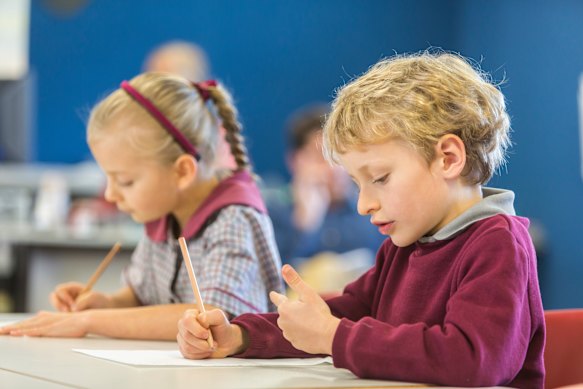

National education authorities have revealed a return to foundations in mathematics classrooms across the country and a screen time “detox” in Australian classrooms, but Queensland remains resistant to the technological shake-up.
Following a meeting of state and federal education ministers on Monday, federal Education Minister Jason Clare said every state minister had agreed to “set or consider” screen-time limits and artificial intelligence bans in schools.
The national assessment authority also revealed a set of curriculum changes the meeting green-lit, including a simplification of the national primary mathematics curriculum sparked by slumping NAPLAN scores.
Queensland Education Minister John-Paul Langbroek reiterated the state’s hesitant stance to following interstate technology crackdowns, which include incoming screen-time limits and device-free learning periods.
The minister said other changes discussed in the meeting – including a possible return to pen-and-paper NAPLAN tests for year 5 students in 2028 – were subject to approvals from the national assessment authority.
However, curriculum changes recommended by the Australian Curriculum, Assessment and Reporting Authority could be rolled out in Queensland as early as next year.
These included tweaks designed to boost mathematics learning for early years primary students, and new topics covering antisemitism, following recommendations made after the Bondi Beach terror attack last December.
Among the mathematics revisions were more accessible language choices, an earlier introduction to financial literacy, sequenced content – which provided step-by-step learning building from basic concepts – and, in some instances, stripping out references to technology use or proposed teaching methods.
ACARA chief executive Stephen Gniel said the aim was to prioritise mathematical content, although that did not rule out the “purposeful use” of digital devices.
“Ultimately, these changes are about giving every child the strongest possible start in mathematics, while supporting teachers with a clearer and more practical curriculum,” Gniel said.
However, Brisbane-based mathematics education researcher Professor Vince Geiger, from the Australian Catholic University, said technology could help link maths learning to real-world scenarios, even in primary school.
“There’s actually a lot of really important uses and opportunities there for kids to learn maths in a deeper and richer way,” he said.
“How do kids understand what money is like, and how to use money when we don’t have coins anymore?”
He said a focus on “the basics” also ran the risk of disengaging students.
“I’ve always said that it’s equivalent to learning how to play sports … if you’re playing cricket, imagine that all you’re allowed to do for the 12 years in school is practice in the nets and never be able to play a game,” he said.
Start the day with a summary of the day’s most important and interesting stories, analysis and insights. Sign up for our Morning Edition newsletter.
From our partners
Disclaimer : This story is auto aggregated by a computer programme and has not been created or edited by DOWNTHENEWS. Publisher: www.smh.com.au