For all of the things that didn’t go right in the Brian Kelly era at LSU, the hiring of Blake Baker to be the defensive coordinator was a game changer for the Tigers, and even after changing head coaching regimes, Lane Kiffin elected to keep Baker around to continue leading up that side of the ball.
If you’re interested, Cody Alexander at Matchquarters.com has a cool piece from this offseason on Baker’s scheme. It’s partially paywalled, but still has a free intro, and honestly, this site is worth a subscription anyway.
LSU defensive coordinator Blake Baker runs one of the most aggressive pressure systems in the country, with a near-50% Pass Blitz Rate (PBR), ranking seventh in the Power 4. That high-pressure approach is built into Baker’s schematic DNA, tracing back to his roots in the coaching tree of current Duke head coach Manny Diaz.
Having worked under Diaz at Texas, Louisiana Tech, and Miami, Baker reflects his mentor’s approach by avoiding passive four-man rushes and instead relying on heavy blitz packages to dictate terms to opposing offenses consistently. The Tigers’ defense is unique, though, in that it operates within a structural paradox.
LSU has always been able to carry elite defensive back play. Man coverage has been a main tool for most defensive coordinators in Baton Rouge. Even the zone-dominant Dave Aranda played mostly “Wizard 1” (four-man rush with Cover 1) during his tenure.
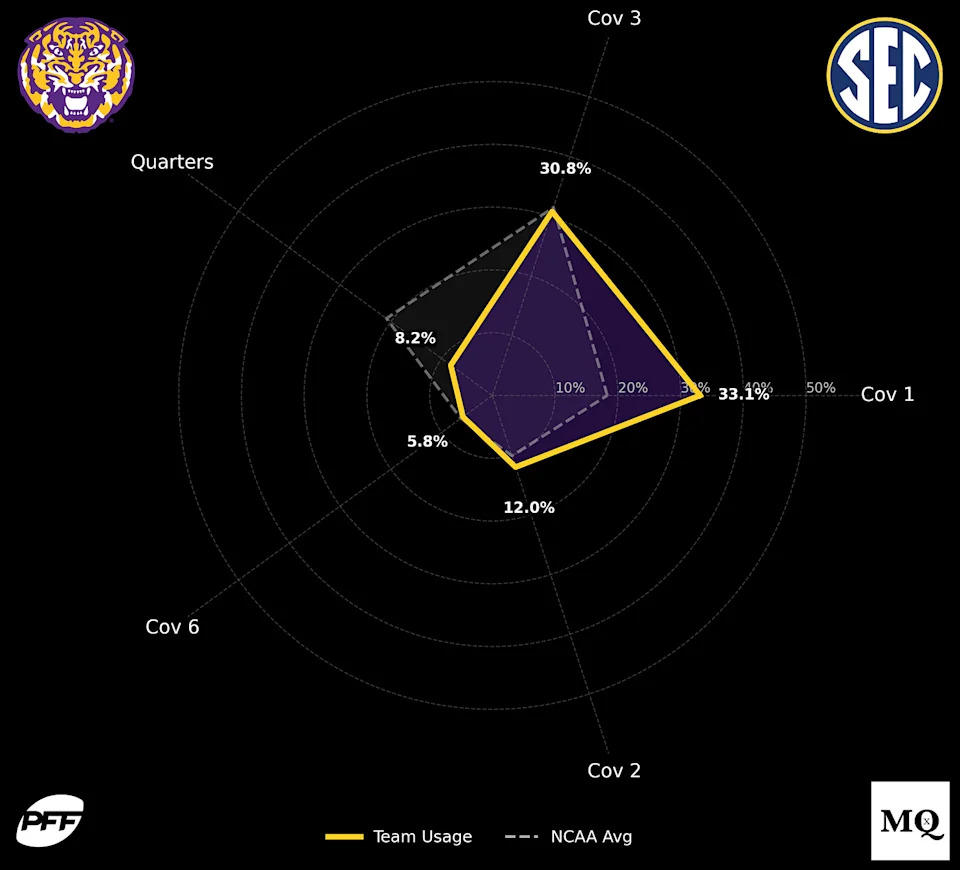
On standard downs, LSU ranked sixth among the Power 4 in Cover 1 usage (34%), with Cover 3 accounting for another 35% of the pie. Varied split field coverages made up the rest.
Coverage, for the most part, was not an issue, which is why the Cover 1 numbers were so high, but the pass rush was. LSU only recorded 24 total sacks, ranking 100th in Sack%. On passing downs, Baker had to consistently amplify the rush by sending numbers. The metrics validate his efficiency as a blitz designer:
Unblocked Pressures (UBP): 5th in the FBS, proving schematic manipulation over raw physical wins. When LSU blitzed, Baker understood how to attack the protections.
Average Time To Pass (ATTP): 16th in the FBS at 2.36 seconds, forcing the ball out before routes could develop. When LSU blitzed, the pressure got there fast, only amplifying an already stout secondary.
Though LSU operates one of the most aggressive systems in the country, sending five or more rushers on 70% of its blitzes, Baker leans heavily into “safe” zone coverages rather than exposing his secondary in man coverage. When sending numbers, the Tigers completely flip from a man-match defense to pure zone. LSU’s structural shift cuts its standard Cover 1 usage to 30% while flooding the backend with Fire Zone coverage on 52% of pressure downs.
Now, for what it’s worth, there have been some frustrations with Baker’s defense this year. They’ve mostly dominated their overmatched competition, but they gave up 32 points and 35 points in losses to Ole Miss and Kentucky. Passing defense was a big problem for them against the Rebels, while the Wildcats were able to hang a bunch of yards in both the passing and the rushing game on them.
Advertisement
Advertisement
Advertisement
Outside of those two games, though, they’ve been stellar. And most impressively, they’re 4th in the country in “havoc rate”, with 22.2% of their defensive plays being a tackle for loss, forced fumbled, pass deflection, or interception. If you like advanced catch-all metrics, their defense is #2 in the country in FPI while they are #5 in the country in SP+.
The main place they’ve struggled is their rushing defense consistency. They get a lot of tackles for loss, but when they don’t, they’re 80th in the country at giving up explosive runs, and the overall EPA per play on rushing plays is in the bottom half.
Essentially, they’re extremely aggressive up front while simultaneously playing safe zone coverages on the back end, and it lends to big rushing plays if the team can get around that initial punch into the backfield.
The big names on this LSU defense are right up front, with edge rushers Princewill Umanmielen and Jordan Ross both transferring in after big years at Ole Miss and Tennessee in 2025. Umanmielen has been arguably the best edge rusher in the country this year, with 8.5 sacks and 12 tackles for loss already this season, while Ross isn’t far behind at 5 sacks and 9.5 TFLs. With those two commanding so much attention on the edges, true freshman defensive tackle Deuce Geralds has stepped up in the middle and has 5 sacks of his own from the interior.
Advertisement
Advertisement
Advertisement
At linebacker, star inside backer Whit Weeks has been out for over a month with an injury, and while many thought that this would be the game he returned to action after a bye week, Weeks was listed as doubtful on LSU’s injury report yesterday. In his stead are Davhon Keys and TJ Dottery, both smaller, speedy linebackers, but both played plenty of SEC snaps a year ago and are more than competent at the position.
The defensive backfield is pretty much the only part of the LSU team that wasn’t built through the transfer portal. DJ Picket is a 6’4″ corner who was a freshman All-American last year as a rotational piece and has now moved into a full time starting role, leading the team with 7 pass breakups so far.. He’s bookended by the much smaller 170-pound PJ Woodland, who was a solid starter for LSU all year last year. At the back end, Tamarcus Cooley returns to resume his starting role from last year. Redshirt freshman Jhase Thomas is the one guy in the crew that’s getting his first real starting action this season.
Finally, the nickelback is Ty Benefield, a first team All-MWC player for Boise State a year ago who’s a physically imposing 6’3″ 216 hybrid DB. He’s third on the team with 33 tackles.
Honestly, I don’t love this matchup for the Alabama offense. To this point, Keelon Russell hasn’t consistently shown he can beat a team willing to blitz him without relying on his ability to make a man miss, and I’m not sure these are the caliber of athletes that Russell can just consistently make free rushers miss him. Their biggest weakness is an overaggressiveness that can lead to some big runs or some good quick passing game – and to this point Alabama has only intermittently been able to do the first and really hasn’t been able to do the latter at all this season.
Advertisement
Advertisement
Advertisement
If the Tide can really get their counter run game going again like they were earlier in the season, then that’s likely their best chance to score points. Basically – follow the second half game plan from the Kentucky game. The problem is, have we seen them with the patience to do that ever since? I’m not sure.
I don’t have a great feeling about this one. The Tide offense has a lot of growing up to do this week if they want to prove they deserve a #5 ranking. And sure, getting Ryan Coleman-Williams, Racin Delgatty, and EJ Crowell healthy (hopefully) should make a big difference compared to what we’ve seen the past few weeks, but we also need to see a lot of improvement from Russell, Ryan Grubb, and the group as a whole if we’re going to see Alabama pull of a win.
My best guess? 24 points for the Tide.
Disclaimer : This story is auto aggregated by a computer programme and has not been created or edited by DOWNTHENEWS. Publisher: Sports.yahoo.com