
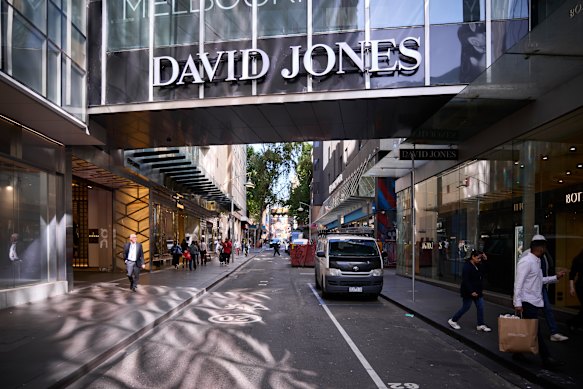
The future of David Jones hangs in the balance, as the 188-year-old department store chain finds itself in administration. As Australians grapple with the collapse of the once mighty business that predates Federation, here’s everything you need to know about what’s happened and what we can expect from here.
Why is David Jones in trouble?
The department store giant is among many businesses that have found themselves scrambling to adapt to a fast-changing retail environment, largely due to the disruption of the internet.
Warning signs of financial distress had been building for years. The corporate regulator is currently investigating David Jones for filing its 2025 accounts late. Last week the group failed to file its financial account for 2026 on time.
When it did file its 2025 accounts, they showed a business with declining sales and mounting losses, struggling to compete with an influx of nimble online-centric retailers and overseas-based fast fashion brands which consumers have been flocking to instead.
Why is it in the news this week?
David Jones’ troubles boiled over this week, when the department store operator’s private equity owners, Anchorage Capital, failed to reach a deal over rent with a major landlord, Scentre Group, the owner of the Westfield shopping centre chain.
On Thursday, after missing key rent bills, David Jones’ chief executive and board directors handed the reins of the business to voluntary administrator McGrathNicol, which will run a sale process for the retailer. Meanwhile, FTI Consulting has been appointed receivers and will handle the company’s operations.
Are the stores still trading? What does being in administration mean?
David Jones stores are still open for business, but many already look very different. In the hours after the business confirmed it had entered administration, luxury brands such as Gucci, Scanlan Theodore, Yves Saint Laurent and Oroton deserted their concession stores within David Jones premises, leaving many shelves empty. By pulling their stock, the brands are limiting their exposure to the chain, which is unlikely to pay its debts, including for items sold, in full.
Women’s shoe departments now appear largely empty, while displays meant to showcase designer offerings are also barren. Beyond some designer offerings, stores are still open, with many Australians visiting this week to get what could be a final look at their local store.
Entering administration is not necessarily a death knell for a business, with the company hopeful of restructuring the department store to be more viable in the current retail landscape. Industry observers say a slimmed-down David Jones could emerge.
Which stores might close?
David Jones’ flagship inner-city locations around the country, such as Bourke Street in Melbourne and Elizabeth Street in Sydney, are likely to keep trading but many of its lower-end suburban stores could shut down. Those locations have traditionally found it harder to support the high-end brands that can make a David Jones store profitable.
The administrators and receivers have not yet confirmed any store closures among the company’s 38 locations, but that total could reportedly fall to as low as 12. The stores seen as most likely to close are those in Parramatta and Hornsby in Sydney, Woden in southern Canberra, Cannington in Perth, and Cheltenham in Melbourne.
Other stores at major risk, according to an analysis by financial firm MST Marquee cited by the ABC are: Warringah Mall in Sydney; Robina, Indooroopilly and Sunshine Plaza in Queensland; Marion in South Australia; Doncaster in Victoria; and Booragoon and Karrinyup in Western Australia.
High-end suburban locations such as Melbourne’s sprawling Chadstone mall and Chatswood Chase in Sydney’s northern suburbs are likely to survive.
What happens to gift cards?
As of Thursday, David Jones was still accepting gift cards, but that may yet change. Purchasing gift cards appears to have been disabled on the chain’s website. Other retailers have cancelled gift cards when they have gone into administration or added onerous conditions for their use, such as requiring customers to spend twice the value of the gift card to redeem one. David Jones-branded credit cards are no longer being issued, though they can still be used.
Is everything on sale?
While no specific sales have been mentioned yet, the receivers are expected to aim to keep the retailer open for the forthcoming Black Friday and Christmas holiday shopping periods. Generous sales across different departments had become common across the chain in recent times as it struggled to attract customers through its doors.
Will staff keep their jobs?
Hundreds, if not thousands, of David Jones’ workforce of about 6000 are all but certain to be made redundant as part of the administration when the stores they work at are shut down. Federal law means they are a priority group when it comes to working out who gets what from David Jones’ limited pool of cash. Under the company’s enterprise agreement, employees who have worked for the company for at least one year get four weeks’ pay if they are made redundant, and those who have served longer get more, all the way up to 24 weeks’ pay for those with two decades of service. If David Jones cannot pay for those redundancies itself, the federal government will step in under a scheme known as the Fair Entitlements Guarantee.
Read more on the collapse of David Jones:
The Business Briefing newsletter delivers major stories, exclusive coverage and expert opinion. Sign up to get it every weekday morning.
 Elias Visontay is a National Consumer Affairs Reporter at The Sydney Morning Herald and The Age.Connect via email.
 Nick Bonyhady is the business editor of The Sydney Morning Herald and The Age. He is a former deputy federal editor, technology editor and industrial relations reporter.Connect via X or email.
From our partners
Disclaimer : This story is auto aggregated by a computer programme and has not been created or edited by DOWNTHENEWS. Publisher: www.smh.com.au




