
Staff writers
Updated ,first published
The Australian sharemarket has slumped at the open after a brutal selloff swept through Wall Street, led by stocks tied to the buildout of AI data centres.
The S&P/ASX 200 fell by 1.5 per cent in the first five minutes of trade but has clawed back some of the early losses to be down 89.1 points, or 1 per cent, to 8976 at 10.35am AEDT.
Mining stocks have tumbled with BHP falling 5 per cent, Rio Tinto 4 per cent and Fortescue 3.2 per cent. Gold miners have also slumped, with Northern Star down 3.6 per cent and Evolution 4 per cent lower.
Technology stocks have fallen across the board on the back of the meltdown on Wall Street’s Nasdaq index. Megaport tumbled 9.5 per cent, Codan shed 3.9 per cent, Xero and Technology One lost 1.9 per cent, while Australia’s most valuable tech company WiseTech retreated 1.8 per cent.
Financial stocks are helping to limit the bourse’s losses with gains across the board. Commonwealth Bank added 1.1 per cent, Westpac rose 0.6 per cent, National Australia Bank jumped 2.2 per cent and ANZ added 0.4 per cent. Macquarie Group slumped 4.4 per cent as it was hit with a $100 million capital penalty by financial regulator APRA, saying it breached capital requirements for its non-bank businesses. The wealth giant also reported half-year profits of $2.48 billion.
Energy stocks are mixed as oil prices advanced overnight after a steep drop in the previous session. Woodside added 0.7 per cent and refiner Ampol edged up 0.1 per cent, but Santos lost 0.8 per cent in early trade.
The Australian dollar is weaker at US69.52¢.
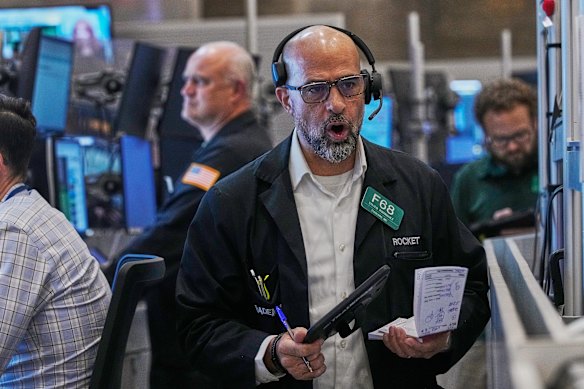
Overnight, the S&P 500 fell 4.4 per cent for its worst drop since President Donald Trump shook markets worldwide in April 2025 with his “Liberation Day” tariffs. The wipeout more than erased the market’s gain from the day before, which was its best in three months. The Dow Jones Industrial Average dropped more than 1800 points, and the Nasdaq composite tumbled 5.5 per cent. In all, about $US3.2 trillion ($4.6 trillion) was wiped off Wall Street.
AI stocks worldwide felt pressure as worries rise about possible moratoriums on data centres following Democratic victories in the US midterm elections.
Stock markets worldwide felt pressure from continued drops for companies that benefited from the boom in the artificial-intelligence technology industry, and South Korea’s Kospi index tumbled 5.3 per cent. Such stocks have been swinging for months on worries that the construction of further AI data centres may slow because of how expensive it’s become to borrow money.
Tuesday’s US midterm elections added another challenge. The nationwide victories by Democrats raised the possibility that governments could force pauses in construction of more data centres. That would mean fewer purchases of AI chips, not to mention electricity and other products and services that are getting vacuumed up in the AI frenzy and driving much of the US economy’s growth.
Nvidia fell 9.3 per cent and was by far the heaviest weight on the S&P 500, a day after dropping 3.2 per cent. Advanced Micro Devices tumbled 17.3 per cent. CoreWeave, a company that rents access to AI chips to customers over the cloud, fell 9.8 per cent.
GE Vernova, which has been helping to power data centres, sank 7.5 per cent.
AI chip stocks are some of Wall Street’s most influential because they’ve become some of the largest. A 1 per cent move for Nvidia, for example, has more effect on the S&P 500 than a 1 per cent move for nearly any other US stock.
The losses were broad, with every sector in the S&P 500 losing ground. The overwhelming losses drowned out a few big gains, including a 31 per cent jump for AppLovin after the marketing platform reported both revenue and profit that topped analysts’ expectations. The company also approved a program to send up to $US3.2 billion ($4.6 billion) to its investors by buying back its own stock, bringing the program’s total potential value to $US3.6 billion.
Tapestry rallied 7.1 per cent after the company behind the Coach and Kate Spade brands likewise delivered a stronger profit than expected. It also raised its forecasts for revenue and earnings this fiscal year.
Stock prices tend to follow where corporate profits and interest rates go over the long term, depending on them much more than on who controls what in Washington.
In other financial markets, the initial knee-jerk reaction to the US midterm election results faded a bit. The price of a barrel of Brent crude oil rose 2.6 per cent to $US97.11 and recovered a chunk of its nearly 9 per cent drop from the day before. Uncertainty still reigns about what will happen in the war with Iran and when the global energy industry can return to normal.
In the bond market, Treasury yields continued to ease. The yield on the 10-year Treasury fell to 4.83 per cent from 4.90 per cent late Wednesday. It had been at 4.95 per cent on election night and above 5.30 per cent last month.
That could be a signal that investors are herding into US Treasury bonds in search of something that’s safer to own than stocks. The drop also came despite some encouraging reports on the US economy.
Fewer US workers applied for unemployment benefits last week. A separate report, meanwhile, suggested overall productivity for US workers improved by more during the summer than economists expected. That could help the economy grow without adding pressure to the nation’s high inflation.
In stock markets abroad, indexes were mixed in Europe and Asia. Besides South Korea, Japan’s Nikkei 225 also felt the sting of drops for tech and AI-related stocks and sank 1.8 per cent.
London’s FTSE 100 dipped 0.4 per cent after the Bank of England increased its main interest rate for the first time in three years to help limit high inflation.
The bank said its next moves on interest rates largely hinge on what happens with the Iran war, which sent oil prices and inflation higher worldwide.
“We’ve seen encouraging news in the past 48 hours,” Bank Governor Andrew Bailey said at a press briefing. “The best thing that can happen is to resolve the conflict in the Middle East; there’s no question about it.”
AP, Bloomberg
The Market Recap newsletter is a wrap of the day’s trading. Get it each weekday afternoon.
From our partners
Disclaimer : This story is auto aggregated by a computer programme and has not been created or edited by DOWNTHENEWS. Publisher: www.smh.com.au



