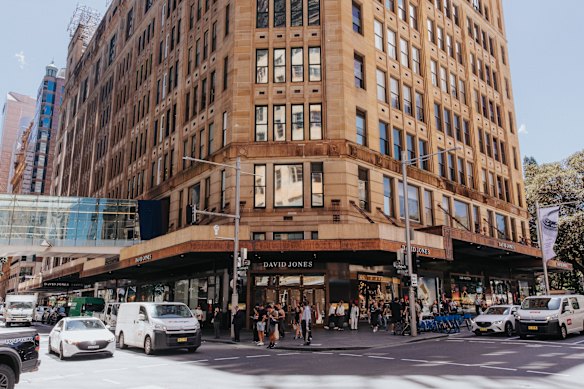

The first time the once great retail empire David Jones collapsed, it was blamed on the economic difficulties of the day, a slowdown in spending across Sydney and poor management decisions.
The iconic department store almost did not survive past its 22nd birthday.
The company founder, David Jones, had retired, retreating to his recently purchased £12,000 mansion, Barncleuth, in Elizabeth Bay, and leaving the management of David Jones & Co to his partners and son-in-law.
But when David Jones collapsed in 1860 amid debts of more than £150,000, Jones came out of retirement to run the family business.
Historian Cathy Jones said Jones sold Barncleuth, among other assets, to help settle the company’s debts. By the time he died in 1873, business was booming.
Author Helen O’Neill said the David Jones family was “as close to aristocracy as Australia seemed to have at that time”.
“They approached retail like theatre, and it was absolutely high-end theatre,” said O’Neill, whose book David Jones’ 175 Years was commissioned by the department store and published in 2013.
Sydney’s fortunes soared with the Jones’ then, over decades, survived several more cycles of bust, including two world wars, the Great Depression and the COVID-19 pandemic. Throughout it all, one constant remained: David Jones, feeding, clothing and cheering generations of its families.
“David Jones had such history. It was a cultural icon; there’s no question about it. It had that sort of cachet. You can’t invent it and can’t buy it. David Jones earned it,” said O’Neill.
But no amount of cachet could save David Jones this week, when it collapsed again, leaving 6000 jobs in limbo and shelves stripped bare as dozens of high-end brands such as Gucci, Oroton and Yves Saint Laurent abandoned the concession stands.
This time, there is also no family member waiting in the wings to rescue the family namesake. No descendants of Jones have been involved in running the retail giant since 1980s.
“If David Jones were to collapse completely at this point, that would be one of the great tragedies and great losses,” said O’Neill.
If 2026 is its nadir, 1927 was its heyday.
That year, Jones’ grandson Charles Lloyd Jones opened the flagship “Wonder Store” on Elizabeth Street.
Crucially, it was across the road from the newly opened St James Station. Joining David Jones in the centre of Sydney were the grand emporiums of other retail giants, named after the wealthy families that controlled them: Anthony Hordern & Sons, Grace Bros, Mark Foy’s, Waltons and Marcus Clark.
When the David Jones men’s store opened on Market Street about a decade later, then prime minister Billy Hughes did the official honours, declaring it “a magnificent temple of commerce”.
“Charles Lloyd Jones brought the business acumen of this family and his own artistic mind to the job, and that was a recipe for innovation,” said associate professor Mark Ian Jones, a design historian at the University of New South Wales, who recently won an Australian Research Council grant for a three-year study of the cultural dimensions of David Jones.
Under Lloyd Jones’ leadership, David Jones’ famous houndstooth print was introduced, window dressing was treated as a key part of its advertising, and the mail order catalogue offered country people the glamour and sophistication of David Jones.
“Unknown to themselves, they were creating a cultural institution,” said David Jones’ former national head of public relations, Skye Leckie. “People would go there to see Santa Claus for the first time, get their school uniform, see the flower show, the fashion parades, the Christmas windows or even a dinner plate presentation by Lord Wedgwood. These were things that brought families together throughout the year.”
Staged events that drew a crowd, rather than just shoppers, have been a feature of the David Jones business for most of its history, particularly during retail booms like the 1950s.
There was the first exhibition of Aboriginal art in 1941, the opening of the David Jones Art Gallery three years later, the first Christian Dior “new Look” fashion parade outside of Paris in 1948 and a state banquet for the newly crowned Queen Elizabeth in early 1954.
That same year, the first international exposition was held at the Elizabeth Street store, called Sweden at David Jones, which became an almost annual international showcase of the best of design from around the world.
As part of the celebrations to mark the 120th anniversary, an Indian elephant called Eddie was brought into the store to sign autographs, 1440 pigeons were released from the awning on Elizabeth Street to represent each month of the company’s existence, there was also a treasure hunt worth £5700, and level five was given over to a display of kangaroos, wallabies, koalas and black cockatoos.
“It wasn’t so much about selling things to people but bringing new ideas to Australia, and using these events and international expositions as a type of window to the rest of the world,” said Mark Ian Jones. “And it was there for all Sydneysiders, not just the people who could afford the high fashions.”
“David Jones was doing this at a time when we didn’t actually have design museums. So there was a department store taking on the status of a cultural institution in the absence of one.”
Funding it all was a consumer market dominated by a handful of family-owned department stores. David Jones was billed as the high-end option.
“In the 1950s roughly half of all metropolitan retail spending occurred within a few blocks in the city. So department stores had this enormous market share,” said associate professor Matthew Bailey, a retail historian at Macquarie University.
Leckie recalls the thrill of working at David Jones as a management trainee in the early 1980s. At the time, the managing director, Brian Walsh, used a “mountain of marble” as part of a makeover of the ground floor and turned level six into a haven called Seventh Heaven.
“You had your own shopper, and they would have a model come out in the latest couture designs while you had a glass of champagne. It was something we’d never seen before in Australia,” Leckie said.
Sally Burleigh recalls similar grandeur and a sense of magic when she took on a similar role to Leckie, helping to launch the careers of stars like Megan Gale, Miranda Kerr, and Sass & Bide.
“David Jones created this fashion family. Megan Gale was the face, and the big designs of the time were all part of it: Carla Zampatti, Collette Dinnigan, Easton Pearson, Jenny Kee, Akira Isogawa,” said Burleigh.
But, adds Burleigh, the spirit of David Jones was always in the doormen, the window displays, the piano player and women dressed in black on the floor who seemed so glamorous, and later inspired the novel The Ladies in Black by Madeleine St John that was made into the 2018 movie directed by Bruce Beresford.
“That’s what David Jones has lost,” Burleigh said. “People go into the stores because they want service. They want an experience. If you walk in now, there’s no one there. If you go up to the counter they’ll tell you they don’t work for David Jones, and they’ll leave you on your own to try and find someone to take your money.”
Bailey said the collapse of the once great city department stores could be traced back far earlier than online shopping: cars fundamentally changed the way people shop in the mid-20th century.
“The solution was the suburban shopping centre. If you look at any of the big, early shopping centres like Warringah Mall, Miranda Fair, Bankstown Square [that opened in the 1960s], there were 30 to 40 specialty stores and a department store that took up half the retail space,” he said.
“Then the discount stores like Kmart and Big W came through from about 1969, and they offer super labour-efficient things like self-service, which placed more cost pressures on the big department stores.”
Competition mounted with the arrival of big-box retailers, like Spotlight for textiles and Rebel for sporting goods, referred to as “category killer stores” by Bailey. “They basically take the department out of the department store,” Bailey said. “And all the while, through all these changes, the department store just shrinks and shrinks.”
It was not until the 2010s that online shopping became a major market disrupter, by which time David Jones had been floated on the ASX in 1995. It was bought out by South Africa’s Woolworths in 2014 for $2.1 billion and resold in 2023 for less than $100 million to Anchorage.
Sydney’s other retail dynasties, such as like Anthony Hordern & Sons, Waltons, Grace Bros and Mark Foy’s have long since been consigned to history. “All these forces are at play for Myer as well,” Bailey said.
On Friday, the pianist was still playing to a bustling lunchtime crowd at the flagship Elizabeth Street store.
Among those listening were supporters taking what may well be their last look around, and shoppers happy to take advantage of discounts. “Offer ends Sunday,” one sign read.
The Business Briefing newsletter delivers major stories, exclusive coverage and expert opinion. Sign up to get it every weekday morning.
 Lucy Macken is an investigative reporter for The Sydney Morning Herald.Connect via X or email.
From our partners
Disclaimer : This story is auto aggregated by a computer programme and has not been created or edited by DOWNTHENEWS. Publisher: www.smh.com.au