Most people are blaming President Trump for the Republican wipeout in the midterm elections, but not Viktor Shvets and Claudia Wang at Macquarie. The blue tsunami was triggered years ago by the U.S. Supreme Court, they argued in an unusually breathless note sent to clients yesterday.
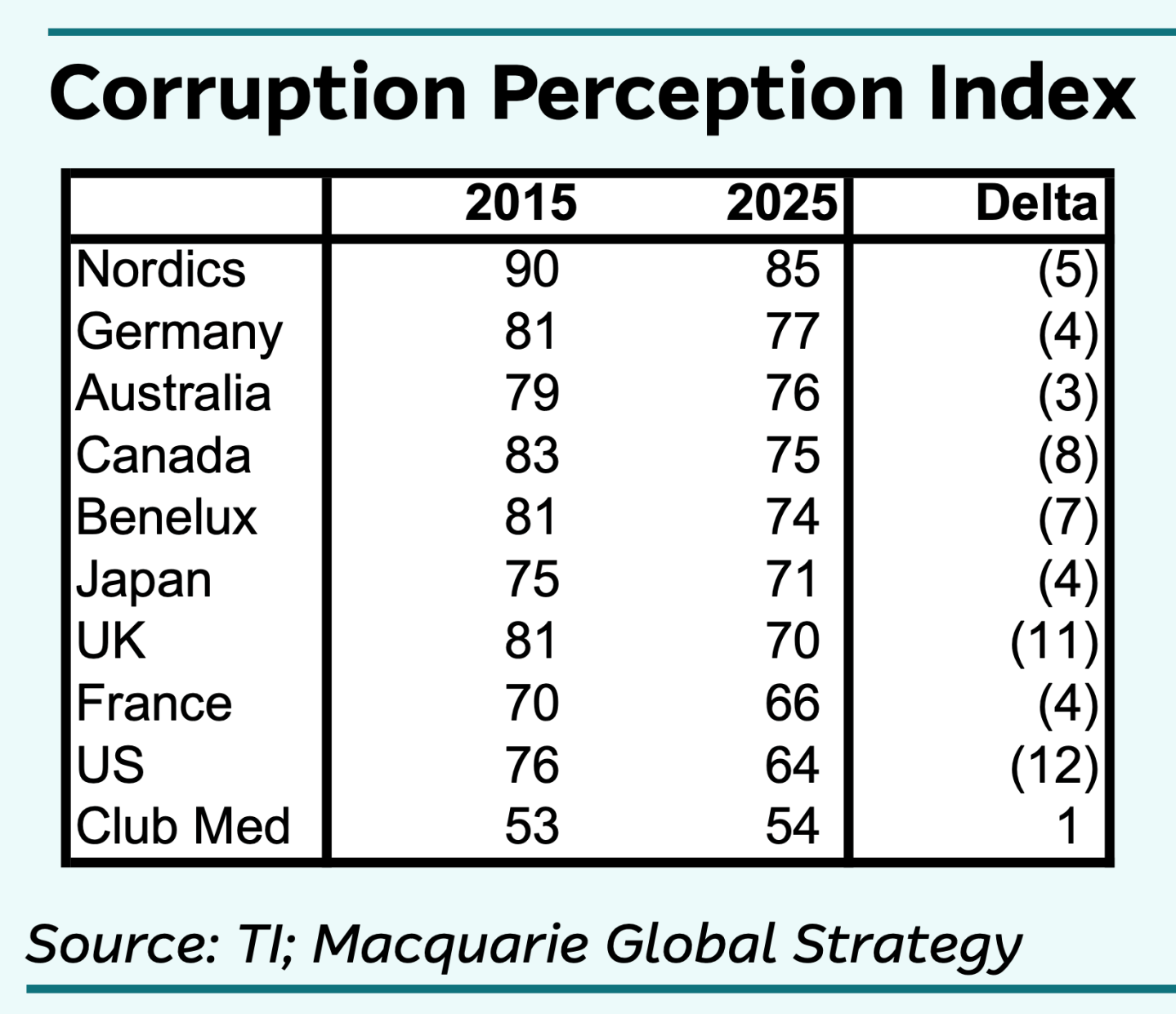
Partisanship has weakened the institutions of U.S. democracy (“independent judiciary, impartial bureaucracy, control of corruption”) ever since President Clinton and House Speaker Newt Gingrich clashed in the 1990s, they say. As evidence, they cite the U.S. slipping down Transparency International’s corruption index:
But after the Great Financial Crisis of 2008, “the conservative SCOTUS turned activist” and began eroding congressional oversight. At the same time, “SCOTUS has not only granted virtual immunity to the president, but also eliminated the century-old tradition of independent civil service, including independent agencies: all now serve at the president’s pleasure. The only partial exception was granted to the Fed.”
The result is that “SCOTUS appears to be restructuring institutions around a generic future elected monarchy, with only three truly independent pillars: the president, SCOTUS and Fed.”
Can the nation be saved? Yes, they say, “if Republicans descend into civil war, survival instincts may kick in, creating a bipartisan coalition that might push through middle-of-the-road bills addressing some of these issues. If Trump vetoes too many, the future of the Republicans would dim in ’28.”
“Thus, the proverbial ‘self-correcting’ nature of the U.S. might work again,” they wrote, “But it won’t be easy.”
THE MARKETS
U.S. futures signal the carnage of the last 24 hours may be overdone
The carnage may be about to end: Nasdaq futures were up 1.18% this morning before the open in New York. S&P 500 futures were up 0.24%. Traders seem to be signaling that the massive selloff in tech stocks over the last 24 hours may be overdone.
The Nasdaq 100 fell 6.36% yesterday, and the index is firmly in correction territory. The S&P was down more than 4%—a huge step down for the blue chip index. More than $3 trillion in market cap was lost. Twenty-two Asian billionaires lost $18 billion of their net worth, Bloomberg calculated.
Asia and Europe followed suit today, with steep losses across the board.
The selling was triggered by the results of the midterm elections in the U.S., which saw the Democrats take over Congress and many statehouses. They are likely to curb the tech industry’s rush to build AI data centers, which have been unpopular with voters because of the perception that they increase local power and water bills.
Tesla was down 10.77%. SpaceX was down 9%. Elon Musk lost $113 billion of his net worth. He reposted an old video of himself quoting Warren Buffett’s analogy that “the stock market’s like having someone stand at the edge of your house and yell prices to buy or sell your house every day. And sometimes they take their meds and sometimes they don’t.” CoreWeave and Palantir both lost nearly 10% of their market cap. The Magnificent 7 tech stocks lost $1 trillion alone.
President Trump blamed voters who had cast ballots against the Republicans. “The Stock Market suffered one of the Worst Days in History based on the results of the Election. Such a sad thing to watch! It took so much work to get us to a level that no one has ever seen before, and then this. Your 401(k)s have, therefore, dropped. Remember, it wasn’t Republicans, it was Dumocrats,” he said on Truth Social. “So sad to see, you only have yourselves to blame!” he added later.
But as dawn breaks over the Eastern Seaboard in America, there are signs of light at the end of the tunnel. In addition to futures rising, non-tech stocks have proven resilient, according to Jim Reid of Deutsche Bank:
“The rotation trade [out of tech stocks] over the last month has had a profound impact with S&P’s information technology (-15.89%) and communication services (-13.43%) posting sharp losses, whereas consumer staples (+13.96%) and healthcare (+11.24%) have posted equally sharp gains. But even though more than two-thirds of the index’s members have moved higher in the last month, the sheer weight of tech has dragged down the broader index,” he told clients this morning.
Read more:
‘The nail that sticks out gets hammered first’: Elon Musk’s net worth falls $113 billion from Tesla and SpaceX drops – Mia Osmonbekov
Tech stocks are suffering their biggest selloff since Covid, as investors see premature end to AI datacenter boom – Alexei Oreskovic
Wall Street’s best post-midterm rally in 44 years lasted just one day—then $3 trillion vanished as chip stocks plunged over AI fears – Catherina Gioino
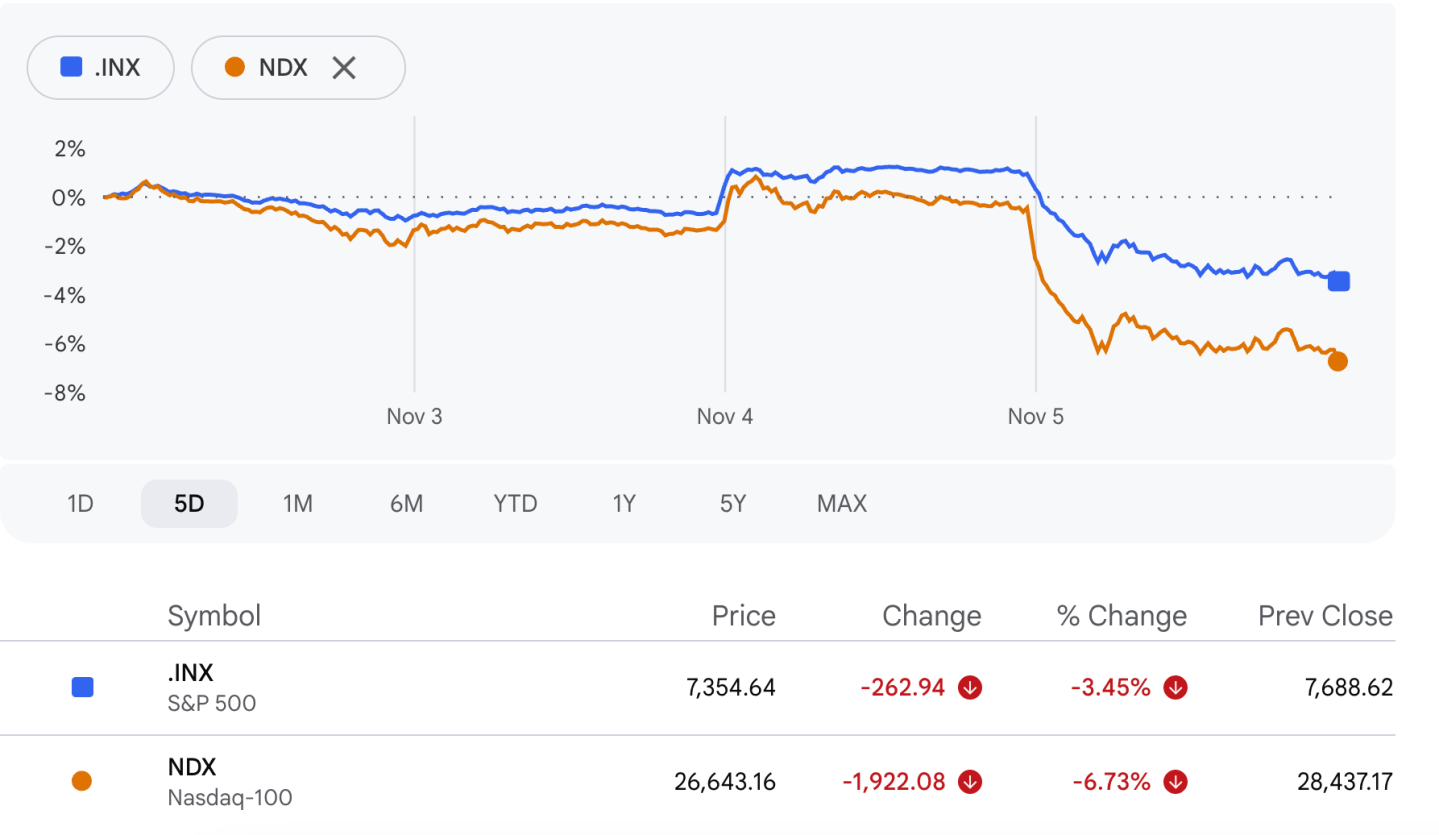
- The S&P 500 closed down 4.36% yesterday. Futures are up 0.24% this morning.
- In Europe, the Stoxx 600 was down 1.52% in early trading, and the U.K.’s FTSE 100 fell 1.92% before lunch.
- Asia: South Korea’s KOSPI was down 6.02%. Japan’s Nikkei 225 was down 5.96%. India’s Nifty 50 was up 2.01%. China’s CSI 300 was down 1.44%.
- Brent crude declined to $96 per barrel.
- Bitcoin fell to $76,117.
Wall Street’s loudest tech bull briefly expressed a small amount of doubt
Dan Ives—whose loudly colored shirts are drowned out only by the volume of his faith in tech stocks—sent clients a note yesterday that did not contain any words in ALL CAPS, bold, italics, or underlined. That in itself was a rare event.
But rarer still was what Ives had to say: This AI thing might be reaching a peak, following the Democratic Party’s victory in the midterms, he told clients.
“We believe Big Tech capex growth rate now peaks in 2027 vs. our previous view that would not happen until 2028/2029. While Big Tech and hyperscaler capex should still easily exceed $1 trillion in 2027 the growth rate into 2028 will clearly moderate significantly as the data center buildout comes at a much slower pace given the political map especially in the state of Texas,” Ives and his team at Yorkville Ives wrote.
They estimate that at least 10% of the planned 800 to 1,000 AI data centers will now not be built, and a further 20% will face “a much longer regulatory road.”
But don’t lose faith. This morning, Ives located a silver lining inside the cloud. Accordingly, he switched back to underlined, boldface type: “We would characterize this sell-off level and magnitude with the tech sell-offs we saw in March 2020 during Covid and the April 2025 Liberation Day sell-off…which were golden buying opportunities to own the tech winners and this one is the same.”
QUOTE OF THE DAY
“You hear a lot, ‘this time is different’. Looking back to my career, ‘this time is different’ might be 0-10, but this time feels different. This time feels different.”
—John Graham, chief executive of Canada Pension Plan, speaking at the Hong Kong Monetary Authority’s annual investment conference about the selloff in tech.
MORE FROM FORTUNE
How Tara Keeney’s Walking Business Show Blew up in 9 Months | Fortune Daily
Zillennials are ‘loud working’: They’re spending nearly 5 hours a week on self-promotion—and driving colleagues to quit – Orianna Rosa Royle
In a contentious North Carolina House race, it was $59,000 against an incumbent’s $3 million warchest—and the challenger won – Marco Quiroz-Gutierrez
Schools blocking AI from student computers will now lose access to Google’s search feature, leaving edtech experts scratching their heads – Sasha Rogelberg
Southeast Asia needs more regulation and investments for its cultural industries to scale, says POPS Worldwide CEO Esther Nguyen – Angelica Ang
A cruise ship sold as a forever home left 203 residents in Cambodia as Iran war fuel costs hit up to $8,000 a cabin – Muskaan Arshad
CHART OF THE DAY
Increased payments to talent recruiters signal recovery in jobs: BofA
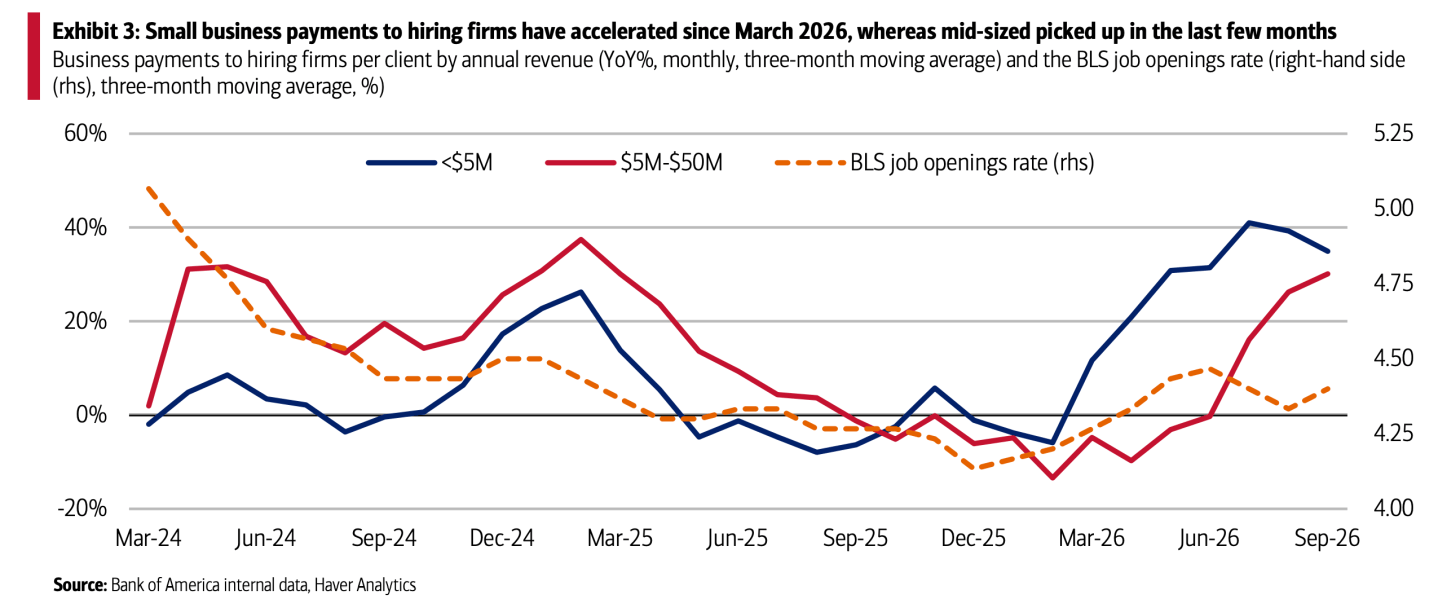
Small- and mid-sized businesses have increased their spending on “hiring firms,” according to Bank of America’s David Tinsley and his team.
“Given the importance of these firms in the economy—they make up around 30% of total payrolls—this, in our view, suggests continued labor demand through the rest of this year,” he said in a note.
NUMBER OF THE DAY
1 in 5
The number of the world’s oil refineries that face “risk of closure” when the global demand for oil peaks in 2032 at 108 million barrels per day, and then enters the “downward escalator” of “structural decline,” according to Wood Mackenzie’s Alan Gelder.
THE FRONT PAGES TODAY
US lawmakers summon Jensen Huang over Chinese spying concerns – FT
Major Investors Are Skeptical Anthropic IPO Can Achieve $1.5 Trillion Valuation – WSJ
Trump meets with national security team, says Iran war decision coming “soon” – Axios
AI Unwind Suddenly Makes Europe a Go-To Trade for Investors – Bloomberg
Trump Tried to Undermine the Nation’s Elections. It Didn’t Work. – NYT
ONE MORE THING
AI shopping bots are not very good at shopping, Visa says
As personal AI agents like Muse or Claude become part of daily life, more people are asking them to carry out shopping tasks. But there’s a problem: the agents aren’t very good at shopping. In a first-of-its-kind study, Visa instructed 22 different agents to purchase three everyday items—a TV, a laptop, and a hair appliance—and, while some agents did better than others, the overall success rate was only around 57%, Fortune’s Jeff John Roberts discovers.
The agents’ struggle to make a successful purchase is rooted in part in a simple reality: The motivations behind any given purchase are often complicated and, in many cases, consumers lack information and are not certain what they want.
- ➡️ Would you like to sponsor this newsletter? Contact advertising@fortune.com for details.
- ➡️ If you would like to receive this information in your inbox every morning before the markets open in New York, sign up here.
Disclaimer : This story is auto aggregated by a computer programme and has not been created or edited by DOWNTHENEWS. Publisher: fortune.com