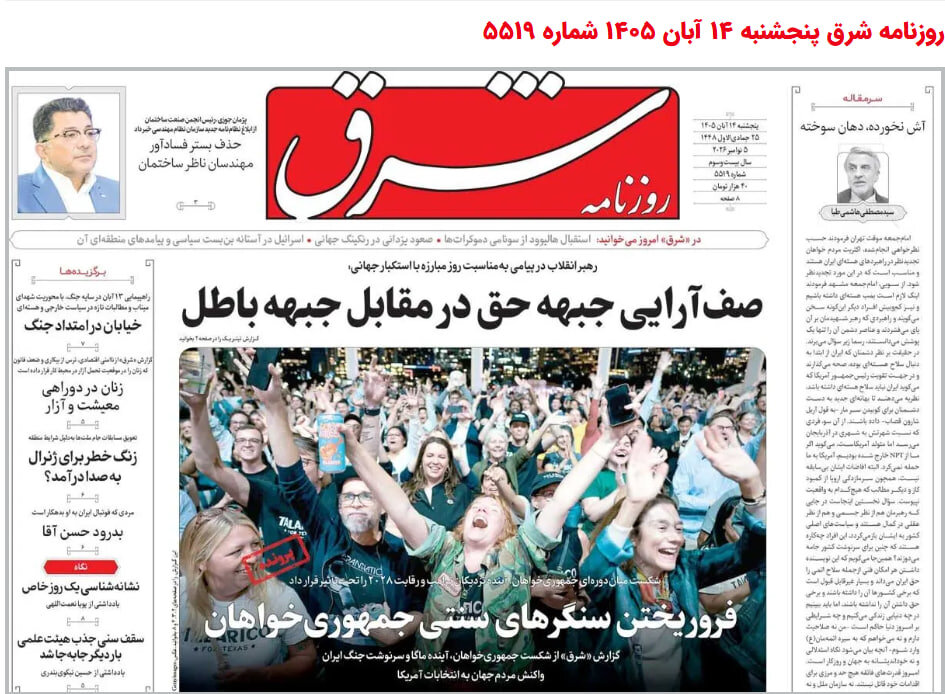
Shargh examined the state of Iran-US relations following the US midterm elections that ended in the Republican Party’s defeat. The US Council on Foreign Relations sees three possible paths before Donald Trump: renewed military strikes, pursuing negotiations while maintaining military pressure, or preserving the current situation in the hope that sustained pressure will force Iran to make concessions.
In the case of negotiations, attention would turn to the outcomes of the conflict and what it achieved. If the current approach continues, the administration would need to explain how long pressure is expected to continue and what results it is supposed to produce. For Iran, the practical significance of the midterm elections will become clear only if their effects are reflected in negotiating conditions, the scale of confrontation, and future budgetary decisions. If Washington moves toward an agreement, Trump will have to explain what benefits the war produced. If military action is resumed, the key question will be what a new round could accomplish that previous efforts failed to achieve.
Hamshahri: The impact of US elections on the current dispute with Iran
Hamshahri argued that the Republican defeat and Democratic gains could influence the ongoing conflict with Iran. The newspaper described the Republican setback as a direct consequence of Trump’s performance and suggested several possible implications. One possibility is that Trump could respond to the defeat by intensifying confrontation and attempting to divert attention from domestic challenges. In this scenario, a new conflict could be launched quickly, presenting political opponents with a fait accompli. A second possibility is the opposite: avoiding further escalation with Iran because of the political consequences of deeper disagreements with a Congress now controlled by Democrats. If a new military confrontation does not occur within the near term, from the coming days through roughly the next two months, the likelihood of such a conflict emerging afterward may decline.
Sobh-e-No: The ball is in America’s court
Sobh-e-No analyzed what it described as Iran’s new strategy toward its enemies. The strategy serves two objectives. First, it seeks to strengthen deterrence. Second, it aims to create the psychological conditions necessary for possible negotiations. Iran’s approach is presented as maintaining military readiness at the highest level while making the cost of any US military action unacceptable. At the same time, Tehran seeks to keep diplomatic channels open by offering a defined framework for resolving tensions. The notion that the “ball is in America’s court” means Washington must choose between accepting an agreement that includes sanctions relief and an end to economic pressure, or facing a new and potentially costly arena of confrontation whose consequences may be difficult to predict. Iran’s strategic position depends on more than missiles and drones. Economic management, social stability, and domestic cohesion are also seen as critical factors. If economic and social pressures weaken conditions at home, Iran’s bargaining position could gradually erode regardless of developments abroad.
Resalat: An obvious crime against Iran
Resalat referred to what it described as a striking report by The New York Times and argued that major US oil companies benefited significantly from disruptions in global energy markets and rising fuel prices. According to the paper, American energy firms earned more than $130 billion in additional profits during six months as a result of market turmoil. The newspaper said that these extraordinary profits revealed the true nature of Washington’s policies, portraying military actions against Iran as driven by economic and strategic interests. It argued that the conflict has imposed severe burdens on Iran through sanctions, economic pressure, and military confrontation. Resalat described the situation as an unjust and damaging war whose consequences extend beyond Iran, affecting regional resources, economic stability, and broader questions of social justice. The paper also criticized what it characterized as the influence of powerful financial and defense-sector interests within the United States.
Khorasan: The threat has not ended
Khorasan argued that Democratic victories in Congress should not be interpreted as the end of pressure from Washington. According to the paper, the political shift following the midterm elections and the Republican defeat was closely linked to economic difficulties, including energy-related inflation and concerns over disruptions to global trade routes. Nevertheless, the newspaper warned against excessive optimism. It argued that Trump, with two years remaining in his presidency, could still choose to increase military and security tensions with Iran as a way of overcoming political challenges at home. In this context, Khorasan maintained that lasting deterrence depends on influencing the broader financial foundations of US strategic policies. The paper argued that if borrowing costs and interest rates remain elevated, the financial burden associated with military operations could increase significantly. Higher costs would make military engagement more difficult to sustain and could become an important factor in shaping future decisions regarding Iran.
Disclaimer : This story is auto aggregated by a computer programme and has not been created or edited by DOWNTHENEWS. Publisher: tehrantimes.com