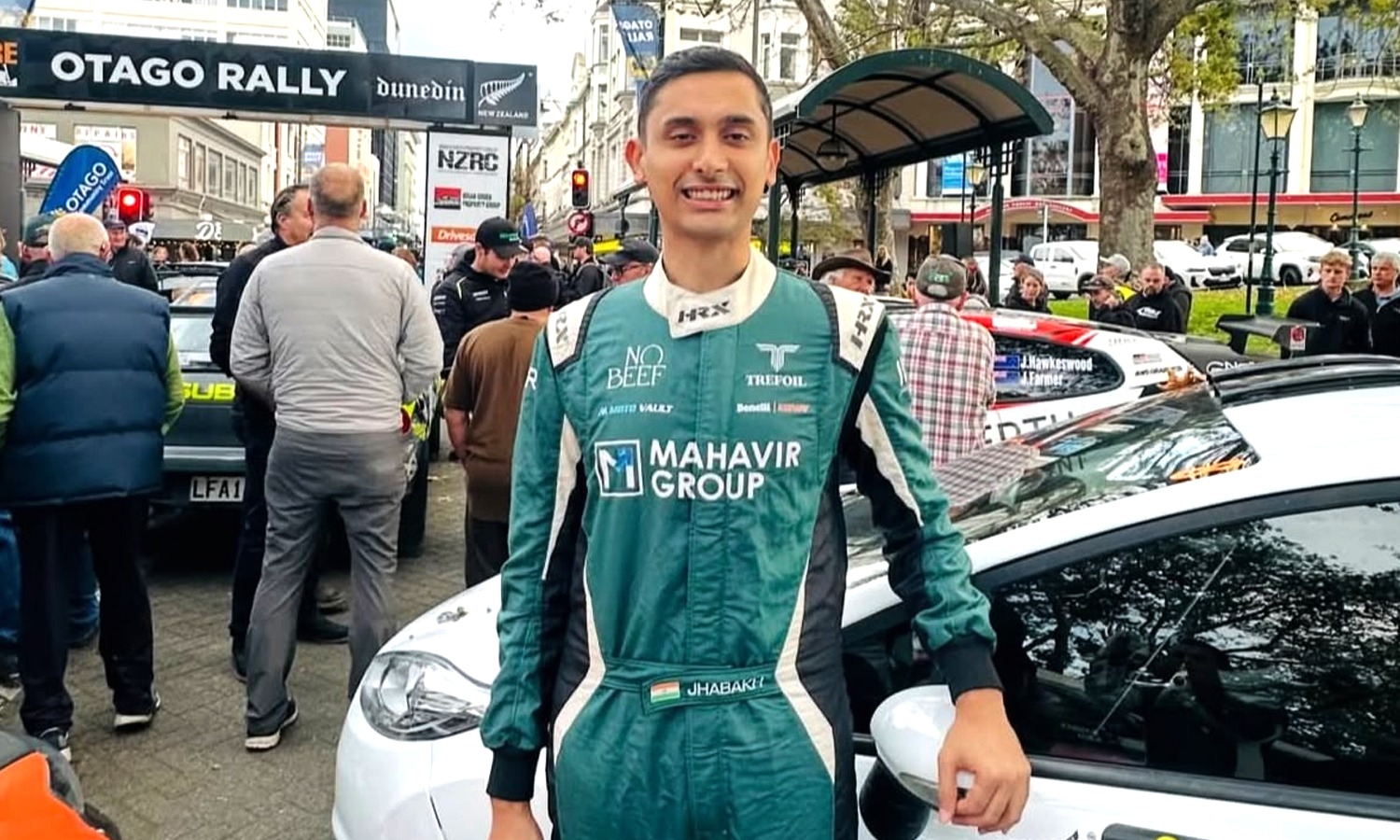
Rallying is as much about adapting to the unexpected as it is about speed, and Jeet Jhabakh learnt that first-hand when he moved from circuit racing to international rallying. The Hyderabad-based racer discusses the mindset behind his historic 2026 FIA Asia-Pacific Rally Championship win, why consistency mattered more than outright pace and how he and co-driver Musa Sherif pulled off a first for India.
You have spent years mastering the precision of circuit racing. What did rallying teach you about embracing chaos rather than controlling it?
On a circuit you drive the same corner sixty times a weekend and the job is finding a hundredth each lap. In rallying you see the corner twice on recce at road speed, and then you get one go at it flat out, maybe two. It took me a few runs to recalibrate. I had to accept that the surface, the grip, the line, the braking point, none of it is the same twice, and that chasing the perfect corner the way I would on a circuit would have me off the road. You read what’s in front of you and you adapt. It’s a very different discipline from circuit racing, and we’re learning with every rally. That’s also what makes the challenge so rewarding.
For 38 years, the APRC title seemed out of reach for a two-wheel-drive car. Did you set out to challenge convention, or did convention simply underestimate you?
I don’t think anyone underestimated our pace. What they probably didn’t expect was the consistency. A four-wheel-drive car is quicker out of every slow corner on gravel, and that’s physics, not opinion. If I’m honest, our target for the year was to win our category at every round. The overall was something we hoped for, but it needed things to go our way that weren’t in our control. What was in our control was showing up at every rally and finishing every stage. We did that from round one. No crashes, no breakdowns, points every weekend. By the time we got to Indonesia the overall was there to be won, so we went and won it.
In rallying, your co-driver calls the road before you see it. How much of winning is about learning to trust someone else’s vision?
This was the biggest adjustment when coming from circuit racing, where you’re largely responsible for reading the track and making decisions yourself. In rallying the notes are still mine. On recce I call every corner and the co-driver writes it down. So, on the stage I’m trusting them to give me back exactly what I saw, at exactly the right moment, at a speed where I can’t check. If they’re a beat late or one number off, I’m correcting the car instead of driving it, and that’s where the time goes. I was fortunate to have Musa, who has done more than a hundred international rallies in a thirty-year career. That kind of experience makes the trust a lot easier.
After mechanical failures derailed your 2025 campaign, did you approach 2026 with a different mindset, or a point to prove?
Motorsport doesn’t give you much margin, and some of what goes wrong isn’t your doing. We were extremely competitive throughout 2025 and had a genuine chance of winning, but mechanical failures at crucial moments affected our campaign. We eventually finished second. I wanted that title. But I wasn’t going to carry the loss into 2026. I took the result, accepted it, and treated the new season as a clean sheet. Not having that baggage meant I could be in the present at every rally instead of driving to settle a score.
You have raced at Spa, Imola and COTA, but what does it mean to put Hyderabad on the international motorsport map in a way no Indian pairing has before?
Driving at Spa, Imola and COTA alongside some very fast cars gave me some of the happiest memories of my career. So far, rallying has given me the bigger result, and one that counts for Indian motorsport, not just for me. I live in Hyderabad, a lot of my business is here, the people who backed this are here, and I am glad the title came to the city. If our achievement encourages even one more person in Hyderabad, or anywhere in India, to explore rallying or motorsport, that would make it even more meaningful.
If you had to choose between a perfectly executed race and a race where you had to fight, improvise and take risks to win, which would you remember more, and why?
In rallying those aren’t two different races. The rallies that look clean from the outside are the ones where you improvised well a hundred times and nobody saw it. So the fight is always there. Risk is the part I’d push back on. A risk that doesn’t come off costs you the weekend, and over a season it can cost you the championship. So I take very few, and only when I’m sure the reward is worth it. That’s a calculation, not a gamble. Which would I remember more? Both, for different reasons. A clean rally tells me the preparation was right. A fight is when the road or the competition throws something at you that no preparation covers, and you find out what you’ve got. You need both to win a championship.
Disclaimer : This story is auto aggregated by a computer programme and has not been created or edited by DOWNTHENEWS. Publisher: deccanchronicle.com