Manuela Tobias and Ignacio Olivera Doll
Officials at the Inter-American Development Bank’s investment arm suspected something was off almost as soon as they walked through the doors of Paraguay’s Ueno Bank SA.
The sleek office building in Asunción, dubbed “The Matrix”, was overcrowded with young employees. The glass panels, polished wood and fancy art seemed better suited to a cash-rich start-up than a business that catered to some of the country’s poorest people.
Bank executives hosted lunch in a private suite with chefs and butlers, seen as a gaudy excess by IDB employees used to less ostentation.
IDB Invest was mulling an equity stake in Ueno, but the visit in 2025 raised too many red flags, according to people familiar with what happened who asked not to be identified because they weren’t authorised to speak with the press. An IDB Invest spokesperson declined to comment.
Fifteen months later, the bank’s swift collapse is reverberating through the country’s politics, business community and the lives of everyday savers who woke up this week to find they’d been locked out of their accounts.
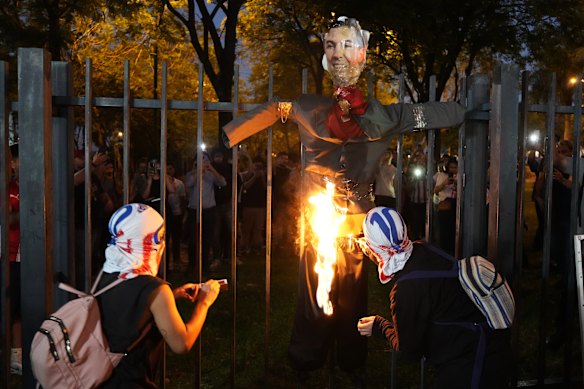
Controlling shareholder Miguel Vázquez, one of Paraguay’s richest men, is in jail. President Santiago Peña, formerly an investor in the bank’s parent company, was removed from office by Congress and placed under house arrest. The central bank director, a former official at Ueno, quit. And now the streets are filled with protesters demanding to know what happened and who is at fault.
Even IDB Invest, which gave a nearly $20 million loan to Ueno in 2024, hasn’t been fully repaid, according to the people familiar.
Paraguay’s Senate voted to end Peña’s presidency on Friday and swore in Pedro Alliana, his vice president, to replace him. A local broadcaster showed a split-screen of Alliana speaking to lawmakers while police surrounded Peña’s home, a stark reminder of how quickly the situation escalated this week.
Not only was the scandal a swift downfall for Peña, it was another blow to US President Donald Trump’s efforts to expand US influence in Latin America. Secretary of State Marco Rubio had held up Paraguay as a model for the region, citing the government’s longstanding loyalty to Taiwan in a region dominated by Chinese investment. Treasury Secretary Scott Bessent met with Peña in Washington just two weeks ago.
And it was just a month ago that Peña was reassuring the public there was nothing to worry about with Ueno and defending the central bank’s oversight.
A digital success story that turned toxic
Ueno had been part of the success narrative for Paraguay — a rapidly growing, digital-first fintech that was bringing newcomers, many of them impoverished, to the formal financial system for the first time.
It appeared to be part of a wave of fledgling financial firms across Latin America that were shaking up the old guard and enabling upwardly mobile consumers to take on credit.
It became Paraguay’s sixth-largest bank by deposits following its 2024 merger with Visión Banco and an aggressive push for government funds. Public-sector deposits surged after Peña took office in 2023, reaching roughly 5 trillion guaranies ($US869 million), or 29 per cent of the bank’s deposits, at the end of June.
Early Tuesday, regulators seized the bank and declared it insolvent and under capitalised. Later that day, authorities raided Vázquez’s art-filled Asunción mansion.
Police found luxury cars lined up in his garage, including a Porsche, a Bentley and a Mercedes, which local media reported were worth more than $US1.4 million.
It’s unclear what will happen to the government funds after the bank’s shutdown. Paraguay’s deposit insurance guarantees savings up to $US38,000, and lawmakers passed legislation on Wednesday ordering the central bank to accelerate deposit insurance payments to savers with money trapped in the lender. More than 1 million Paraguayans – in a country of just over 6 million – opened their first bank account through Ueno, according to the lender.
Alliana called on Friday for Ueno account holders to be reimbursed immediately, starting with the most vulnerable.
Even Paraguay’s World Cup players – heroes a few months ago for defeating powerhouse Germany – are caught in the mess, trying to claw back the equivalent of millions of dollars deposited in Ueno, the team’s official sponsor.
The bank’s seizure comes days after local media reported that regulators found that Ueno had given out loans to companies with ties to Grupo Vázquez, the holding company controlled by Miguel Vázquez, that far exceeded legal limits and weren’t properly classified. Back in 2025, IDB Invest’s team had found similar issues with intracompany loans.
Other aspects of the bank’s operations also raised alarms with IDB Invest. Ueno reported a bad-loan rate of just 2 per cent – half the level of the bank’s more experienced rivals.
Ueno bank came under growing public scrutiny in early September, when local newspaper ABC began publishing internal central bank documents and correspondence flagging concerns about its lending practices. The central bank opened a formal inquiry into Ueno later that month, and eventually forced Ueno to revise it books. Once corrected, the bank’s solvency ratio fell below the 50 per cent required minimum.
A painful blow
The collapse is a particularly painful blow for a country that had spent years projecting political and economic stability to foreign investors, despite being one of the poorest nations in South America. It has also exposed divisions inside the Colorado Party, which has dominated Paraguayan politics for most of the past seven decades, as the focus turns to who will take over from Peña.
“The central question here is how the political situation will unfold,” said Luis Breuer, a former official with the central bank and International Monetary Fund.
Police guard the home of the ousted president Santiago Pena, as prosecutors investigate the collapse of Ueno bank.AP Photo/Jorge Saenz
Alliana faces his own critics, he said, and instability in the government could lead to “a systemic impact on the economy that affects everyone, not just depositors at one institution.”
Peña saw his political prospects collapse as the patriarch of his party, former leader Horacio Cartes, called for impeachment. Cartes had helped launch Peña’s political career, naming him finance minister before his political movement propelled him to the presidency in 2023.
But their relationship had fractured more recently as Peña built his own power base within the Colorado Party, which Cartes still leads.
Trump lifted financial sanctions on Cartes in October 2025 after the Biden administration imposed them two years earlier over alleged corruption, which Cartes denied. Peña publicly celebrated the reversal, though he said his government hadn’t lobbied Washington for it.
In March, Ueno sold $US350 million of bonds in international capital markets, a record for Paraguay’s corporate debt issuance. They traded Tuesday at 85 cents on the dollar. By the time the market closed Thursday, they were priced at less than 10 cents.
Bloomberg
Get a note directly from our foreign correspondents on what’s making headlines around the world. Sign up for our weekly What in the World newsletter.
From our partners
Disclaimer : This story is auto aggregated by a computer programme and has not been created or edited by DOWNTHENEWS. Publisher: www.smh.com.au