Elana Castle
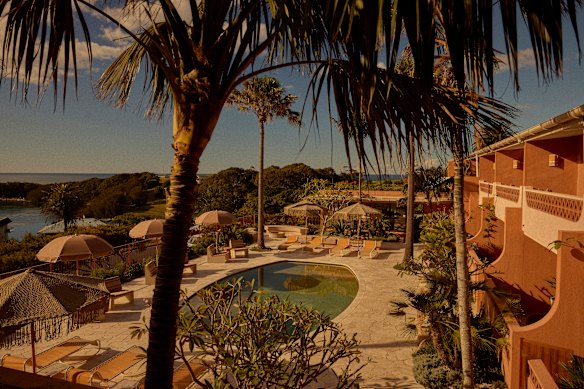
At a former motel in the sleepy town of Narooma, on the NSW South Coast, melodies from a vintage record player waft across a sunken lounge at The Whale, Merivale’s latest hospitality venture, an eclectic retreat inspired by the bohemian glamour of 1970s Ibiza.
“The best hotels have a real sense of identity; they tell you something about the city you’re in but they also create a world of their own,” says David Flack of Flack Studio. “Design is such an important part of travel because it shapes how you remember a place.”
Flack’s interiors have always invited exploration and his work at Melbourne’s Hannah St Hotel is no exception. Rather than revealing everything at once, the spaces unfold as a series of discoveries, from unexpected materials and distinctly Flack-esque colour combinations to intriguing spatial arrangements (like the art deco-inspired open-concept bathing configurations) and individually conceived guest rooms. Art and objects by leading Melbourne artists and makers add further layers to a rich and sometimes surprising narrative, reflecting Flack’s desire to distil the essence of his home city. “It’s a city that doesn’t necessarily try too hard,” he says. “It does its own thing. It’s kind of a melting pot of everything.”
Meanwhile, in the Murraylands region of South Australia, the shifting shadows of a safari landscape filter across textured walls, leathered stone, and woven fabrics, establishing a quiet dialogue with the surrounding wilderness at the new Monarto Safari Lodge.
Twenty luxury safari tents, on either side of a central lodge, almost appear to hover over the grassy plains. Oversized, openable canvas “windows” and a glazed frontage offer uninterrupted views of the landscape beyond.
These properties are connected by a considered approach to design that goes beyond aesthetics.
Genesin Studio, the design practice responsible for the interiors has used locally quarried Wallaroo granite, dry-pressed brick tiles, and works by Australian artists like ceramicist Kerryn Levy and sculptor Lucas Guilbert to lend the interior a local character and a deeper connection to place. Careful spatial planning ensures views remain largely uninterrupted by other guests.
“The idea was to avoid clichéd safari and animal prints and to use materials that feel warm, comfortable and familiar, a grounded luxury that embraces the beautiful, dusty surroundings,” offers Genesin Studio’s director, Ryan Genesin.
What also sets the property apart, is the complete absence of crowds and a masterplanned design that creates an overwhelming sense of solitude, allowing the savannah and roaming wildlife to take centre stage.
Privacy and a sense of escape are central to a trip to Tasmania’s Freycinet Peninsula, where the coming Saffire Jewel Private Villa (opening in December) offers a rare opportunity to inhabit this extraordinary landscape. Designed by Altis Architecture, this exclusive, secluded residence takes an immersive approach, weaving locally sourced granite, sculpted celery-top pine ceilings and a palette drawn from the surrounding bushland into spaces that frame Great Oyster Bay and the Hazards. A three-sided infinity pool appears to merge with the bay beyond.
What connects these properties is evidently neither location nor experience but, rather, a considered approach to design that goes beyond aesthetics. Materials are chosen for their provenance and tactile qualities, architecture responds to its setting, and furniture, art and objects lend spaces a character of their own. The result is a more individual expression of hospitality, where the architecture becomes part of the journey.
Get the best of Sunday Life magazine delivered to your inbox every Sunday morning. Sign up for our newsletter.
From our partners
Disclaimer : This story is auto aggregated by a computer programme and has not been created or edited by DOWNTHENEWS. Publisher: www.smh.com.au