Updated ,first published
The federal government has backed down on its decision to sell off a number of historic defence properties, including the Victoria Barracks in Melbourne, which together would have raised $3 billion for the Department of Defence.
The sale of the heritage properties, including the Victoria Barracks in Sydney and Melbourne, was met with sharp backlash from Returned and Services League (RSL) branches and former prime minister Paul Keating, when the government announced in February that it planned to fully or partially sell 67 sites for an estimated $3 billion – or $1.8 billion after costs.
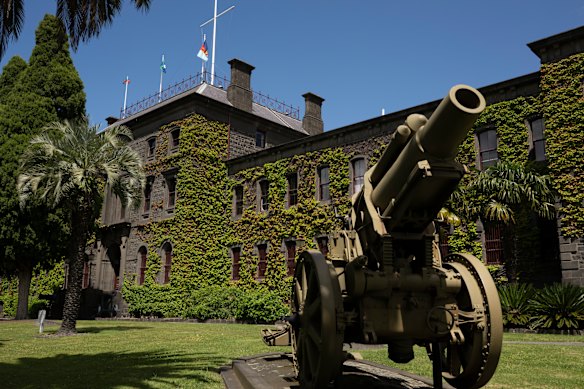
The Victoria Barracks site on St Kilda Road – across the road from the Shrine of Remembrance – along with Fort Queenscliff on the Bellarine Peninsula and the RAAF base in Point Cook will be spared from the sale, the government announced on Sunday.
The sites will remain publicly owned, and the government will open them to public access. The Australian War Memorial would “interpret these sites and tell the defence stories [there],” Deputy Prime Minister and Defence Minister Richard Marles said on Sunday.
Marles said 11 of the 67 defence sites identified for divestment had already been fully transferred to the Department of Finance.
He defended the government’s decision to divest, despite Sunday’s backtrack, as “it is utterly untenable to be spending hundreds of millions of dollars maintaining [these properties] as defence sites when we don’t use them, and when they are not central to the defence of Australia”.
The government had previously highlighted the opportunity to use the prime real estate for sites to build new homes.
Master Builders Australia chief executive Denita Wawn said in February the release of surplus defence land would “go a long way in tackling the housing crisis”. But on Sunday, Prime Minister Anthony Albanese and Marles did not mention housing developments at the spared Victorian sites.
Albanese said some of the other sites would have “significant housing development in pristine locations and produce revenue for the government”, and did not rule out housing being built on Sydney’s Victoria Barracks site.
“This is a site as well that’s so close to a lot of the activity that happens here in Sydney, close to the football stadium, the [SCG], a lot of the facilities that are around here, in what is a pristine location, and at the moment, this pristine location has been locked out for Sydneysiders,” he said.
“This will be held by the Australian government, and we will keep it in full public ownership. That doesn’t mean that there can’t be [other commercial] activities.”
RSL Victoria president Mark Schroffel said the government had “made the right decision” by withdrawing the Victorian sites from sale.
“It is good to see the government finally listening to veterans and the broader community about the significance of these historic sites,” he said.
“Having reconsidered its position, the government must now ensure that these sites are properly protected, maintained and preserved for future generations.”
RSL national president Peter Tinley welcomed the decision and said the visible Defence presence in strategic locations was “critical” to attracting new personnel to the Australian Defence Force.
A spokesperson for the RSL’s national branch said the organisation hadn’t been consulted about the most recent reports, nor had it been initially consulted before the original announcement on divestment.
Consultations weren’t done “in good faith”, said the spokesperson, who also said the government had told the RSL “this is what is happening” rather than seeking advice.
Generally, the RSL does not support the sale of the properties, the spokesperson said, but “obviously there are some sites in the list that need to be sold off, and we would be encouraging the government to loop the RSL in”.
Albanese said the program “creates opportunities to open Defence’s historic sites and buildings to the public, and to commemorate our nation’s history”.
Opposition Leader Angus Taylor said in a post on social media that the divestment was “never about modernising the Defence estate – it was just another smash and grab for revenue by a prime minister who can’t manage money and can’t control his spending”.
Marles said it was “more important now than ever” that Australia had a robust defence force, “and that involves a fit-for-purpose defence estate”.
The government could not “afford to be wasting money”, Marles said.
This masthead reported in September that Marles insisted he would not back down from selling the properties, and at the time labelled one of the locations “the oldest wine cellar in Sydney”.
“It matters that we have a government which is willing to make difficult decisions,” he said then.
“Victoria Barracks Sydney is effectively off limits to the people of Sydney and the people of Australia.”
Divesting the barracks in Sydney and Melbourne could save taxpayers hundreds of millions of dollars over the next decade, and highlights the scope for major savings if dozens of other defence sites are also sold as expected.
Lord Mayor Nick Reece praised the federal government for keeping Melbourne’s Victoria Barracks.
The City of Melbourne’s indicative masterplan for the 5.7-hectare site around the barracks envisions public buildings including a prep-to-year-12 school.
“This is Australia’s most densely populated suburb and one of the fastest growing suburbs – this would be an ideal location,” Reece said on Sunday.
But he stressed that it would take a lot of work between all layers of government and several years for such plans to be realised.
“We are now looking for the state government to get behind that [the school] and we will have to work with the Commonwealth as well,” Reece said
Construction on Victoria Barracks in Melbourne began in 1856, and it originally built as accommodation for British troops.
Finished in 1858, it was used as the headquarters for the Defence Department from 1901 to 1953, and is still used as an administrative centre.
The building has a 56 per cent utilisation rate, meaning it is nearly half-empty most days.
Meanwhile, Defence Plaza Melbourne in the city’s CBD has just a 46 per cent usage rate.
Fort Queenscliff, built to defend the entrance to Port Phillip Bay, was established in 1860 and was used for military purposes until the mid-1940s. It is now used as an administration site and museum, as well as for archiving and historical research.
In March, this masthead reported the Point Lonsdale Lighthouse Reserve was falling into disrepair, and residents were frustrated by long delays in the restoration of historic structures.
The 112-year-old air base in Point Cook, in Melbourne’s south-west, was the first home of the Royal Australian Air Force.
It now houses national heritage-listed but now-dilapidated World War II aircraft hangars that are fenced off, and which the government had previously considered tearing down.
Following a public campaign by the National Trust, the government withdrew that proposal earlier this year.
At the time, the Department of Defence said it had spent $50 million on upkeep works at Point Cook in five years, and would need to spend a further $163 million over the next 25 years to maintain building assets.
Be the first to know when major news happens. Sign up for breaking news alerts on email or turn on notifications in the app.

From our partners
Disclaimer : This story is auto aggregated by a computer programme and has not been created or edited by DOWNTHENEWS. Publisher: www.smh.com.au