
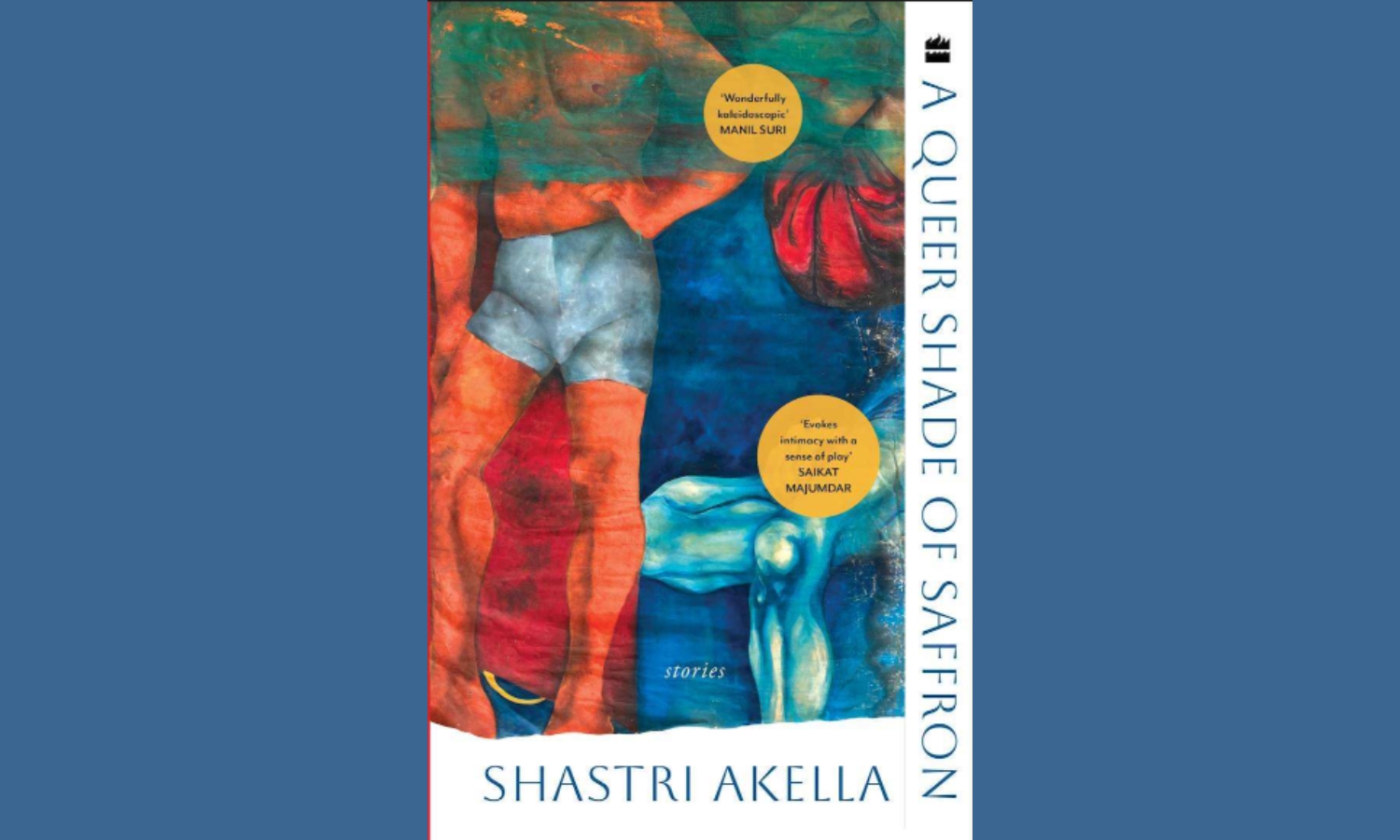
What happens when boundaries are discarded like unnecessary clothes? What happens when familiar stories of a country are retold from the point of view of those seldom allowed to inhabit them? This is the territory Shastri Akella explores in A Queer Shade of Saffron, a captivating collection of short stories bringing together desire, folklore, religion, caste, memory, and the supernatural.
Akella takes readers into places where sexuality is rarely discussed openly, and where family, faith and social convention exercise considerable authority over private lives.
I loved ‘The Magic Bangle’ (selected among The Best American Short Stories 2024), set in old Hyderabad. Kartik, a gay man, decides to become a “tourist in his hometown” after his father hits him and gives him an ultimatum: change within a year or face an arranged marriage. On workday evenings and weekends, he picks up a camera and embarks on a journey to experience a Hyderabad that can be, in his imagination, a “real home”, a place where he belongs. The journey leads him to Shah Rukh, a Muslim gay man, and “the magic bangle”, which reveals whom its wearer loves. Kartik and Shah Rukh find themselves in a world where Hindu and Muslim lives, queer desire, djinns and ancient legends coexist without requiring anyone to apologise for their existence. “On Monday, they stand in the balcony and watch people on the street smear each other’s necks and faces with colour and water. Sectarian differences — particularly volatile under the present regime — seem to vanish. The only riot is that of colours staining the air pink, blue and green…,” writes Akella.
The bangle’s promise is moving precisely because the world outside it remains dangerous.
Another story, ‘The Border Ghosts’, winner of the 2025 Desperate Literature Short Fiction Prize, takes this imaginative audacity to the Kashmir border. Here, queer love unfolds in a divided landscape, where ghosts encounter restrictions imposed by human beings. Akella’s clever use of the supernatural unsettles the authority of the border.
Other stories take us into different terrain and social worlds: a temple singer in Gujarat discovers love without humiliation; two women in rural Andhra Pradesh find strength in their relationship against caste and patriarchal restrictions. And more.
Akella urges us to reimagine colours. In an interview with Platform magazine, he explained the title’s unorthodox pairing of saffron and queerness. For Akella, queer is an identity; queering is the act of breaking open closed systems and making room for bodies previously excluded.
“It’s a queering of the colour…To say that every voice deserves to be heard…It’s also a reclaiming… Whenever conservative uncles call ‘gay things’ a Western import, I disarm their prejudice with fact: 10% of our population is queer, including small towns, rural spaces, mohallas with their favourite chai ki dukaans. I root my stories in such settings to convey this truth.”
Akella’s stories, through their exploration of South Asian experiences of queerness and queering, ask readers to look again at familiar places, beliefs, and inherited narratives and to imagine an India more open to difference and contradiction.
A Queer Shade of Saffron
By Shastri Akella
HarperCollins India
pp. 243; Rs 599
Disclaimer : This story is auto aggregated by a computer programme and has not been created or edited by DOWNTHENEWS. Publisher: deccanchronicle.com









